Over the course of the last few months, a lot of you have let me know that you regularly forward the series of emails to friends, relatives and interested parties. Thank you! Yesterday I received an email letting me know that one of the friends – a US Naval Academy graduate from the Class of 1959 – let them know that his father, a Lt. Colonel in the US Marine Corp – had been assigned post-war duty on the island of Chichijima. Curiosity kicked in.
Chichijima is the largest and most populous of the Bonin Islands. Chichijima is located in the Pacific Ocean about 620 mi south of central Tokyo and 150 mi north of Iwo Jima. The island is only 9 sq. miles in size. It is the largest of the Bonin Islands and has traditionally (and still today) the seat of local government. The name “Chichijima” means “Father island.”
The Early Years. The island shows some evidence of early inhabitants and various explorers sighted the island (Dutch in 1639; English, Prussians and Russians in the 1820s ) but the “discovery” of the island was when a Japanese merchant shipwrecked there in 1669. The crew eventually repaired the ship 72 days later and sailed home to Japan but reported the unknown island. In May 1675 a specially commissioned expedition located the island, came ashore, collected samples of plants and animals, created preliminary charts and maps, and then returned home to Japan. The island was claimed by Japan, but since Japan was in full isolation, it was more pomp and ceremony since the island remained uninhabited.
This is the last post in this series in which we explored the War in the Pacific…for the time being.
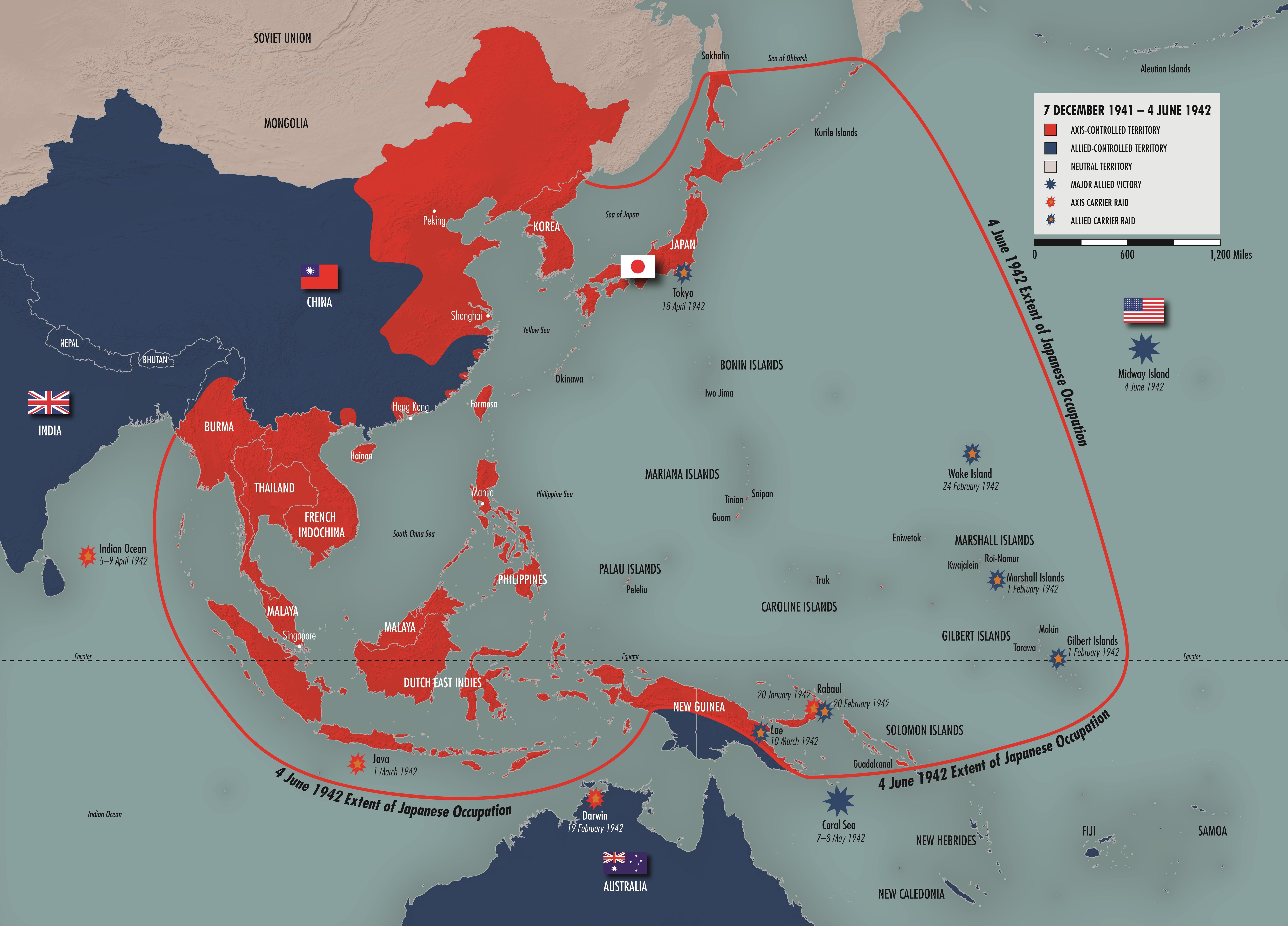
Along the way, it became clear that it was really the Asia Pacific War and had started in 1937 when the imperial ambitions of the nation of Japan launched military action against the nation of China, a conflict that had been simmering since 1931. We traced the rise of Japanese militarism that served as the agent of their colonial ambitions. When their 1939 forays into the border areas of Soviet controlled Mongolia and Siberia were easily repulsed, Japanese attention and planning turned to the Southeastern Asia region. If Korea (annexed in 1910) and Manchuria served as a food basket and new homesteads for an exploding Japanese home population, then Java, Malay, Borneo and other nations served as lands rich in oil, rubber, and other materials needed for their military-industrial complex. There was a strong sentiment among Japanese leaders that their national destiny was to be the rightful leader of the “Asia Co-Prosperity Sphere.” It was an ideology that was part of the education system and propaganda from the 1920s onward. It was not to free other Asian nations from the colonial rule of European nations, but to establish themselves as the new colonial master.
The early December 1941 charge across Southeast Asia ultimately led to the deaths of 30 million Asian civilians – and no small measure of war crimes known (Nanjing, Shanghai, Manilla, and more) and unknown. It was not the case that only a small platoon or company of Imperial Japanese soldiers were out of control, its prevalence across time and nations leads one to conclude it was an understood policy among field commanders. Was it the classic forage and pillaging of invading armies or was it also rooted in the notion of nihonjinron (theories of Japanese uniqueness). It was a view that underpinned a broader societal view that placed Japan at the center of Asia and devalued neighboring peoples as lesser people.
The series did not follow all the allied actions in the Central and Southwest Pacific areas, nor did it explore the details of the campaigns in the China-Burma-India (CBI) area. The series tried to point out critical U.S. military encounters with the Japanese that would shape next-step strategy but also inform the war planners on what were the military and socio-political factors needed to be overcome to end the war. Two early posts, Saipan and Battles that changed the War, gave an early indication of the bushido spirit that was present in Imperial soldiers, but also in Japanese civilians, and later in their kamikaze squadrons. The battlefield experience was that less than 3% of Imperial Japanese Army (IJA) soldiers surrendered or were captured. On Saipan and Okinawa, the Army and Marine encountered non-uniformed civilians participating in armed combat. This included women and children. In both battles, allied soldiers witnessed civilian suicides as the alternative to “capture” by the enemy. Such was the indoctrination.
The focus of the series then shifted to considering the role of Emperor Hirohito, the Supreme War Council, and other key leaders in control of Japanese war governance. The early September 2025 posts were extensive and meant to let the reader understand the inner workings of the wartime governance of Japan and the role of Emperor Hirohito. Post-war accounts in the more immediate aftermath of the surrender present the Emperor as constitutional monarch, preventing from interfering with the governance of pre-war and wartime Japan. As time marched on and more accounts were made available, a picture emerged that constitutionally he was in fact the supreme commander of all armed forces, and had considerably more leverage in non-military governance. His role in the continuation of the war with China and the attack on Pearl Harbor and across Southeastern Asia that brought the U.S., Britain, Australia, New Zealand, the Netherlands and other countries, is debated by historians from the west, China, and Japan.
But is clear from the historical record is:
Cabinet and Supreme War Council recommendations to the Emperor must be unanimous and if unanimity can not be reached, the government collapses and a new cabinet and council must be promoted.
In accord with the Meiji Constitution, certain cabinet members must be filled by active duty members of the military. In the context of #1 above, this means that the military held a de facto veto on anything with which it does not agree. A single military member can either “filabuster” or simply resign – either achieve the same thing: collapse of the government.
In accord with the Meiji Constitution, the Emperor is a Constitutional Monarch, but at the same time is “Supreme Commander” of the Military (daigensui). Yet he seemed to operate out of a self-imposed neutrality at times and at others was actively involved at strategic level planning.
There was a strong current of ultranationalism among the Imperial Army staff and field officers deployed. There was no assurance that they would follow orders to lay down arms since they had ignored orders and instigated armed conflict and operations from Manchuria to New Guinea and beyond. Decisions in the field were often made by majors and colonels based on their view of national priorities. In 1937, there were cases when direct orders from the Emperor were ignored.
There was a long history of military-led assassinations of political leaders in the 1920s and 1930s. The assassinations included Prime Ministers, Navy Secretaries and top governmental leaders.
In the middle of the milieu, decision making, pre-war and during the war, was pluralistic and consensus-oriented participation of ruling elites that resulted in ambiguous individual responsibility baked into a process of negotiation and compromise – this included the Emperor. There was no single desk where the “buck stopped.”
The one decision that needed to be made was some form of surrender. By January 1945, for all practical purposes Japan was militarily defeated. But then surrender is not a military decision, it is a political one. The post Behind the Curtain and others pointed out the lack of a political consensus and will to end the war. From late 1942 onward, Japan was “on the back foot,” suffering defeats on land and at sea. Despite that, the Emperor was assured that the decisive battle (win or lose) that would bring the Allies to the negotiating table was “next.” That was always the goal – negotiate an end to the war that left Japan as the colonial ruler of Southeast Asia, retaining a standing military, and with the kokutai – the Imperial institution in place. That was not the Allied goal.
The Allies’ experience of World War I made clear that an armistice or negotiated cessation of arms only “kicked the can down the road.” The allied intent was to win the war, occupy the nations, and rid Germany and Japan of any trace of the militarism that started the war – and to make sure that they knew they had been defeated so as to preclude the rise of the next generation problem such as the rise of Nazism in Germany in 1930.
As the war entered 1945 both sides were planning for the decisive battle – the invasion of the Japanese home islands. The Japanese planned Ketsu Goand as the end of summer drew near their plans took shape and portended a horrific battle. In parallel, the Allies prepared for the invasion with a naval blockade, unrestricted operations against Japanese merchant shipping by U.S. submarines, and a devastating strategic bombing campaign which included firebombing of Japanese cities, military installations and manufacturing centers. The latter of which grew more intense once US Army Air Forces could operate from Iwo Jima and Okinawa. This all part of a larger Operation Downfall Planning which continued to evolve in the face of intelligence operations that revealed a massive build up of forces on Kyushu that would oppose any landings. The June 1945 Downfall casualty estimates continued to grow at an alarming rate as the late July intelligence became available indicating Japanese troop strength ready to oppose any Kyushu landing force was now 3 times larger than any June planning estimates.
As discussed in last week’s posts, in our counter-factual where no atomic weapons are or will be available in 1945, the Allies still have to find a way to stop the war – and there are only bad options. There are no options that do not involve massive Japanese civilian casualties. But some option has to be found in order to stop the on-going deaths of non-Japanese Asian civilians across Southeast Asia.
Operation Olympic, the invasion of Kyushu, was planned for November but no later than December 1, 1945. In actual history, the weather at the beginning of November would have pushed the invasion until late in the month. In the interim the “blockade-mining-bombing” operations would have continued as discussed in The Unbearable End. The result of this approach without an accompanying invasion of Kyushu would like result in the following:
Month
Expected Condition
Aug–Sep 1945
Urban food ration breakdown begins; coastal transport essentially halted.
Oct–Nov 1945
Coal shortages cripple industry and electric power; rail transport is minimal.
Dec 1945–Mar 1946
Famine and disease on a nationwide scale; mortality potentially in the millions.
Mid–1946
Economic and social collapse, food riots, and potential regime breakdown.
In that post, I wrote:
“Assuming that the Japanese surrender on December 1, 1945, that still means the war continued for another 4 months (August thru November). Without an invasion, losses to the Allied military would have been minimal as Japan began to wither on the vine. If the estimates of blockade lasting until March 1946 yielded 6-10 million deaths due to starvation and disease, what would be the effect by December 1945? Other famine studies suggest that deaths would have been in the 20-25% of total by the half-way point. That translates to roughly 1.4 and 2.25 million people in Japan. Outside Japan in the occupied territories, in the same 4 month period approximately 1 million non-Japanese Asians will die.”
“The resulting death toll of the blockade-mining-bombing (only) is projected to be between 2.4 and 3.25 million civilian deaths across the Asia-Pacific region. Truly an unbearable end.”
Would that have been enough to end the war? Would the collapse of Japanese society be enough to bring the Emperor to issue a Saidan, a sacred decision, to direct the Cabinet and Supreme Council to accept the terms of the Potsdam Declaration? Would the advance of the Soviets in Manchuria changed the minds of Japanese leadership? Would the Soviets attempt a larger scale invasion of Hokkaido?
August 1 – December 1, 1945: the death toll
These numbers reflect continued blockade and bombing, Soviet operations in Manchuria, the Kyushu invasion, and continued Japanese action and occupation across Southeast Asia.
Allied military – 100,000 but, in addition, another 115,000 allied POWs would die by either execution or starvation. (note: there were no reliable numbers for Soviet losses in Manchuria)
Japanese military losses in Manchuria and on Kyushu – 1.0 to 1.5 million with another 200,000 dying in Soviet gulags after the war.
Japanese civilians – 1.9 to 2.75 million
Asian civilians outside Japan – 1 million
For just the period Aug 1- Dec 31, 1945 the death toll is estimated at 3.4 to 5.75 million people.
The historian Richard Frank tells a story in his book Downfall about a history symposium in the late 1990s that was meant to cover the breadth of the war in the Pacific. He sat with a noted Chinese historian as together they listened to presenter after presenter talk about the use of atomic weapons on Hiroshima and Nagasaki. It was as though that was the only topic that mattered. The presenters’ views were extremely narrow – both for and against the use of the atomic weapons. All presented the topic as only a Japan-Allied confrontation. There was no recognition of the tremendous human suffering and death brought about by Japanese aggression across Southeast Asia and the Pacific Islands. No recognition that the war started before December 7, 1941. Without intention they continued a trend that, by its singular focus on three days of the war in August 1945, unknowingly devalued the humanity of millions and millions of Asians outside Japan. Further, the arguments against the atomic weapons to end the war, never considered the other options to end the war, even in terms of Japanese civilian lives. The majority of the presenters at the symposium were either western or Japanese. When lessons of the past are lost, then consideration of the future becomes even more narrow.
As part of the series I also included several posts on Just War Theory. I had the same kind of impression as Frank and the Chinese Scholar: an extremely narrow view. To be fair, I did not do the same kind of research as with the other aspects of the series, but I found no fruitful leads to continue the search. All the moral theologians and theorists that were accessible to me, after their extended writing, simply concluded that the use of the atomic weapons was immoral and not allowed in the just war tradition. Like the historians above, none of them considered the options to end the war. None of them addressed the wholesale slaughter of civilians up to August 1945 and the moral implications of not stopping the war as quickly as possible. Too many of them pointed to international agreements that were absolute: civilians could not be targeted in war. In 1945 such agreements did not exist.
Nor do they fully exist now. Article 51(5) of Additional Protocol I of the 1977 Geneva Conventions prohibits any “attack which may be expected to cause incidental loss of civilian life, injury to civilians, damage to civilian objects, or a combination thereof, which would be excessive in relation to the concrete and direct military advantage anticipated.” The absolute prohibition against civilian deaths does not exist in law or convention. The incidental loss of civilian life is held “in the balance” against “direct military advantage anticipated.” The intended targeting of civilians for no other reason than to target them is prohibited. But often war has no intention but civilian deaths happen.
That was not an argument for using atomic weapons. That is something others can take up.
The whole series is also not an argument that “if you don’t want to face a catalog of bad options to end a war” then don’t participate in warfare in the first place. The history of humanity is that even peaceful nations are not given such neat options. There are nations and non-state actors that have their own vision of the way the world should be: a greater Asian prosperity zone free of European powers, a greater Russia, a Roman Empire, a Mongolian Empire, and the list is far longer. And it is always the case that there is a vision held by a small cadre of people that leverage their aspirations upon the people of a nation so that the people see “their destiny.” And somehow that destiny often crosses recognized borders sometimes drawn without regard to peoples. For every Ukraine there is always Russia.
Will there be a World War III? I hope not. But then the nature of war is changing. The battle space remains in the world and now exists online. Nations will battle national; other nations will take sides. Some wars are internal to a nation casting a group as terrorist or patriots depending on one’s point of view; other nations will fund one side or the other. Warfare is increasingly urban which inevitably leads to civilian deaths. More and more women and children, out of uniform, are involved in warfare. Even the vocabulary of warfare is evolving:
After the war, though the atomic bomb has understandably dominated Catholic just war reflection, a number of Catholic theologians reflected more broadly on World War II through the lens of just war. Figures such as Jacques Maritain, Romano Guardini, Johannes Baptist Metz, John Courtney Murray, and Yves Simon uniformly agreed that the war against Nazi Germany and Japan met the just war criteria jus ad bellum – but each also questioned the known effects of strategic bombings, intentional fire bombing, and failure to discriminate actions against civilians as failures, jus in bello.
In this age there has been more attention on The Warfighter and the moral, spiritual, psychological burden brought about in the events they expected to encounter and events that were not part of what combat was supposed to be about. Some also carry the burden of being unable to provide medical aid to a wounded comrade or freezing during a dangerous moment. And there can be moments when one wonders if the toll and sacrifices are not valued or understood by the civilian population. One wants to go home, but worries if they can “go home.” When you read the post-WW II theorists the focus was clear: the burden on the war planner. When one reads the current theorists the burden seems to have fallen on the warfighter – the one whose world consists of himself and the men and women in his unit. It is a small world the warfighter tries to save.
While allied forces completed the battle for Okinawa, naval units continued the blockade, bombing continued as did the Japanese occupation and subjection of Manchuria and parts of China, Indochina (Vietnam, Laos, Cambodia), Burma (Myanmar), Malaya and Singapore, Dutch East Indies (Indonesia), other smaller locales. Borneo’s liberation was underway as was the Philippines. This was the Asia-Pacific war that needed to stop. The root cause of the war needed to be removed from power and the means to wage war.
In August 1945 there was no end in sight that had anything but bad options.
Thanks for reading.
Image credit: Image credit: various photographs from Naval Aviation Museum, National World War II Museum, and US Navy Archives.
In 2005 the translated diary of Admiral Yonai, the Japanese Navy Minister and member of the Supreme Council, was released. In the days between the Imperial Saiden (Sacred Decision) to accept the terms of Potsdam and before it was announced, Yonai wrote that “It may be inappropriate to put it in this way, but the atomic bombs and the Russian entry into the war were in a sense, God’s gifts…Now we can end the war without making it clear that we have to end the war because of the domestic situation.. I have long been advocating the conclusion [of the war], not because I am afraid of the enemy’s attacks or because of the atomic bombs, the most important reason is my concern over the domestic situation.”
The atomic weapons offered an external excuse for surrender, allowing Japan to end the war without explicitly revealing that the domestic situation had become untenable. Emperor Hirohito, once considered a demigod, was losing public support for continuing the war amid growing hostility toward him and his government. The official propaganda was losing traction in the face of unopposed allied bombers and fighters over the home islands, growing food shortages – the “domestic situation.” Yet even then the general public did not know the extent to the “situation.”
Yoshio Kodama was not a government leader during World War II, but an ultranationalist and powerful political fixer who operated behind the scenes. During the war, he was an agent for Japanese military intelligence and amassed a fortune through smuggling and procuring materials for the Imperial Japanese Navy. He had a unique view of the war from the ground level to halls of power. After the war he wrote a memoir, I Was Defeated, in which he wrote:
Although the nation was resigned to the fact that the decisive battle on the Japanese home islands could not be avoided . . . they still thought that the Combined Fleet of the Japanese Navy was undamaged and expected that a deadly blow would be inflicted sometime either by the Japanese Navy or the land-based Kamikaze suicide planes upon the enemy’s task forces. Neither did the nation know that the Combined Fleet had already been destroyed and neither could they imagine the pitiful picture of rickety Japanese training planes loaded with bombs headed unwavering towards an imposing array of enemy [aircraft carriers and battleships].
In history, after the dropping of the second atomic weapon on Nagasaki, Emperor Hirohito called an Imperial Council, a meeting of serious consequence. The Supreme War Council was deeply divided yet, for the first time, they worked on terms to end the war. After a prolonged discussion the Council was divided. They agreed that the war needed to end, but they disagreed with the conditions of surrender. The post August 1945 in History outlines the divisions between the group that would only accept the Potsdam Declaration for unconditional surrender with four conditions vs. the group that wanted to accept with the only condition being the retention of the Imperial House (kokutai). At the August 9/10 Imperial Council, when all had spoken, the Emperor had the final word. He then announced his support of the “one condition” offer. He said that Japan must “bear the unbearable.” One can only imagine that Hirohito was referring to the psychological impact of defeat after so many years of propaganda.
Without the availability of atomic weapons, as this series has assumed, and as the war continued it would be the civilian people of Japan that truly have to “bear the unbearable.” But it would not be limited to the psychological. The impacts would also be physiological and sociological at the national and the personal levels.
You may have noticed the change in the series graphic from “Ending the War in the Pacific” to “Ending the Asia Pacific War.” The reasons were made clear in the two posts immediately preceding this post. One of the key points to keep in mind is “Excluding Japanese, every single day the war continued [in the summer of 1945] between 8,000 and perhaps 14,000 noncombatants were dying.” (Richard Frank) That is between 56,000 and 98,000 each week or 240,000 and 420,000 per month. The tragedy increased each day, and by far the greatest impact of that tragedy was borne by people who were not Japanese and who were not Westerners.
To not understand this basic reality of the summer of 1945 is to not consider the common humanity of all people involved in this epic battle. It was the dilemma of August 1945 for Allied planners (not having any atomic weapons in this counter-factual speculation) and facing this reality:
Japan is militarily defeated by any meaningful measure.
Surrender is not a military decision but a political one.
The polity of Japan, via the Supreme Council (Big 6), allows hard-core militarists and nationalists to essentially veto all war decisions not to their liking. These people are committed to Ketsu-Go, the decisive battle that will bring the Allies to a negotiating table.
The junior officers in Army Headquarter and in the units operating outside Japan in the occupied territories have a history of setting their own agenda. In other words, there is no surety that they will lay down arms even if Japan surrenders.
As long as Japan does not surrender, the death toll of civilians outside of Japan will continue to increase.
What are the viable options available to the Allies? There are not many and what is available is not good.
Having described the actual history of August 1945 in the previous post, it is time to consider our counter-factual: what if the US and Allies did not possess atomic weapons and did not expect to possess them any time in the immediate future? How does the Asia-Pacific War come to an end?
But then we need to be sure we are talking about the same war. Here is the most commonly offered timeline:
September 1, 1939 World War II began in Europe with Germany’s invasion of Poland
September 3, 1939 France, Britain, Australia, and New Zealand declared war on Germany
September 6, 1939 South Africa declared war on Germany
September 10, 1939 Canada declared war on Germany
May 10, 1940 the Netherlands, officially neutral to this point, declared war after German troops invaded.
July 10, 1940 Italy, an Axis ally, declared war on Britain and France after seeing German success. It is generally thought Mussolini felt it was an opportune moment to enter the war on Germany’s side, believing France was on the verge of defeat and that Italy could secure a place at the eventual peace negotiations with minimal cost.
June 22, 1941 Germany declares war on Russia and begins the invasion. Russia did not technically declare war … They were busy fighting against a blitzkrieg.
December 7, 1941 Japan declared war on the United States (but failed to deliver the diplomatic message prior to the Pearl Harbor attack)
December 8, 1941 Japan attacked Singapore, Hong Kong and Malaya. Diplomatically no message was delivered to Britain who learned about the attack via military channels. In Japan the information was printed in the newspapers.
December 8, 1941 the United States, Britain, Australia, Canada, New Zealand and the Netherlands declared war on Japan after the Pearl Harbor attack. Interestingly the following countries also declared war on Japan that same day: Cuba, Costa Rica, Guatemala, Panama and the Dominican Republic.
January 11, 1942 Japan declared war on the Netherlands the same day it launched its invasion of the Dutch East Indies
May 22, 1942 Mexico declares war on Japan, Germany and Italy. Thousands of Mexican citizens enlisted in the US armed forces but most notably the Mexican Expeditionary Air Force’s Escuadrón 201, also known as the “Aztec Eagles,” fought alongside the U.S. in the 1944 and 1945 Philippines Campaign.
August 8, 1945 – late to the battle, Russia declared war on Japan. Russia’s goal was control of the inland sea, warm water ports, Manchuria, Korea and possibly the resource rich Hokkaido.
With that all the major combatants were formally engaged in World War II. At least these are the dates that are given from a western perspective. When did it all end?
September 3, 1943, the Italian government formally agreed to an armistice with the Allies although the German-backed Italian Social Republic in northern Italy continued fighting until April 29, 1945.
May 8, 1945 Germany unconditionally surrendered its military forces to the Allies
August 15, 1945 Japan announced it accepted the unconditional surrender terms (with one condition – maintenance of the kokutai). The formal surrender was signed September 2, 1945.
Six years and 1 day after the start, it was finally over – at least from a western perspective.
We are at a point in the series at which we should depart from history and consider the counter-factual that no atomic weapons were yet available to the United States and the Allies, nor would they be for the foreseeable future. But before we take that departure, let us consider the actual events of the first 15 days of August 1945 so we might gain insight into the forces and currents within and outside of Japan.
The atomic weapon was successfully tested on July 16, 1945, ten days before the Potsdam Declaration. President Truman was briefed of the test’ success. The USS Indianapolis departed from Hunters Point, San Francisco carrying the weapon that would be dropped on Hiroshima on July 16th, delivering the weapon to Tinian on July 26th. The sequence of external events unfolded as follows:
August 6, an atomic weapon is dropped on Hiroshima
August 8, near midnight, the Soviets declare was on Japan
August 9, an atomic weapon is dropped on Nagasaki
August 15, the Emperor announced his Seidan, “sacred decision,” that Japan accepts the provisions of the Potsdam Declaration.
The Japanese-Soviet story is more detailed than discussed in this series to this point. It is important to understand the “history” between these two Asiatic imperial powers. In the series to date, we picked up the “story” when the Soviets announced that they would not renew the neutrality pact with Japan in April 1945, giving the required one year notice that by April 1946 the pact would lapse. As previously noted, the Soviets were already transferring soldiers, transportation, armaments and ammunition to their “Eastern Front” – meaning Mongolia and Siberia. This was in accord with the February 1945 promises made to the Allies at the Yalta Conference when they promised to declare war on Japan within 3 months of Nazi Germany’s surrender. And all the while Japan was attempting to recruit the Soviets to represent Japan and broker an end to the war (detailed in Japanese-Soviet Diplomacy).
But why did Japan enter into a neutrality pact with the Soviets in the first place? Weren’t the Soviets part of the Allied war effort against the Tripartite Pact of Germany-Italy-Japan? Yes, but conflict with Japan and Russia (and then later the Soviet Union) had history in each country’s expansionist interests. Those interests included Korea, Manchuria, and Inner Mongolia.
An Imperial Collision in Asia
The Russian Tsars always held a vision of a “Greater Russia” that extended from west to east. With the completion of the Trans-Siberian Railway in the late 19th century, Russia sought economic and strategic footholds in Manchuria and Korea. This meant they needed ice-free ports on the Pacific (Port Arthur, later Dalny) to replace Vladivostok, which freezes in winter. At the same time, they saw the decline of the Qing dynasty and unrest in China as an opportunity to expand influence.
After the Meiji Restoration (1868), Japan rapidly modernized and adopted imperial strategies modeled on Western powers. For Japan the interest was raw materials, food imports to the home islands, and “room to grow” for the Japanese people. Japan needed to secure resources and strategic depth for its new industrial power. Korea was vital to its national security—“a dagger pointed at the heart of Japan” (per a common Meiji slogan) but strategic depth and raw materials widened the ambitions to Manchuria and beyond.
In 1895, Russia, Germany, and France forced Japan to return the Liaodong Peninsula to China after the Sino-Japanese War (a peninsula to the west of the Korean peninsula containing Port Arthur). For Japan this was a humiliation with its victory over China nullified by European imperial powers, especially Russia. The dagger was “twisted” in the wound three years later when Russia leased the returned territory from China in 1898, establishing Port Arthur as a naval base. To make matters worse during the Boxer Rebellion (1900), under the pretext of restoring order, Russia occupied Manchuria and was slow to withdraw. At the same time Russia began asserting control over northern Korea, despite earlier informal understandings that Korea would remain in Japan’s sphere.
Over the next several years tensions rose between the two nations, diplomacy started, stopped, stalled and fueled the rising tensions. Of primary importance to Japan was the formal recognition of its national interests and its preeminent role in the Asian world with an equal footing to European colonial powers. Japan proposed recognition of Russia’s dominance in Manchuria in exchange for recognition of Japan’s dominance in Korea. Russia refused, offering instead to make Korea a neutral buffer and demanding Japan stay north of the 39th parallel which allowed Russian continuing control over Port Arthur.
Russian diplomacy stalled negotiations while the Russians expanded troop presence in Manchuria. Japan interpreted this as an attempt to exclude it entirely from the Asian mainland. After months of fruitless negotiation, Japan broke off talks. Without a declaration of war, the Japanese Navy launched a surprise attack on Port Arthur (Feb. 8, 1904). Japanese victory at the naval battle of Tsushima in 1905 ended the war. In the subsequent treaty Japan gained recognition of their special interests in Korea (which they annexed in 1910), southern Sakhalin Island, and lease rights to Port Arthur and the South Manchurian Railway. This was the first time an Asian nation defeated a European one in modern warfare. It changed the hierarchy of imperial power in the Asia Pacific region, established the Japanese military as the embodiment of the Japanese ideals and virtue, and fed the view of Japan’s destiny as leader, not just of the Asia Pacific but of the “eight corners of the world.”
Japanese-Soviet Conflict in the 1930s
By 1931 Japan sought to expand its dominance in Manchuria and northern China for economic and strategic security. Japan’s Kwantung Army seized Manchuria and established the puppet state Manchukuo. The Soviets, weakened by internal purges and economic strain, avoided open conflict but reinforced defenses in the Far East in order to preserve its influence in Mongolia. Both sides increased military presence along the Manchurian–Mongolian frontier. Another imperial collision was inevitable – only the scale of the collision was in question.
By 1935 small scale conflicts and cross border actions ratcheted up tensions in the region, so much so that by 1936 Japan signed the Anti-Comintern Pact with Nazi Germany identifying the Soviet Union as a common ideological enemy. In 1937 the Second Sino-Japanese War was fully underway. While the Soviets were not actors in the conflict, they were essential suppliers of arms, ammunition and airplanes to the Chinese forces – both Nationalists and Communists.
In 1938 there were growing border conflicts that led to a large-scale battle along the Manchukuo border with Mongolia. The action was initiated by the Japanese but Soviet–Mongolian forces decisively defeated the Japanese Sixth Army. This was a key moment in the years before the attack on Pearl Harbor. The Japanese Army recognized the limits of land war against the Soviets and as a strategic consequence the Army (Kwantung faction) was humiliated allowing the Navy to gain influence.
The Strategic Fallout
The result was a Japanese strategy focused on expansion toward Southeast Asia and the Pacific instead of northern expansion into Siberia. As for the Soviets, they undertook a “wait and see” attitude as the rise of Nazi Germany complicated their western borders. In August 1939 the Soviets agreed to the Molotov-Ribbentrop Pact with Nazi Germany. This pact guaranteed that neither country would attack the other, and for the Soviets was a strategic piece to avoid a two-front war. This was followed by the Soviet–Japanese Neutrality Pact (April 13, 1941) in which both sides pledged mutual neutrality and respect for territorial integrity of Mongolia and Manchukuo – the other piece the Soviets needed to avoid a two front war. But it also served the same purpose for Japan as it pursued its plans to expand into Southeast Asia and the Pacific.
Four Years Later – August 1945
With Nazi Germany defeated, the Soviets were not at war. All was quiet of their Western front facing Europe – the first Berlin crisis was almost 3 years away. All was busy on their Eastern front facing Japanese occupied Manchuria and Korea as Soviet troops, tanks, artillery, and supplies amassed opposite the Japanese Kwantang Army – once the pride of the Imperial Japanese Army, but not a shell of its former self with its resources transferred to fighting the allied advance in the Central and Southwest Pacific.
The Soviet’s imperial aspirations in the East had not changed since the 19th century – their 1945 entry into war against Japan was the fulfillment of a promise to the U.S. and Britain and a reason to do what they always intended to do: occupy Manchuria and Korea. In history, they took advantage of the bombing of Hiroshima and formally declared war just hours before Nagasaki. Historians seem united in their view that it was a rushed decision as regards timing because they wanted to declare war before Japan surrendered. Otherwise, their August Storm plan was pointed at the last week in August.
As mentioned in a previous post the outcome in Manchuria was not in question. The odds and manpower were overwhelmingly in the Soviet’s favor. The Soviets captured about 2.7 million Japanese nationals with 1/3rd of them civilian. The dead and permanently missing numbered ~470,000.
Beginning immediately after the surrender, the NKVD (Soviet secret police) organized the mass transfer of Japanese POWs to labor camps across the USSR. Between 500,000 and 600,000 Japanese soldiers and officers were deported to Siberia, the Urals, Kazakhstan, and other regions as slave labor. The Soviet reasoning for the internment was framed as legitimate war reparations—compensation for Japanese aggression in 1904–1905 and in the 1930s. While in the gulag-like conditions, between 50,000 and 100,000 died from conditions of forced labor, poor nutrition, disease, and other causes. Repatriation of soldiers began in late 1946 with the release of 400,000 POWs and continued off and on until the mid-1950s. In the end, tens of thousands were never accounted for.
Around 1.5 million civilians were stranded in Manchuria. Thousands were killed in the chaos following Japan’s surrender due to Chinese revenge attacks, bandit raids, and Soviet troop abuses (looting, executions, and rape, particularly in the first weeks). Women and children were especially vulnerable. There are remembrances and contemporary Japanese accounts that speak of mass assaults and suicides. Repatriation of civilians began in late 1946 and continued until the mid-1950s.
These numbers are the history and most view that our counter-factual history would have turned out the same way. The primary question that is unanswerable is whether the Japanese would have invaded Hokkaido – would the allies let them? – and would the Soviets have advanced to northern Honshu? It is clear that the Soviets did not have amphibious capability to sustain an invasion.
That being said, it is hard to know the effect of the Soviet declaration in our scenario. There are historians such as Tsuyoshi Hasegawa’s [Racing the Enemy: Stalin, Truman, and the Surrender of Japan (2005)] that hold, absent atomic weapons, the Soviet invasion into Manchuria would have galvanized the Imperial Japanese Army to overthrow the home government, declared martial law, and continued the war – not only waiting for the invasion of Kyushu but unleashing widespread warfare in part of Southeast Asia where their armies still maintained control. There is no feasible way to estimate the increase in civilian deaths except to note that the already horrific numbers of lost non-Japanese Asian lives (and Japanese lives) would only become horrific at a new level.
Image credit: Image credit: various photographs from Naval Aviation Museum, National World War II Museum, and US Navy Archives.
July 1945, in some ways was like the lull before the storm. I remember my first experience of the eye of a hurricane passing over my home town. I was a small child and my parents told me about what would happen. Sure enough in just a moment we went from hurricane winds and lashing rains to an amazing stillness. We wandered outside just to feel the stillness and utter silence. In time and slowly, the winds picked back up to the full whip of hurricane winds. July 1945 is like the passing of the eye of a hurricane. The winds of Okinawa have quieted, the “divine winds” of the kamikaze are still … for the moment. And the world waits to see if the winds of the Asia-Pacific war will roar back with the advent of Operation Olympic, the invasion of Kyushu.
Analogical imagining aside, there were key events that continued to play out in the month of July, both on the battlefield and behind the curtains in the halls of allied and Japanese governance.
Many years ago I prepared a couple for Sacramental Marriage. He was an Army Officer assigned to a local joint operations base and had primarily served in the Quartermaster Corp (Supply). He had written a history of Army Logistics in World War II. He gave me a copy and it was very interesting. My take away from the book was that perhaps the German generals and divisions were better than the Allied counterparts, but integrated allied logistics won the war in Europe. He certainly made a case. One of the examples he used in his book was the Battle of Anzio in Italy, especially during the major German counter attack against the Anzio beachhead. It was a detailed explanation of the same observation Rick Atkinson makes in his The Liberation Trilogy, the second book, The Day Of Battle. In short, the ability of the allied forces to deliver a massive tonnage of munitions (air, shore bombardment, artillery, etc) across the entire front of the German advance turned the battle.
This post is my homage to the logistics forces of the war in the Pacific.
“The sooner the Americans come, the better… One hundred million die proudly”
Such was the Japanese wartime propaganda campaign in 1945 as part of the Ketsu-Go defense plan against the inevitable invasion of the home islands by Allied forces. The slogan urged a total commitment, even unto death, to protect Japan. If necessary, Japanese civilians were to fight to the death to defend the homeland. Along with military operations, the goal was to inflict unacceptable casualties on the enemy and force a negotiated peace.
Japan had a standing army of 4 million men, but more than half were spread out across the Asia Pacific region with a large part garrisoned in China and Manchuria but unable to cross the Sea of Japan to reach the home islands because of the naval blockade, submarine operations, and mining of the sea lanes by allied bombers operating from Saipan. Thus the call for the people to come to the aid of their homes and nation.
For more than 2,000 years, Japan had never been successfully invaded. The most serious threat had come from two attempted Mongol invasions in the 13th century, both of which were thwarted by typhoons that caused massive losses of ships, sailors and soldiers. Although the story of the “Divine Wind” (Kamikaze) “grabbed the headlines” in both invasions, the on-shore Japanese resistance was epic. It is estimated that the Mongol losses approached 100,000 with survivors becoming enslaved. The foundational story became the intervention of the divine and total commitment of the people.