Between 1939 and 1941, President Franklin D. Roosevelt confronted a central strategic dilemma: how to oppose Nazi Germany and keep Britain in the war while U.S. public opinion overwhelmingly opposed entering another European conflict. Roosevelt’s response was a policy of incremental engagement on economic, military, and political level, all designed to shift the balance of power without formally declaring war. This strategy succeeded in sustaining Britain and positioning the United States as the decisive future belligerent in Europe, but it also produced ambiguity and mixed signals both within his own administration and abroad, particularly affecting Secretary of State Cordell Hull and Japanese perceptions of U.S. priorities.
The Core Concerns
Roosevelt’s overriding concern after 1939 was that a German-dominated Europe would fundamentally threaten long-term American security. He believed that Britain’s survival was essential to prevent Nazi hegemony over the Atlantic world for reasons of democracy and international trade as well. He was convinced that a German victory would eventually force the United States into a far more dangerous war under worse conditions or would leave the U.S. isolated with fascist nations on the other side of two oceans.
Importantly, the U.S. needed time to build industrial and military capacity both of which were the nation’s most valuable strategic asset. In 1936 the Washington Naval Treaty, which had sharply limited the future growth of the U.S. Navy in the name of arms control, expired. Roosevelt let it lapse. He then ordered the Navy to launch its first major shipbuilding program in more than twelve years (one of the ships to come. In 1938 the Army Air Corps got the biggest authorization for buying planes in its history. From the fourth-biggest military force in the world in 1918, the United States Army shrank to number eighteen, just ahead of tiny Holland. By 1939 the Army Air Corps consisted of some seventeen hundred planes, all fighters and trainers, and fewer than 20,000 officers and enlisted men. Arthur Herman’s Freedom’s Forge is a fascinating account of the plan FDR put in place so by December 1941, the industrial capacity of the U.S. was well underway to achieving a war footing from an industrial base.
At the same time, Roosevelt faced a public with deep and recent memories of the costs of World War I resulting in a wide-spread suspicion of foreign entanglements. As a result there was a strong isolationist sentiment in Congress and among the public. This led Congress to pass the 1935 Neutrality Acts which stated the U.S. could trade with belligerents in foreign wars.
Escalation short of war
From 1939 to 1941, Roosevelt pursued a steady escalation of U.S. involvement short of becoming involved in the European war. Key elements of that escalation included:
Cash-and-carry (1939) allowed Britain and France to purchase arms.
Destroyers-for-bases (1940) provided Britain with vital naval assets.
Lend-Lease (1941) transformed the U.S. into the “arsenal of democracy.”
Naval patrols and Atlantic convoy escorts increasingly blurred the line between neutrality and belligerency.
The Atlantic Charter (August 1941) publicly aligned U.S. war aims with Britain.
Roosevelt understood that these actions made eventual conflict with Germany likely, but he judged that preserving Britain and buying time outweighed the risks. Importantly, he often moved faster than public opinion but slower than his own private convictions, using executive authority and rhetorical framing to narrow the gap.
Strategic Ambiguity
Roosevelt’s diplomacy depended on strategic ambiguity. He avoided explicit war commitments while steadily expanding U.S. involvement. This ambiguity was essential domestically but costly diplomatically. Publicly, Roosevelt repeatedly promised not to send American troops into foreign wars but framed the actions he took, often by executive authority, as defensive or humanitarian. At the same time, privately, he anticipated war with Germany as increasingly likely and prepared the military and economy accordingly. This dual-track approach was politically effective but institutionally destabilizing, especially for the State Department.
Secretary of State Cordell Hull favored clear, principle-based diplomacy rooted in international law, multilateralism, and formal commitments. He believed that clarity strengthened deterrence and credibility. Roosevelt, by contrast, preferred personal diplomacy, trial balloons, and backchannels. FDR accepted ambiguity as a tool. In discussion with Hull and others he sometimes explored hypothetical compromises without formal follow-through. This created confusion about presidential priorities and led to some elements taking a “wait and see” approach while others believed they had just been given the “go ahead.”
Hull worried that Roosevelt’s improvisational style undercut the coherence of U.S. foreign policy, sent mixed signals to adversaries, and encouraged tactical maneuvering rather than genuine compliance. Nowhere was this tension more visible than in Japan policy, where Roosevelt’s willingness to entertain personal diplomacy (such as a potential Konoe summit) clashed with Hull’s insistence on firm principles. While Hull was razor focused on Japan and the Far East, Roosevelt’s primary strategic focus remained Europe, even as tensions with Japan escalated. He viewed Japan largely through the prism of the wider global struggle. FDR was concerned that a Japan aligned with Germany threatened the Atlantic strategy. Above all, he wanted to avoid a two-ocean war and yet he was not willing to abandon Britain or China in the Asia-Pacific theatre. The President believed that diplomatic pressure on Japan had little success given their internal factions and fractures. He believed economic pressure on Japan could deter further expansion without immediate war. However, Roosevelt’s strategic ambiguities sent mixed signals to Japan.
From Japan’s point of view the U.S. Navy remained concentrated in the Pacific and was meant to be a deterrent to Japan. Yet Roosevelt’s rhetoric and actions increasingly emphasized Germany as the principal enemy. Japan concluded that U.S. restraint in Europe (no declaration of war) and inferred American caution or division. In addition, it was noted that Roosevelt was impatient with prolonged negotiations which suggested to some in Tokyo that the U.S. sought delay rather than confrontation. Some historians believe Japan mimicked that style; others held it suited their own style of delay and ambiguity. In any case, Japan’s response strengthened Hull’s already held belief that Japan was exploiting negotiations to buy time, much as Germany had exploited diplomacy in the 1930s. Roosevelt’s continued openness to dialogue even as U.S. policy hardened deepened Hull’s fear that ambiguity was now enabling aggression rather than restraining it.
1941- Crises Converge
By mid-1941, Roosevelt’s balancing act became increasingly unstable as Germany invaded the Soviet Union, Japan moved into southern French Indochina., the U.S. froze Japanese assets and imposed an oil embargo, and Atlantic naval incidents with Germany intensified. Roosevelt now faced two converging paths to war, but still lacked public authorization for either. The result was a tragic irony: a strategy designed to prevent premature war may have contributed to miscalculation, especially in Tokyo, even as it prepared the United States to fight and ultimately win the war Roosevelt believed was unavoidable.
Image credit: various photographs from Naval Aviation Museum, National World War II Museum, and US Navy Archives.
In the flow of this series we have worked our way into 1941 as we covered several key events/periods on the way. There is a lot going on – probably best to “drop a pin” to locate us in this flow of history.
The period of the “moral embargo” (1938 to July 1940) in which U.S. companies were asked to voluntarily limit exports and sales to Japan because of their aggressive behavior in China.
The Export Control Act of July 1940 which stopped the sale of high grade aviation fuel (but not all aviation fuel), scrap iron, raw steel, and other materials. The argument was that these were needed for U.S. stocks – and they were – but it was also intended to stop the sale of these items to Japan. It did not stop bulk oil sales.
In September of 1940 Japan signed the Tripartite Pact, aligning itself with the fascist nations of Nazi Germany and Mussolini’s Italy. In June 1941, Germany invaded Russia.
In April 1941, Japan and the Soviet Union signed a neutrality pact. For the Soviets, free of worry about Japanese invasion in Mongolia or Siberia (as in the 1939 Nomohan Incident) they could move troops and equipment to their western front against Germany. For Japan, it removed concerns over their northern and northwestern flanks, freeing the movement south to resource and oil rich areas to the south.
In the summer of 1941 the Japanese moved into Southern Indochina. The U.S. response was the Financial Freeze implemented in August 1941. Between the freeze and “slow roll” to approve exports, the net effect was a total oil embargo.
Another recent post discussed the unintended consequences of the financial freeze action, not only in Japan’s response, but in the less-than-unified action/reaction with the U.S. Departments of State and Treasury as there were too many “cooks in the kitchen” – Hull, Morgenthau, Hornbeck, Acheson, Grew and the list goes on. We also introduced a lot more background information on Japan’s Prince Konoe who served as Prime Minister for a long swath of time from late 1937 until late 1941. The background is necessary to understand how he will be perceived when the concept of a one-on-one summit with President Roosevelt is floated.
It’s a lot of information to keep straight and if you find it vague, disordered and confusing, so did the real time participants and 1940 and 1941. Presumptions, assumptions, misunderstandings, and more simply left the two nations at cross purposes.
There is a basic concept in communications: instantiation. “Instantiated” and “uninstantiated” communication refers to the difference between a specific, active, and concrete interaction (instantiated) and an abstract, potential, or theoretical idea (uninstantiated). Instead of talking about “a car” in general (abstract), you are talking about “my red Honda Civic” (instantiated) comparable to talking about the general idea of “bravery” without pointing to a specific, real-world example. Which is all just a fancy way of describing U.S. and Japanese diplomatic communications and negotiations. A simple way to describe it is to borrow the iconic words of the Prison Captain speaking to Luke (Paul Newman) in Cool Hand Luke: “What we’ve got here is failure to communicate.” The U.S. would offer general fundamental concepts (Hull’s Four Points) without detailing specific required actions. But then in another round, the actions were very concrete (“withdraw from China”) and did not take into considerations either military ability, public reaction in Japan, and the political liability to a Japanese figure who might support the idea – even as the start of negotiations. The U.S. was well aware of the very recent history of assassinations and even the ill-fated 1936 coup attempt by a radical element of the military.
On the other hand, Japan would ignore the four principles and then offer a response but it was uninstantiated in that the response was always open ended, contingent on some future state of things, e.g., the French Indochina government asks us to leave after they have had free and fair elections (… as we continue to occupy their nation). The U.S. reaction was mostly, “they’re stalling and not to be trusted.” The Japanese reaction was leaving things open ended in order to explore what new concessions would be wrangled. An example was:
U.S. – respect recognized national boundaries and do not interfere in the internal dynamics of another nation. If that sounds like the Treaty of Westphalia in 1648 (for all you history buffs) you’d be correct. It was Hull’s basic approach. From those fundamental principles, Japan “had” to understand that meant withdrawing from China and not interfering.
The Japanese response: we will withdraw from China two years after they settle their own internal struggles between the Nationalists and Communist Chinese factions and if the new government asks us to leave… and since we have agreed to your terms, please send oil now…. and by the way, Manchuria is not part of China. It is the nation of Manchukuo (that no foreign government recognized) and a friend to Japan.
That wasn’t exactly the diplomatic conversation, but it was exactly the dynamic between the principal diplomats. The backroom chatter from within the various U.S. and Japanese factions, ministries and departments only added to the cacophony of misunderstanding.
The purpose of this post was to “drop a pin” so that we could locate ourselves in the series. We are moving from 1940 into 1941. The above style of diplomatic exchange is becoming de facto. Factions within each government are hardening their positions. And cast over all of this are the presumptions, assumptions, misunderstandings that left the two nations at cross purposes only exacerbating the communications.
Image credit: various photographs from Naval Aviation Museum, National World War II Museum, and US Navy Archives.
In previous posts, we have tried to trace the Japanese strategic commitment to the southern strategy focused on the resource rich Southeast Asia mainland and Pacific Islands. The movements into Indochina brought about increasingly more stringent export controls and licensing for Japanese concerns, ratcheted up and hardened positions inside and outside government – especially within Japan where when the “military coughed, the Japanese cabinet developed pneumonia and collapsed.” With each cycle, the military was increasingly dominant in Japanese policy and strategy. There was a lot going on…
The “roadmap” above is nowhere as complex as the underlying reality and labyrinth pathways. Over the next several posts, the conversation will advance along threads that move from January 1941 until Pearl Harbor on December 7, 1941. Those posts are meant to be part of the buildup of background to understand organizations, factions within organizations, government departments, key persons and personalities, and more – all to set the context as we move ahead.
Back in one of the first posts, I asserted that the August 1941 “oil” (full) embargo did not start the war. The war in the Asia-Pacific region was already underway. One only needed to ask the Chinese, Vietnamese and Mongolians, as well as the Koreans. The full embargo of late July 1941 was a calculated political action by the U.S. in reaction to the Japanese occupation/invasion of French Indochina. It was a political action whose hope was to deter Japan from further expansion even further south to Hong Kong, Malay, Java, Borneo and the rest of the Dutch East Indies. Consider the map below (Sep 1939) and then add Indochina (Vietnam) and one can see Japan’s dagger is clearly aiming south.
To focus on only the oil embargo because Japan’s “economy” needed it, one has to remember it was a wartime economy that had already led to the deaths of 7 million Chinese by July 1941. Even if one chooses to only focus exclusively on the full embargo, one can ask:
Was the embargo the decisive reason why Japan attacked Pearl Harbor or just more proximate than a collection of other reasons that was denying Japan unfettered access to war resources?
The U.S. understood the goals for Japan southwest incursion, but did the U.S. truly understand the underlying motivations? I would suggest the U.S. perfectly understood Japan’s motivations and disagreed on moral and political grounds. Japan was fascism in the Asia-Pacific region – aligned to the fascist nations of Europe via the Tripartite Act.
Did the U.S. have a clear understanding of the internal Japanese dynamic that increasingly marginalized any peace/negotiation faction as the military grew in stature and power? This was the shift that was transforming a potential Asia-Pacific trading partner into a deadly rival fixated on status, honor, and establishing its equivalent of the Asia-Pacific Monroe Doctrine.
Was the embargo a virtual declaration of war hoping to draw Japan to military action so that the U.S. could enter the war in Europe? If so, then why was the U.S. so unprepared to fight any war, much less a two-ocean war?
Clearly the December 1941 and early 1942 “blitzkrieg” across Southeast Asia, the Southwest Pacific, and Central Pacific regions accomplished the mission of (a) capturing the resource rich nations and (b) setting a “line of defense” west of Hawaii. Was the attack on Pearl Harbor necessary for the plan to access the resource rich lands to the southwest of Japan? Couldn’t they just have moved south and left a “blocking force” against the Philippines and prevented U.S. resupply?
How did Japan so misjudge the U.S. public’s reaction to Pearl Harbor? Thanks to the movie “Tora!, Tora!, Tora!” we have Admiral Yamamoto, the architect of the Pearl Harbor attack, iconically uttering, “We have awoken the sleeping giant.” He never said that, but he should have because he clearly understood Japan could not win a protracted war.
Most, if not all, of the questions are not simply military moves and political reactions – but they form the milieu in which diplomatic dialogue swims. The external and internal dynamics make the path to diplomatic resolution akin to walking a moonless night in the wilderness with but only a lighted candle to show the way. There is light but its glow only reveals so much of the dark night. And as we will see in a later post, there are lots of things that “go bump in the night.”
Image credit: various photographs from Naval Aviation Museum, National World War II Museum, and US Navy Archive. | Mapworks | Original timeline by G. Corrigan
This second phase of the series on the Asia-Pacific War began with a goal of discovering if there was merit to the claims made by some historians that in the summer and autumn of 1941 the United States missed diplomatic opportunities that could have avoided war with Japan and at the same time took a series of economic actions that brought about U.S. involvement in the Second World War. The exploration has taken us from the pre-history to Japan of the early 20th century discovering currents, trends, events, personalities and changes that brought that nation to 1937. Along the way we considered the complex and evolving nature of Japan’s relationships with China, Korea, Russia, and the United States. All of this (and far more) were the ingredients in the mix that formed Japan’s strategic, economic, political, and civil policies.
A Future of the Asia Pacific Region
These policies brought Japan and the U.S. to a crossroad each having different objectives and visions of their roles and future in the Asia-Pacific region. The U.S. was committed to its own Westphalian vision of the world as its fundamental principles: democratic government (without kings or emperors), open markets with fair and free trade (at least in theory), respect for national boundaries and sovereignty (with an aversion to classic colonialism but with a Monroe Doctrine), and non-interference with the internal governance of another country (but trade and the Monroe Doctrine were priorities). Without a doubt that is so general a description it suffers in accuracy, but it has points and exceptions. Some of the exceptions are striking: Admiral Perry’s presence in Tokyo Bay ostensibly to open up trade in the western Pacific, the annexation of Hawaii, the territories of Guam and the Philippines, and its business interests in China. What was a fundamental driver of its Asia-Pacific ambitions? Business. The U.S. was a nation of massive natural resources, industrial power, financial wealth, and at least in a business sense, a drive to be a market leader. It was a country with minimal import needs and massive export capacity.
Japan was an island nation of limited key material natural resources, limited land for agriculture, a net importer of strategic raw materials and in the 20th century was over populated and a net importer of basic foodstuffs, even rice. While in its own history Japan had never been successfully invaded it was always concerned to the point of obsession with its vulnerability to invasion and embargo. The fall of the once great China to its state in the 19th and 20th centuries was a clarion call to protect Japan from the grip of the western colonial powers. This gave way to the transformation of the feudal samurai system to a modern army and navy based on European models, ultimately leading to rise in militarism that was only enhanced by Japan’s defeat of China and Russia within a 10 year period. Now it was ready to take its place and be recognized as a world power with a special sphere of influence in the western Pacific – a role and recognition it never received, only enhancing its sense of vulnerability to the western powers.
Colonialism and Racism
Japan abhorred western colonialism yet it had colonial ambitions for Korea (annexed in 1910) and Manchuria (conquered by 1932 and renamed the independent nation of Manchukuo) for both strategic buffer and for emigration of its people and access to food and raw materials. It participated in world trade but with a wary eye seeing what the “Open Market” policy (a U.S. initiative) had done to China. The Meiji Restoration and Constitution’s governance appeared as liberal democracy akin to Britain – and in many ways it was growing into it – but the military had an outsized place in the nation and without civilian control. The military was responsible only to the Emperor.
When modern people consider the 1942 internment of west coast U.S. citizens of Japanese origins, it is commonly held that it was basic racism and unwarranted fear that motivated the action. It was primarily fear and national politics, but that was just the immediate context for the underlying racism in California – which was present elsewhere. The U.S. federal government had to inject itself into California politics when the state passed laws restricting land ownership and segregating schools that applied only to Japanese. But in 1924, the federal government passed the 1924 Immigration Act which specifically excluded Japanese from U.S. and all territories, e.g. Hawaii. In 1924, 40% of Hawaiian residents were of Japanese origin. The U.S. was just more overt about racism as Japan had its own form.
Japan viewed all westerners as decadent, weak, uncultured and morally inferior. At the same time, this anti-Western racial critique coexisted with hierarchical and discriminatory attitudes toward other Asians, especially Chinese and Koreans, who were frequently described as backward and in need of discipline. The result was a contradictory worldview: Japan opposed Western racism in principle, yet practiced its own racial and cultural hierarchy in Asia, a tension that shaped both its propaganda and its imperial conduct in the 1930s.
A Cautious Eye
These were the two nations that arrived at the crossroads of the 20th century each casting a cautious eye towards the other, each sensing that the other would be the inevitable rival. Early in the century each country, as is prudent, developed “what if” war strategies. Both countries were adherents of Mahan’s theory of naval power (The Influence of Sea Power upon History) and saw in each other threat to their own ambitions. Each nation’s naval war colleges developed and adjusted its Pacific strategies. Virtually every senior naval leader in the Pacific had studied these and contributed to it as new circumstances, technology, and situations arose. As one historian noted: “it was part of their DNA.”
Japan’s army faced west and northwest to expand its colonial ambitions on the Asian mainland. Japan’s navy faced south to the oil rich regions of the Pacific island nations as it also faced east to the U.S. its current major supply of oil and ship building materials. The U.S. navy had missions in the Atlantic and Pacific but only enough assets for a “one-ocean navy”. After World War I, the U.S. interest was controlling navies and the status quo. This led to the 1922 Washington Conference that established limits on capital ships. It also ultimately led to deep divisions with the Imperial Navy. One faction knew it could never match U.S. industrial power and wanted to avoid a naval arms race and was satisfied that the limits were within the Mahanian theory in that the U.S. would have to transit the Pacific Ocean. The other faction was more driven by an ideology of the Navy as the ocean guardian of the Imperial destiny of a greater Asia led by the Emperor. The Washington treaty was a barrier and worse, an insult to national honor.
Key Figures at the Crossroads
By 1937 it seems fair to say that Japan was a nation with an amazing degree of disunity within – and a single key to the unity of the nation as a whole: the Emperor and the idea of kokutai – and these were not clear to West nor it seems to Emperor Hirohito himself as to the role he could play.
Historians do not agree on the role Hirohito played in the path to the Asia Pacific War. He was the Commander-in-Chief of the armed forces, yet his Kwantung Army in Manchuria feels free to do what it wants, not expecting and not receiving punishment for their actions. Emperor Hirohito’s response to incidents such as the Marco Polo Bridge affair was to “fire” the Prime Minister but not to take any action within Army ranks. This does not seem to indicate Hirohito feels he should be an absolute monarch or even the “buck stops here” commander-in-chief. The range of views includes Herbert Bix’s assessment that Hirohito was an active, knowledgeable, directive monarch and had a key role in strategic military decisions. There is historian Stephen Large’s idea of “self-induced neutrality” in which Hirohito knew his power and authority but withheld its use to allow others to lead. The historian Peter Wetzler’s version is that the Emperor periodically put his thumb on the scale but he did not see himself responsible for the result. This version sees Hirohito aware of Japanese atrocities but taking no action to intervene but in the end it was Hirohio’s “thumb on the scale” that ended the war.
And yet the man and his role in Japanese governance was unclear at best to 1940 Washington leaders. But hardly less clear were key government positions. Between July 1937 and December 1941 there were nine different people serving in the role of Foreign Minister. There were six different Prime Ministers in that same period although Prince Konoe served for a total of 12 months and during critical periods.
In that same period Roosevelt was President and Cordell was Secretary of State – but they were not always on the “same page.” Hull was very territorial of his role and believed the role of the President was to set macro-level policy and everything else was the purview of the Secretary of State. But Roosevelt dabbled in foreign policy from time to time. Hull’s irritation with Roosevelt’s “dabbling” in Japan policy between 1937 and 1941 stemmed from the president’s habit of personal, informal, and sometimes contradictory diplomatic initiatives, which Hull feared undercut coherence, leverage, and credibility.
Roosevelt was noted and preferred back-channel and personal diplomacy. Most notably, FDR repeatedly encouraged or entertained the idea of a personal summit with Japanese leaders (especially Prince Konoe in 1941), sometimes through intermediaries or informal messages, without firm preconditions. Roosevelt also floated tentative peace feelers, exploratory trial balloons, and hypothetical compromises often orally, ambiguously, or indirectly rather than through formal diplomatic notes. In addition, FDR occasionally made public statements or private assurances that suggested flexibility (or restraint) that had not been fully coordinated with the State Department.
Hull’s experience was that Japan used negotiations tactically to buy time while consolidating aggression in China and preparing for further expansion. Roosevelt’s informal probes, in Hull’s view, risked sending mixed signals about U.S. resolve and principles, weakened bargaining leverage by suggesting concessions before Japan changed behavior, undermined State Department control over a carefully constructed, principle-based negotiating position, and encouraging Tokyo to believe that persistence or pressure might extract a deal from the president personally
Hull favored clear, written, multilateral, principle-driven diplomacy (non-aggression, territorial integrity, Open Door), whereas Roosevelt favored personal flexibility and strategic ambiguity. To Hull, the president’s “dabbling” threatened to turn diplomacy into improvisation at precisely the moment when clarity and firmness, he believed, were essential.
Even though our “cast of characters” was consistent, Hull was concerned the “message” was not. This added a degree of uncertainty to any dialogue that was compounded by the frequent changes in Japan. As one might imagine this was the tip of the iceberg. More details were provided in the post American Diplomacy in 1937 which describes a lack of unified thinking with the State Department.
The Crosses
There are cross purposes, crossroads, crossed messages and more. In July 1940, the United States initiated significant export restrictions against Japan by passing the Export Control Act which allowed the President to license or prohibit the export of essential defense materials. Roosevelt restricted licenses for high-grade aviation gasoline, lubricating oil, and certain iron and steel scrap. These measures aimed to curb Japanese aggression, specifically in response to pressure on French Indochina, without triggering an immediate, total war-inducing oil embargo. In general, they were also intended to impact Japan’s aggression in China. These actions followed earlier 1938–1939 “moral embargoes” on aircraft and raw materials. All this complicated any foreign policy dialog between nations that were only going to become more difficult.
In November of 1940 retired Admiral Nomura was assigned as Ambassador to the United States. When Emperor Hirohito was in his teens, Nomura was one of his private tutors. He also served as Naval Attache in Washington DC when Franklin Roosevelt was Assistant Secretary of the Navy. They were friends and so it was hoped that the connections to the leaders of the two nations would help communications. But neither the Foreign Ministry nor State Department wanted such channels open and required formal communications through the usual chain.
Ambassador Noruma was also not in the mainstream of senior naval officers as he was known to be a supporter of the 1922 naval treaties. He understood that the U.S. was the nexus between industrial power and ultimate sea power. He was also one of the few senior people who understood that the American public would see any Japanese-U.S. conflict as a battle of fascism vs. democracy, and also if Japan moved against British interests in the Pacific, Britain would be fully supported.
He recognized that the only bulwark to prevent Japanese-US conflict would be if senior naval leadership acknowledged that Japan could not prevail in a protracted war with the United States nor would there be the “decisive battle” that caused the U.S. to negotiate a peace. Once bloodied, the U.S. could bring its industrial power to bear and in the interim the American public would give enduring support to war efforts. All of these positions were mixed at best among senior naval leaders. Among mid and junior naval officers these were discarded as weak thinking. This group was very positive about the Tripartite Pact with Germany and sought distinction in a naval move into the Southwest Pacific.
Nomura made his views known to Navy Minister Oikawa and Fleet Admiral Yamamoto who agreed. Yet former Prime Minister Yonai (a naval officer) warned Nomura that he was being sent as the scapegoat. He warned that Foreign Minister Matsuoka would take credit for any success and blame Nomura for setbacks and failures. At best Matsuoka would sweep into Washington DC with a separate agenda and negotiate as he had done in Berlin and Moscow.
As one dedicated in service to his nation, he accepted the position. And in a harbinger of things to come he was sent without specific policy instructions.
When he arrived in Washington DC his naval attache was Capt. Yokoyama with whom he had served in the Military Mission in Britain years before. Yokoyama shared Nomura’s ideas and perspectives. But the American concerns in that time period were not Japan. The administration was focused on Europe having established a “Europe First” policy. The goals were munitions and supplies to Britain and convoy escort and protection. U.S. Chief of Operations Stark (the title was actually different) bluntly told Nomura that war with Japan was “when, not if.”
This is the diplomatic milieu facing Japan and the United States at the beginning of 1941.
Stay tuned…
Image credit: various photographs from Naval Aviation Museum, National World War II Museum, and US Navy Archives.
On this day in February 1945 on Iwo Jima, four days after the initial landings, Harold G. Schrier led a 40-man patrol up Mount Suribachi with a small American flag provided by Chandler Johnson. After a brief firefight with Japanese defenders, the flag—reportedly obtained from the attack transport USS Missoula (APA‑211)—was raised over the crater. Later that day, a larger eight-foot ensign from the tank landing ship LST‑779 replaced it. As Marines struggled to hoist the second flag, John H. Bradley and fellow servicemen were captured on film by Associated Press photographer Joe Rosenthal, creating one of the most iconic photographs of the twentieth century.
Image credit: Raising the Flag on Iwo Jima, by Joe Rosenthal of the Associated Press |Wikimedia Commons
The Japanese – U.S. relationship was difficult, ambiguous, conflicted at times and never seemed to find a “spot” where simple co-existence had any endurance. There were many actors in this drama, but one actor is often overlooked in the popular understanding of the dynamics leading up to Pearl Harbor: Prince Fumimaro Konoe. Prince Konoe was one of the most influential, and in a way, one of the most tragic figures in Japan’s descent into total war from 1937 until 1945.
A scion of one of Japan’s oldest aristocratic families, Konoe served three times as prime minister (1937–1939, January–July 1940, and October 1940–October 1941) and occupied a unique position at the intersection of civilian politics, imperial authority, and an increasingly autonomous military. Although he often recognized the dangers of war, most notably with the United States, his actions and indecisions ultimately contributed to Japan’s expansion in China, its southward advance into Southeast Asia, and the breakdown of diplomacy with the Western powers.
Entering the Political Realm
Konoe emerged from the prewar aristocratic elite with a troubled family history, his father dying when Konoe was 12 and his step-mother a distant and aloof person. But he was taken under the wing of Prince Kinmochi Saionji, one of the genro, who had guided Japan into the Meiji era. Saionji took the 27 year old Konoe to the Versailles Peace Conference of 1919. After the conference he wrote an essay denouncing the Conference as an “Anglo-American Peace.” In that essay, Konoe’s world view was evident: the division of nations into “haves” and “have-nots.” He viewed Versailles as the Western Powers rigging an international system to protect the status quo and their privileged position. This world view was present in his later basic approach to foreign affairs. The essay did not mention that Japan, an ally in WW I, was also the beneficiary of all of Germany’s Asia-Pacific colonies and territories from China’s Liaodong Peninsula to the Mariana, Marshall and Carolina Islands. This experience shaped his enduring belief that Japan must assert itself as a great power independent of Western dominance.
Konoe – Prime Minster
As a prince he gained a place in the House of Peers, the upper chamber of Japan’s parliament, and took his place in Japanese politics. His ascent in political stature was flamboyant, not without mistakes, and while he gained popularity in many circles, his mentor, Saionji, began to suspect Konoe’s judgment. Nonetheless, his bon vivant and youth stood in contrast to the drab, older political figures around him. His sense of courtesy engendered wide public support and confidence as well as within some political circles. He was the “John F. Kennedy” of his day, the new hope to lead Japan out of its many problems. As already noted, he ascended to the role of Prime Minister in 1937. There he discovered his charm only went so far. He discovered being Prime Minister was akin to herding cats: it was difficult to impossible to control the various factions. It is also important to know that Japan’s Prime Minister was not like Britain’s. The word in Japanese translated as Prime Minister basically means “head of the meeting” which was an apt description for the role that lacked direct control over cabinet ministers.
Konoe garnered a reputation for indecisions, short-sighted decision making, and seemed to believe he could control or at least shape forces beyond him: namely, the Japanese military. He recommended two of his cabinet appointments as a means to show favor to the military and exert increased influence in that sector. It proved to be fateful. Foreign Minister Yosuke Matsuoka and Army (War) Minister Hideki Tojo. Yosuke, a supremely confident peer although low born, was a favorite of the Army. Tojo was a career Army officer, who served as a military attaché in Germany in the early 1920s, promoted to general in 1934, was assigned as chief of staff of the Kwantung Army leading military operations against the Chinese before eventually joining Konoe’s cabinet. He was known as the ultimate loyalist to the Emperor and an officer respected by all the factional divisions within the Army.
Yet, Konoe was never a militarist ideologue. He distrusted the army’s radical factions and feared Japan’s industrial inferiority relative to the United States. His dilemma was structural: as prime minister, he lacked constitutional authority over the armed forces, which answered directly to the emperor and were protected by custom and political intimidation – hence the two appointments.
The first goal of Konoe’s cabinet was establishing a comprehensive war economy with two goals in mind: resolution of the China quagmire and to position Japan for the coming change of the international order.
Foreign Policy
Yosuke’s role – which in itself is a fascinating story – was highlighted by the signing the Tripartite Pact with Germany and Italy and then later negotiating the Russian-Japanese Neutrality Act. The Tripartite Pact was viewed extremely positively within Army circles as it aligned itself with the country where Japanese officers served as attaché (none served in Britain or the U.S.). It was equally unpopular with naval officers, most of whom served in the U.S. or Britain, fearing that such a pact would eventually draw them into naval combat with the U.S. – a war they did not believe they could win.
Interestingly, the Tripartite Pact was written in English possibly to signal the target of the agreement. The agreement was an absolute commitment to attack any nation who attacked a member of the Pact. Japan had reservations specifically about how this would apply to the United States. Yosuke and Germany’s Foreign Minister Eugen Ott devised a “side deal” that effectively gave Japan the option to engage or not engage the U.S. This was a nod to the Navy’s concerns. However, the German requirement was that the “side deal” remain secret. After signing, Ott did not deliver the agreement to Germany. While Yosuke viewed the agreement as the means to acquire allies – those allies were half a world away. When the Pact was made public, all Japan really gained was potential enemies (U.S., Britain, Australia, New Zealand, and the Netherlands). They already did not trust Japan and this did not improve their view. Although Yosuke imagined and promoted himself as the “grand master” who would reshape Japan’s place in the world, the first “act” of a diplomacy whirlwind was not his idea. He admitted that the Army was the “playwright” and he was but the “actor.” This relationship would reappear again as regards Indochina.
China
Konoe’s first term coincided with the outbreak of full-scale war with China following the Marco Polo Bridge Incident in July 1937. Initially, Konoe hoped the conflict could be localized and resolved quickly. Instead, he presided over a dramatic escalation. He sanctioned military expansion in China, despite limited strategic objectives and no clear exit strategy and approved the capture of major Chinese cities, including Beijing, Shanghai, and Nanjing. His distrust of the more radical elements of the Army proved valid as he and Tojo were unable to restrain the army’s operational autonomy, culminating in atrocities such as the Nanjing Massacre, which severely damaged Japan’s international standing. Perhaps his most significant failure in judgment was issuing the 1938 declaration rejecting negotiations with Chiang Kai-shek, effectively committing Japan to a prolonged war of occupation.
In late 1938 Konoe endorsed and announced the idea of a “New Order in East Asia” (Tōa Shin Chitsujo). While vague, it implied Japan would reshape China politically, not merely extract concessions; existing treaty-based diplomacy was obsolete; and peace would not come through compromise. Konoe’s rhetoric boxed him in and closed off any path to negotiating with Chiang Kai-shek, the symbol of resurging Chinese nationalism and sovereignty. Any return to conventional diplomacy would look like retreat.
It wasn’t just his rhetoric that boxed him in. The army did as well. They were clear that they did not view Chiang Kai-shek as a legitimate negotiating partner, demanded that the “new order in East Asia” be under Japanese leadership, and insisted that only total political restructuring of China could secure Japan. Going against them risked the resignation of the army minister which would automatically collapse Konoe’s cabinet. Given recent history, potential violence or coup threats by radical officers was to be feared. In addition Konoe feared a loss of imperial confidence in his ability to govern.
In Japan’s political culture, seeking peace too early after the army’s string of victories could be seen as implying that Japan’s enormous sacrifices had been unnecessary. He would lose popular support, internal support and be accused of betraying the “spirit” of the imperial mission. Konoe was also concerned that he lacked “strategic air cover” that while Hirohito expressed concern about the war’s direction, he did not explicitly order Konoe to negotiate. Without such a directive, Konoe was reluctant to challenge the army directly.
Konoe did not initiate the war in China but he legitimized it politically and foreclosed diplomatic solutions. His initial belief that Japan could force a settlement through military pressure proved catastrophically wrong as he and others misread Chinese resilience and the leadership of Chiang Kai-shek. As a result they locked Japan into a conflict that further radicalized domestic politics and moved the nation towards authoritarian controls by nationalist/militarists.
Resignation
The Konoe cabinet collapsed on January 4, 1939 when Konoe resigned. The immediate cause was a political deadlock over how to end or even manage the war in China, combined with Konoe’s loss of control over the army. Konoe recognized the war was becoming open-ended and economically draining, but lacked the authority to impose negotiations. At the same time cabinet unity broke down as the army and navy pushed very different strategic postures for the nation (the North vs. South Expansion). Facing the risk of being blamed for an unwinnable war, Konoe chose to resign.
In what would prove to be another questionable judgement, after resigning in 1939, Konoe remained politically influential. He came to believe that party politics were obsolete and that Japan required national unity to survive in a hostile world. This belief culminated in his sponsorship of the Imperial Rule Assistance Association (IRAA), designed to replace competitive party politics with a mass mobilization structure under elite guidance (meaning him). With this Konoe abandoned even the remnants of liberal constitutionalism in favor of a vague, authoritarian leadership, one that ultimately empowered the very forces he feared.
Konoe was reappointed Prime Minister in July 1940 because Japan’s leadership wanted a prestigious, non-party figure who could unify the nation, manage the military, and stabilize foreign policy at a moment of deep crisis without provoking the army. As a prince of the ancient Fujiwara line, Konoe carried symbolic authority acceptable to both the emperor and the military, there was a political vacuum, and Konoe promised to transcend party politics via the IRAA. In essence, Konoe was brought back not because he had solved Japan’s problems before, but because he seemed the least dangerous compromise. He was a figure who could command legitimacy without challenging the military head-on.
Indochina
The Army had aligned Japan with Germany via Matsuoka, the Foreign Minister, and the Tripartite Pact. The fall of France in 1940 “orphaned” French Indochina and left it under the control of the Vichy French government – an ally of Germany. The local French governor understood only too well what this meant. Even before formally asked by Japan he suspended all trade and arms traffic to China. But the Army wanted more. They wanted to be the enforcement of suspended trade and wanted to position and move troops through Indochina to attack southern China. The Army General Staff wanted an immediate invasion. The Army Ministry wanted diplomacy. Diplomacy won the day and French Indochina agreed to terms and conditions acceptable to Matsuoke and Army Minister Tojo. But not to the Army General Staff.
In a series of events, as byzantine as it comes, with orders, counter-orders, forged orders and flagrant insubordination and refusal to follow orders, an armed invasion crossed the border on September 23, 1940. Combat operations continued after direct orders to stop but did not. When the dust settled the Kwantung Army had invaded (unnecessarily) and occupied Northern Indochina. General Tojo took immediate measures to restore chain-of-command and discipline. Offending officers – including the one who forged imperial orders – were dismissed and transferred to other duties, but no court martial actions were taken. The junior officers remained in place but were warned next time severe punishment would follow. All the senior officers eventually returned to important wartime commands. This all followed the pattern of the Mukden Incident that started the Sino-Japanese War.
Southern Expansion
Facing resource shortages exacerbated by the China war, Konoe endorsed the “southern expansion” into Southern French Indochina and Southeast Asia (he was again Prime Minister). These moves were intended to secure oil, rubber, and strategic depth but they directly challenged American and British interests. In July 1941, Japanese forces entered and occupied Southern Indochina (South Vietnam). The reaction was decisive as the U.S. froze Japanese financial assets and slow-rolled approval of required export licenses for oil, gasoline and other critical supplies. It was a de facto oil embargo. The details of this were covered in “The Financial Freeze.”
Final Attempt at Peace
In the late spring and summer of 1941 quiet negotiations – of a sort – were being conducted between the U.S. Secretary of State, Cordell Hull and Japan’s Ambassador to the U.S., Admiral Kichisaburō Nomura. This will be covered in a later post, but in short the talks were fruitless. This was also approaching the time when “Plan A” and “Plan B” were proposed by Japan (also covered later) as a way to forestall war. Meanwhile in Japan, it had already been decided to initiate combat in the Southwest Pacific and against Pearl Harbor – with one caveat. The Emperor insisted that there be one more attempt at some diplomatic solution to forestall war. With approval of the Emperor, Konoe made a genuine, if belated, effort to avoid war with the United States. He sought a personal summit with President Roosevelt, hoping imperial prestige and personal diplomacy could break the deadlock. The summit was opposed by Hull and in the end was never acted upon by Roosevelt.
Konoe resigned in October 1941, clearing the way for Army Minister Tojo to become Prime Minister and at the same time continue as Minister of the Army (now increasingly called “War Minister”).
Why this long post?
There are a number of revisionist historians (meaning later working with newer sources) who hold that the U.S. was culpable for what followed by not taking the summit with Konoe. There is an argument to be made that given both sides felt they were rapidly approaching the threshold of war that any dialogue was better than no dialogue at all. But by this time the U.S. had broken “Code Purple”, the diplomatic code (sometimes referred to under the general rubric “MAGIC”). We were able to “look behind the words.”
By late September 1941 we knew that Japan was repositioning military assets to move on the Southwest Pacific and the moderate wing of government had no leverage to change the tide of war. If these were reason enough to prepare for the inevitable, it must be remembered that Konoe “came to the table” with a history.
Konoe had never been able to enforce civilian control over the military. In addition, Kanoe was the author of the “New Order in East Asia” (Tōa Shin Chitsujo) which at its root was, from the U.S. perspective, the core problem. Kanoe had not started the war in China, but he had expanded the war. Later he was unable to stop the occupation of Southern Indochina. In the view of the State Department – “new boss, same as the old boss.” Japan was still not considered trustworthy given their history of vague diplomacy, military aggression apart from civilian control, and a habit to ask specific current actions of the U.S. while pinning their commitments to future events that might or might not happen. There was nothing in Konoe’s resume that indicated there would be anything new.
And finally, intercepted diplomatic cables made clear, Japan would not offer anything new not already considered in Plan A and Plan B.
And now they were proposing Konoe as the new voice of diplomacy and he could not offer a coherent negotiating position before the summit. In the end the summit came to nothing. Konoe resigned in October 1941, clearing the way for General Tōjō, whose government would authorize war.
In his book, Tower of Skulls, historian Richard B. Frank describes part of Konoe’s story in a chapter rightly called “Japan’s Prince of Self-Destruction.” Prince Kinmochi Saionji, his early mentor, was prescient in wondering if Konoe possessed a keen sense of judgment.
Image credit: various photographs from Naval Aviation Museum, National World War II Museum, and US Navy Archive. | Source credit: Tower of Skulls by Richard B. Frank notably the chapter “Japan’s Prince of Self-Destruction”
In the previous post, we considered the actions taken by the United States in response to the Japanese occupation of Southern Indochina. In short, with the Export Control Act of 1940 already in place, in July 1941 President Roosevelt authorized the Treasury to freeze all Japanese assets held in US institutions. The export of goods to Japan required an export license and the approval of the FFCC (Foreign Funds Control Committee) to release funds to pay for the commodities – including and perhaps especially oil.
Edward S. Miller’s book, Bankrupting the Enemy, was an in-depth and interesting exploration of the financial aspects of US financial and foreign policy. It is filled with statistics, graphs and all manner of things that are probably not the reading fare of most people. But he uses all that data to make his case and take a new approach toward the U.S. financial and trade sanctions against Japan by treating “embargoing” and “bankrupting” of a hostile nation’s economy as two different economic sanction strategies. The author suggests that the trade embargoes (both export and import controls) that the Roosevelt administration employed against Japan, although discriminatory enough to hurt the Japanese trade and their feelings, did not produce desired outcomes, and he even goes so far as to argue that the abrogation of the 1911 Commercial Treaty in January 1940, traditionally considered as an important step in U.S. economic sanctions against Japan, was “a meaningless gesture because the United States did not invoke any trade penalties” (p. 83).
Miller points out that as early as 1933 the Roosevelt administration was aware that Section 5(b) of the Trading with the Enemy Act of 1917 empowered the president to regulate American financial dealings with all foreign countries and entities, and Roosevelt momentarily flirted with the idea of a financial freeze against Japan when Japan invaded China in July 1937. However, his administration continued to rely mainly on moral embargoes partly because U.S. financial experts at that time did not believe that Japan could wage a long war because of its lack of hard currency. Unbeknownst to them, Japanese banks had hidden a reserve of U.S. dollars large enough to postpone its bankruptcy perhaps to 1943. The moral embargoes were ineffective.
Leading up to the summer of 1940, the Economic Control Administration (ECA) undertook vulnerability studies of Japan’s strategic resources, including commodities essential for the Japanese people such as food and clothing on the premise that in total war there should be no distinction between soldiers and civilians. Miller’s discussion of the vulnerability studies by the ECA reveals the extent of the U.S. government’s understanding of the state of Japan’s economy and its vulnerabilities and how to exploit them. The U.S. government was fully aware that petroleum was the most vulnerable resource for Japan’s economic life and especially for its military, and that petroleum supplies from the United States were irreplaceable.
Any consideration of freezing Japan’s assets was not something in isolation, but was part of a larger action that froze the assets of Germany and all nations under Nazi control. At this point one has to consider “financial freeze” as having some element of being an offensive weapon. Unfortunately for Japan, at this same time Germany invaded the Soviet Union. The effect was that Japan no longer had access to the Trans-Siberian Railroad to ship/receive goods from its European trading partners. This made the U.S. dollar Japan’s only medium of international exchange but it was sorely lacking in trading partners. But Japan had put in place contingency plans.
Immediately before the FFCC was established, as of June 1941, Japanese companies had already obtained approved licenses for 7.1 million barrels of gasoline, 21.9 million barrels of crude oil, and 33,000 barrels of lubricants, altogether worth about $50 million. This was already licensed, but not shipped. It would have been sufficient, above and beyond current Japanese reserves, to supply all of Japan’s needs until the end of 1943. With a single stroke of an FFCC pen, it was possible to cut U.S. exports to Japan to zero despite the approved licenses for oil purchase Japan had already obtained. Under Secretary Dean Acheson who served on the FFCC was the one who ensured FFCC approval was not obtained.
In Going to War With Japan: 1937-1941, the author Jonathan Utley argues that the intent of the dual track arrangement of Export Controls and the FFCC was not to cut off all oil, but to ration it at a rate that let Japan know we control the spigot. This was the understanding of Hull and Sumner Wells. Utley asserts that Acheson, an advocate for a complete embargo, used his position to implement the de facto embargo from the FFCC side. Hull and Sumner were away from Washington on summer vacations and were unaware. There is good indication that Roosevelt was well aware and did nothing to alter Acheson’s actions. It was September before Hull became aware of the extent of Acheson’s action and by then any change in de facto policy would send the wrong signal to Japan.
Miller’s book’s main argument is clear: the U.S. government’s actions to date had done nothing to deter Japan from its “New Order” policy announced by Prime Minister Konoe. The announcement of a true embargo was a declaration of war – not a path that Roosevelt wanted to take in the summer of 1941 – but some response and action that was new and had some possibility of deterrence was needed given Japan’s move into Southern Indochina. Miller’s argument is that this was the point when the U.S. deliberately pursued the policy of using financial leverage to ratchet up the pressure on Japan. From Japan’s point of view, it was a declaration of economic “warfare.” All of Japan’s reserves for foreign trade were US dollars, including the assets banks had secured out of sight of the international banking system – but with Germany’s attack on the Soviet Union, the only trading partner available with the needed supplies was the United States. Japan was facing potential bankruptcy even with funds available to purchase needed supplies. But the one supplier judged all those supplies to be supporting the war machine that was Japan in East Asia.
Miller holds that it was the financial freeze that was the most devastating effect in that by not approving oil sales it could halt military operations, but the financial freeze’s impact also affected every aspect of Japanese life on the home islands. Miller argues that the U.S. attempt to defeat the enemy by moving them in the direction of bankrupting its economy provoked the enemy into the very war that the Roosevelt administration hoped to avoid.
Miller points out that although the U.S. already possessed enough data to have analyzed the effects on Japanese civil society, it did not do that specific analysis until after Peart Harbor. Miller argues that if key U.S. leaders had known, they would have made other choices. I can’t say that I agree. Via embassy staff and a network of information streams, the Departments of State and Treasury knew the conditions.
If anyone would have objected to the actions it would have been Secretary Hull, but he had just finished three months of secret discussions with the Japanese Ambassador to the United States and the Prime Minister. It reinforced two impressions: Japan was not an honest dialogue partner and the moderate wing of the Japanese government had no significant influence. The military/nationalist wing was clearly in charge. The New Order Policy was announced and intelligence clearly pointed to repositioning of military assets moving towards Southwest Asia. To this point Hull’s policy had been to press for fundamental agreements that could become lasting treaties and along the way to do nothing to aggravate the Japanese. The combination of three fruitless months of talks plus the move into Southern Indochina was the tipping point for Hull. Now, apart from Ambassador Grew, the U.S. was committed to more positive action in an attempt to change Japan’s aggression.
Image credit: various photographs from Naval Aviation Museum, National World War II Museum, and US Navy Archive. | Source credit: Bankrupting the Enemy: The U.S. Financial Siege of Japan before Pearl Harbor, by Edward S. Miller – and and Japan Prepares for Total War: The Search for Economic Security, 1919-1941 by Michael A. Barnhart
This post is not a summary of all the actions with unintended consequences that step-by-step drew the U.S. into the Asia-Pacific War. Perhaps the entire history of Japanese-U.S. relations has been marked by these. At one level it is not surprising given cultural differences. Compared to Japan, the United States was an infant country without substantive history, traditions, and a society that most readily ignored boundaries and traditions that did not seem to suit our future. The U.S. was a cauldron of immigrants, settlers and pioneers – all from somewhere else – completely committed to the idea that there were no limits. Japan was the antithesis of that. Steeped in tradition, social class, racial purity, a nation apart from all other nations – and so many other factors. Japan, its culture and language, were subtle, nuanced and intentionally vague at times. The American psyche lacked all those things. The difference can be seen in the U.S Department of State’s basic view towards Japan: they were not an honest dialogue partner in that their words “did not mean what they said” – a trait sometimes maddening to even the Japanese. If diplomacy is the art of words to reach mutual agreements, the relationship was bound to face hurdles. None more so the Japanese move into Southern Indochina and U.S. reaction to that move.
One of the intriguing tales of the summer of 1941 was the role of the Foreign Funds Control Committee (FFCC). After the July 1941 asset freeze, the FFCC was created and composed of representatives from State, Treasury, and Justice. It was created to decide whether frozen Japanese funds could be released to pay for licensed exports. Although approved licenses already existed for items as required by the 1940 Export Control Act (including oil), funds had to be released for transactions to occur. The FFCC became the final control point, bottleneck, obstruction – take your pick – for the commodity to be transhipped to Japan.
As Assistant Secretary of State for Economic Affairs, Dean Acheson was the State Department’s principal representative on the FFCC and the member most concerned with the strategic implications of fund releases so that such releases were consistent with policy and plans. Depending on the historian’s point of view, he fulfilled his role in accordance with the directions and desires of State and the President, or he was the rogue bureaucrat responsible for pushing Japan to attack the U.S., or he was a de facto operative of the White House acting as directed in the moment by the President, or was part of a governmental-industrial conspiracy to accelerate the U.S. to war with Japan and with Germany.
The FFCC was charged with determining whether frozen funds could be released to pay for licensed exports. This structure preserved formal flexibility and allowed the administration to claim that economic pressure could be adjusted in response to Japanese behavior. In practice, however, the committee became the instrument through which flexibility slowly disappeared.
But it was Acheson’s interpretation and execution of the financial freeze that effectively converted an ambiguous measure into a de facto total embargo.
Intended Ambiguity
Roosevelt and Secretary of State Cordell Hull had deliberately left the asset freeze ambiguous, preserving room for maneuver. They put the FFCC in place with the State Department’s representative, Acheson, with essential veto power over the release of assets for approved licenses – even ones already approved before the establishment of the FFCC. Acheson approached the asset freeze with a clear premise: Japan’s actions had fundamentally altered the strategic situation and partial economic accommodation would undermine U.S. credibility as to the seriousness of Japan’s actions in Indochina most immediately and China in general. But it was Acheson’s interpretation and execution of the financial freeze that effectively converted an ambiguous measure into a de facto total embargo.
The practical effect of the FFCC’s decisions was swift and unmistakable. Japanese oil imports from the United States ceased almost entirely. While the administration never formally declared an oil embargo in July 1941, Japanese officials and American observers alike understood that this was its substance. Japan faced the prospect of exhausting its fuel reserves within eighteen to twenty-four months or sooner if military operations expanded.
Historians often describe this moment as one in which bureaucratic implementation became strategic policy. Roosevelt and Secretary of State Cordell Hull had deliberately left the asset freeze ambiguous, preserving room for maneuver. Acheson’s strict enforcement closed that space. Importantly, neither Roosevelt nor Hull reversed or overruled the FFCC’s decisions once their effects became clear. This silence has led most scholars to conclude that Acheson’s actions, while assertive, aligned with the administration’s evolving judgment that Japan must be confronted decisively.
The central historiographical debate concerns Acheson’s intent. Did he deliberately seek confrontation, or did he accept it as just the risk inherent in enforcing policy? There is little evidence that he desired conflict for its own sake but he was noted for believing Hull’s policy to date had been continually ineffective – and yet Hull appointed him to the FFCC.
More critical interpretations suggest that Acheson underestimated the degree to which economic strangulation would empower hardliners in Tokyo and eliminate remaining diplomatic leverage (if there were any by this point). From this perspective, the FFCC’s rigidity foreclosed possibilities that Ambassador Grew and Japanese moderates still hoped to explore. Yet even these critics tend to frame Acheson’s actions as firmness, not reckless adventurism or rogue action.
What is broadly agreed upon is that Acheson understood the stakes. He recognized that denying oil would be perceived by Japan as an existential threat. His willingness to proceed reflects a judgment, shared by Hull and Roosevelt, that deterrence required clarity, even at the risk of war.
Strategic Deadlock
From Tokyo’s perspective, the FFCC’s decisions confirmed the worst suspicions of the Japanese Army. Diplomats reported repeatedly that licensed exports meant nothing if funds could not be released. The oil cutoff became central to Japanese strategic calculations, reinforcing arguments that the United States sought to force Japan into submission without regard for its survival.
This perception mattered more than American legal distinctions. Japanese leaders concluded that time was running out and that negotiation under embargo conditions could only produce humiliation or surrender. The FFCC thus played a direct role in accelerating Japan’s decision-making timetable, but it did not dictate the final choice for war. That choice was Japan’s.
By late 1941, both Japan and the United States viewed their positions as defensive and morally justified. Japan believed economic strangulation threatened national survival and left only force as an option. The United States believed failure to draw a firm line would invite endless expansion and undermine international order. The tragic irony is that each side’s attempt to avoid future disaster accelerated immediate catastrophe.
The road to Pearl Harbor was thus paved not by a single decision, but by a decade of incremental actions, misconceptions, and narrowing choices. Japan’s pattern of faits accomplis eroded trust; America’s gradual escalation of economic pressure collapsed the space for compromise. In that sense, the final crisis of 1941 was less a sudden rupture than the inevitable culmination of a long, unresolved confrontation between power, principle, and fear.
Image credit: various photographs from Naval Aviation Museum, National World War II Museum, and US Navy Archive
Between July 1940 and the Summer of 1941, the war in China continued. The military situation in China was characterized by a transition into a brutal war of attrition against Japanese occupation, alongside a significant internal breakdown in the alliance between Chinese Communist and Nationalist forces. Among major actions was the “Hundred Regiments Offensive” (Aug 1940 to Jan 1941). It was the largest Communist-led offensive of the war, involving roughly 400,000 troops. It targeted Japanese-held infrastructure, specifically railroads and mines, in northern China to disrupt supply lines. In retaliation, the Japanese initiated the “Three Alls” policy: kill all, burn all, loot all. It was a scorched-earth policy, leading to widespread massacres and the destruction of thousands of villages.
Meanwhile to the south, the Nationalist Army enjoyed some victories and endured some losses. It was a clear implementation of the “war of attrition” policy against the Japanese.
During this period the U.S. continued to provide supplies via the Burma Road and began formalizing military aid through the Lend-Lease program, which included the procurement of P-40 aircraft for the American Volunteer Group, known as the “Flying Tigers.”
The Turning Point
In July 1941 Japan moved into Southern Indochina. This was the “bridge too far.” By mid-1941, Japan’s strategic position had become increasingly precarious. The war in China showed no sign of resolution, Japan’s economy was under strain, and dependence on foreign, especially American, oil had become acute. The occupation of southern Indochina in July 1941 represented a decisive escalation driven by both necessity and ambition, as Japanese leaders concluded that time was working against them.
The immediate rationale lay in Japan’s southern expansion strategy (Nanshin-ron), which had become the strategic plan after the defeat at Nomonhan at the hands of the Soviet Union. Southern Indochina offered strategic airfields and naval bases particularly around Saigon and Cam Ranh Bay. This placed Japan within striking distance of British Malaya, Singapore, and the Dutch East Indies, the latter being Japan’s most coveted objective due to its vast oil reserves. Control of southern Indochina would serve as a springboard for future operations, not merely a continuation of the China war.
Japan also viewed the move as defensive and deterrent. Japanese planners feared that continued U.S. and British pressure would eventually choke off vital imports. Occupying southern Indochina was intended to secure strategic depth, signal resolve to Western powers, and strengthen Japan’s negotiating position. Coercion had proved successful before and so Japan stayed with what worked.
Japanese leaders still hoped to avoid war with the United States but the nationalist and military believed that a show of strength would compel Washington to accept Japan’s dominance in East Asia or at least negotiate a settlement recognizing Japan’s “special position.” As with earlier expansions, Tokyo framed the occupation as temporary and stabilizing, carried out with Vichy French acquiescence rather than outright conquest.
Unlike the occupation of northern Indochina in 1940, which could be justified as cutting Chinese supply lines, the move south had no plausible defensive rationale. It directly threatened Western colonial holdings and, crucially, placed Japanese forces astride the sea lanes connecting the United States, Britain, and Southeast Asia. For American policymakers, southern Indochina marked the point at which Japanese intentions could no longer be interpreted as limited or negotiable. Their goal of regional domination, far beyond trade, was unmistakable. All signs were that Japan was preparing for an offensivewar – which was exactly the Nanshin-ron strategy.
The U.S. Internal Debate
The Japanese move triggered an intense but brief debate within the Roosevelt administration. The debate was brief because all the arguments had already been raised during earlier crises. Within the State Department, Cordell Hull concluded that Japan had crossed a qualitative threshold. While Hull had previously opposed measures such as an oil embargo on the basis that it might force Japan into a corner, he now accepted that failure to respond decisively would invite further expansion. Southern Indochina confirmed Hornbeck’s and others’ arguments that incremental pressure and diplomacy were never going to constrain Japan.
At the same time, Treasury Secretary Morgenthau and others argued that the United States had been subsidizing Japanese aggression through continued trade, especially petroleum exports. Morgenthau pressed for immediate financial measures that would cut off Japan’s access to dollars and strategic materials. President Roosevelt, who had long sought to balance deterrence with delay, now sided with the more forceful camp. It was not because he sought war, but because he believed that credibility and long-term security required drawing a firm line. Southern Indochina convinced Roosevelt that ambiguity no longer served U.S. interests.
U.S. Actions and Their Consequences
In response, the United States took a series of actions that fundamentally altered the strategic environment. Two coordinated actions were put in place. In July 1941 the U.S. froze all Japanese financial assets in the United States. The funds were available when connected to a valid and approved export license. The 1940 Exports Control Act already required an export license for oil and oil products, but now companies and purchasing agents had to navigate the dual administrative processes. At no point did the U.S. formally announce an oil embargo, but a de facto embargo was enacted by these two administrative processes that could “slow roll” any license applications. These two actions effectively prevented Japan from purchasing American goods, including oil, as approvals became trapped in the bureaucracy of the two separate processes. That being said, Japan’s petroleum supply from the U.S. was effectively cut off. Given Japan’s heavy dependence on American oil, they viewed this as an existential threat.
Britain and the Netherlands soon imposed similar freezes, closing off alternative sources in Southeast Asia. Japan now faced the prospect of economic strangulation within a year if no resolution was reached.
These measures were intended to force Japan back to the negotiating table. American leaders hoped that the severity of the response would compel Japan to halt further expansion and reconsider its position in China. Instead, the effect was the opposite: Japanese leaders increasingly concluded that only force could secure the resources Japan needed to survive and continue their military expansion.
The occupation of southern Indochina was Japan’s final major expansion before U.S. involvement in the Asia Pacific War. From their point of view it was driven by strategic desperation, resource insecurity, and overconfidence in coercive diplomacy. For the United States, it marked the moment when gradualism gave way to decisive economic action. The resulting asset freeze and effective oil cutoff were not intended as steps toward war, but they made war increasingly likely.
Japanese leaders were nationalistic and supported the military. Their analysis of history was that it was only with military power and control that Japan’s future against western powers could be secured. And so for them they saw that peaceful options had run out. The irony is that for the previous four years, Japan had never taken a peaceful option but had always exercised the military option – and always via surprise attack and mobilization: Mukden, Nomonhan, and soon enough, Pearl Harbor.
The Japanese move into Southern Indochina was the irreversible hinge between diplomacy and conflict. It was the moment when both sides believed they were acting defensively, yet set in motion the final march toward Pearl Harbor.
Image credit: various photographs from Naval Aviation Museum, National World War II Museum, and US Navy Archive
By June 1939 Japan was deeply entrenched in China with a military stalemate, the Chinese willing to fight a war of attrition, and there was no political settlement in sight. Japan had just suffered a major defeat at Nomonhan, though this was not fully appreciated in Washington at the time, and elements of Japanese leadership were increasingly suspicious of Western intentions. That same month the U.S. formally notified Japan it would terminate the 1911 Treaty of Commerce and Navigation, effective January 1940. This did not impose sanctions immediately but freed the U.S. legally to restrict trade later. The purpose of the actions was to signal displeasure with Japan’s conduct in China, create leverage without escalation, and preserve diplomatic ambiguity. It was not well received in Japan as they understood that beginning in January 1940 there would be no treaty in place that could limit trade restrictions. At the same time the State Department issued nonbinding requests to U.S. firms not to sell aircraft, aviation fuel or strategic materials to Japan. This reflected Hull’s belief that economic pressure should precede coercion, and coercion should precede war. This would come to be known as the “moral embargoes” and marked the first move from moral pressure towards economic leverage
French Indochina
A key reason China could continue fighting was that foreign supply routes remained open, especially the Burma Road and rail and port access through French Indochina, particularly via Haiphong into Yunnan Province.From Tokyo’s perspective, cutting these supply lines became essential. Japan was presented a strategic opportunity with the collapse of France to German forces in June 1940. As a consequence the Vichy regime replaced the French government. This left French colonial authorities isolated, under-resourced, and politically uncertain. To Japanese planners, Indochina now looked militarily weak and diplomatically unsupported and unlikely to receive British or American military support in the short term. To the Army, Navy, and politicians this created a low-risk window of opportunity.
Japan initially pursued its objectives through coercive diplomacy, not outright invasion. Japan demanded that Vichy France close supply routes to China, permit the Japanese to station inspectors at transportation junctions (and later military forces), and provide unfettered access to airfields in the North. Vichy France wanted to preserve sovereignty but lacked the military means to resist and so hoped that accommodation would prevent full occupation. Negotiations dragged on while Japan prepared militarily, a familiar pattern since Mukden.
Despite French promises, Japan believed that supplies were still leaking into China, French officials were unreliable, and only physical control could guarantee closure of routes. The Japanese Army argued that diplomatic assurances were meaningless without troops on the ground, reflecting the Army’s broader pattern of fait accompli strategy.
In September 1940, Japanese forces crossed into northern Indochina and occupied key airfields and rail lines. They clashed briefly with French colonial troops but soon enough all resistance collapsed. Shortly afterward a formal agreement legalized the Japanese presence while French administration remained nominally in place. Japan was fine with leaving administration to the French because they had gained what they wanted: control of transport corridors and air bases from which to control supplies into China.
Japan limited itself initially to northern Indochina because the stated goal was cutting China’s supply lines and it allowed Japan to test Western reactions in an incremental way as it avoided directly threatening oil supplies.
To the international community, Japan deliberately framed this as a “temporary” measure, a defensive necessity and not an annexation. But while China was the immediate justification, larger strategic calculations were at work. After the defeat at Nomonhan, the Northern expansion against the USSR lost credibility and attention shifted south toward Southeast Asia. Indochina offered a stepping stone toward the Dutch East Indies with airfields within reach of British Malaya. Japan also believed a decisive move would demonstrate resolve to the point the U.S. and Britain would protest but would not fight or take any decisive action. Internally it provided prestige to the military and the government and was promoted at home. Japan calculated that in the short term Britain was fully engaged in a battle for its national life (the “Battle of Britain”) while the U.S. was still divided and formally neutral.
The U.S. response was as Japan expected: a strong diplomatic protest, limited export controls, but no other embargo action. All in all, this reinforced Japanese beliefs that incremental expansion would work.
Reaction with the U.S. Government
The U.S. response to Japan’s occupation of northern Indochina exposed deep internal divisions within the Roosevelt administration over how far and how fast to confront Japan. At the center of the debate was a shared recognition that Japan had crossed an important threshold, but no consensus on whether that threshold justified decisive economic retaliation or continued diplomatic caution.
Within the State Department, Secretary of State Cordell Hull favored a measured, incremental response. Hull believed Japan’s move was aggressive but still reversible and that premature, sweeping sanctions, especially on oil, risked provoking a war the United States was not yet prepared to fight. State Department officials continued to emphasize negotiation, the preservation of legal and moral principles (such as the Open Door in China), and the use of graduated economic pressure to influence Japanese decision-making. Hull and his advisers, especially Ambassador Grew, held out hope that divisions within Japan, particularly between civilian moderates and the military, could still be exploited diplomatically.
By contrast, Treasury Secretary Henry Morgenthau Jr., supported by some in the Interior and Navy Departments, argued that Japan’s occupation demonstrated that incremental pressure had failed; it had been applied for almost three years. This faction favored stronger economic sanctions, including tighter export controls and financial restrictions, to signal that further expansion would carry unacceptable costs. Morgenthau was particularly concerned that continued U.S. trade, especially in oil, gasoline, aviation fuel, and scrap metal, was materially enabling Japanese aggression. President Franklin Roosevelt ultimately sided, for the moment, with Hull’s caution: the U.S. imposed new export controls and intensified diplomatic protests but stopped short of an oil embargo. The compromise reflected a broader strategic judgment that time was needed to strengthen U.S. defenses while keeping open the possibility, however slim, of restraining Japan without war.
Export Controls Act
In July 1940 Congress passed the Export Controls Act in response to Japan’s move into northern French Indochina. At the core of the legislation was that the State Department gained authority to license or deny exports. Immediately restrictions were placed on aviation gasoline, high quality scrap iron and machine tools. The licensing process gave the State Department the ability to “approve” the request and then slow march the license through the administrative process where decisions were deliberately incremental and often reversed
The Departments of Treasury and Interior wanted stronger measures and more excluded items. Despite pressure from Treasury and some Navy officials, the administration deliberately excluded oil from the provisions of the 1940 Act. Petroleum exports continued, ordinary commercial goods remained largely unaffected, and financial transactions were not yet frozen. All this reflected Secretary Hull’s view that an oil embargo would be indistinguishable from a declaration of economic war. This marked a clear escalation in U.S. policy, but one carefully calibrated to apply pressure without forcing an immediate showdown.
Image credit: various photographs from Naval Aviation Museum, National World War II Museum, and US Navy Archive

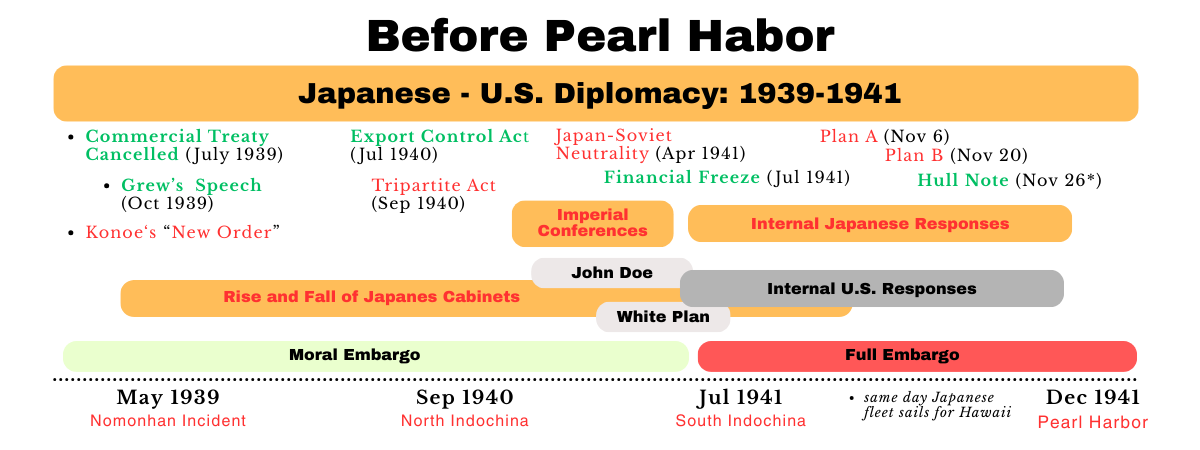
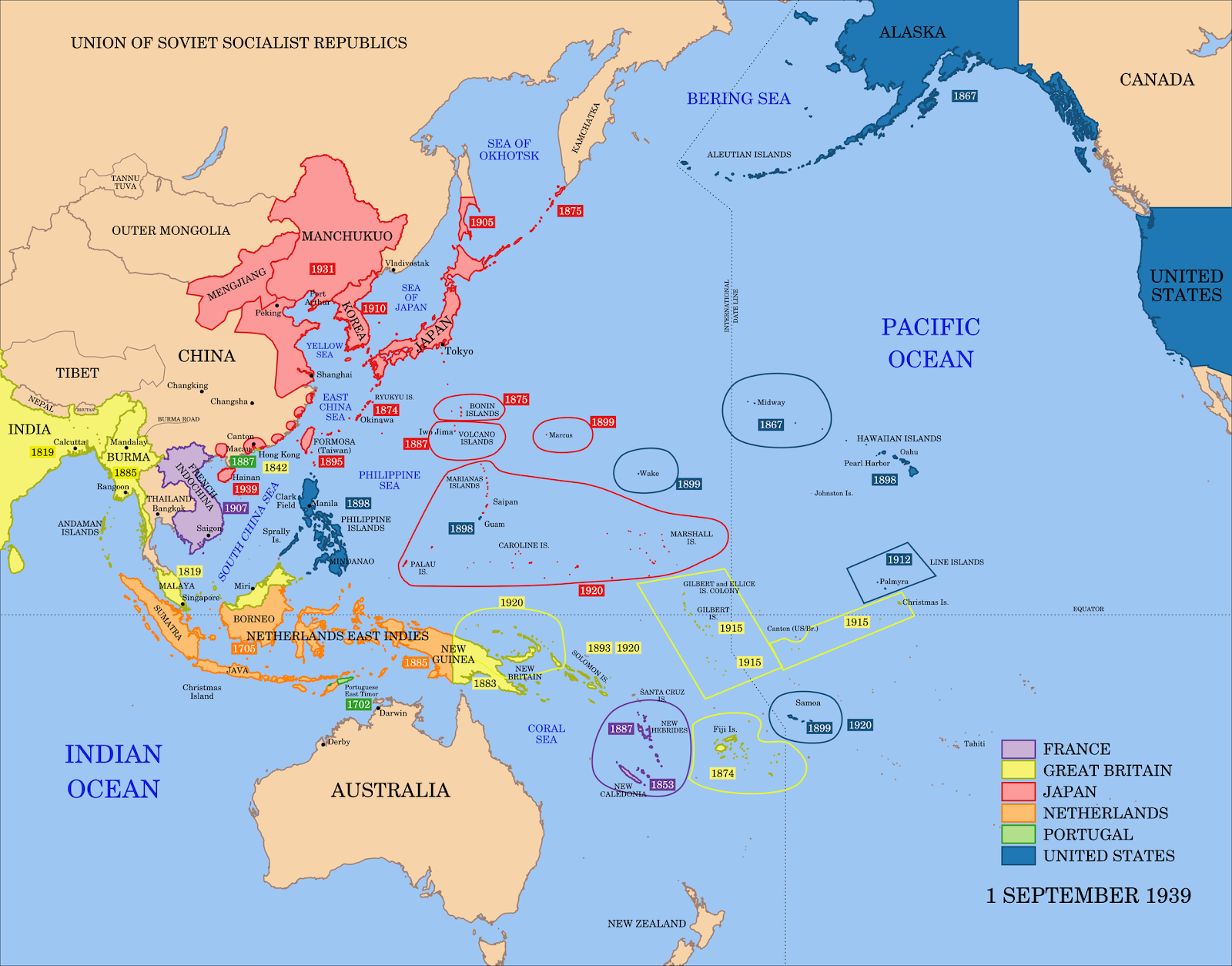
 friarmusings