
Please refresh the screen/page to ensure all posts display
- Iconicby Friar MusingsOn this day in February 1945 on Iwo Jima, four days after the initial landings, Harold G. Schrier led a 40-man patrol up Mount Suribachi with a small American flag provided by Chandler Johnson. After a brief firefight with Japanese defenders, the flag—reportedly obtained from the attack transport USS Missoula (APA‑211)—was raised over the crater. Later that day, a larger eight-foot ensign from the tank landing ship LST‑779 replaced it. As Marines struggled to hoist the second flag, John H. Bradley and fellow servicemen were captured on film by Associated Press photographer Joe Rosenthal, creating one of the most iconic … Continue reading →
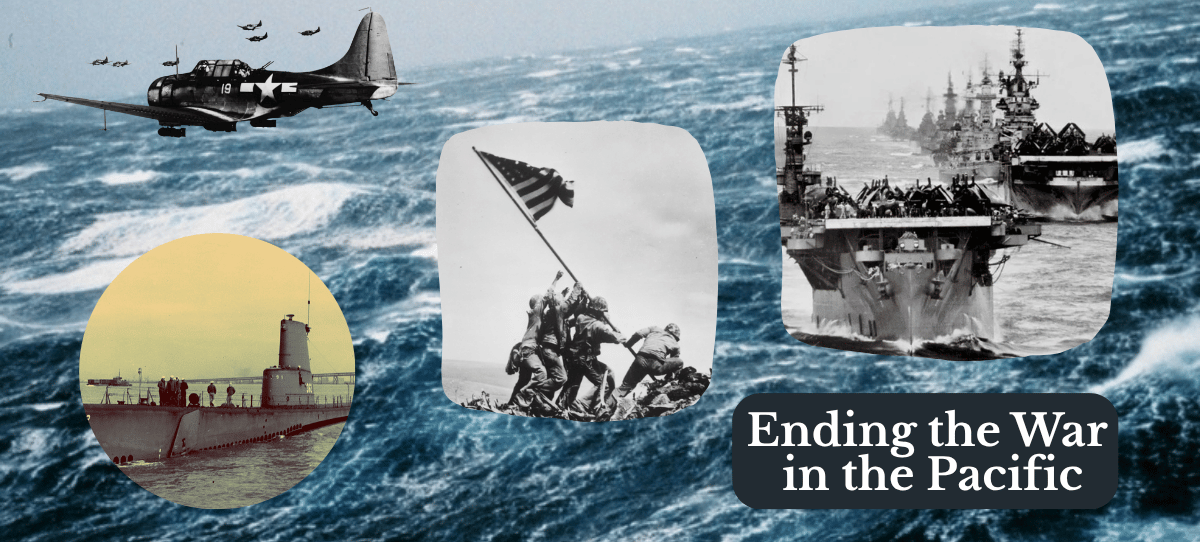
- To those reading the new World War 2 postsby Friar MusingsThanks to all who have been reading the series. I wanted to let you know that I have divided the series “Ending the Asia Pacific War” into different categories as I ran into a technical limit on the blog for showing previous posts on their own page with an associated menu item. Enjoy Image credit: various photographs from Naval Aviation Museum, National World War II Museum, and US Navy Archives
- The Hard Choiceby Friar MusingsThis day in history – November 19, 1943. The submarine Sculpin (SS-191) was heavily damaged by the Japanese destroyer Yamagumo north of Truk in the Caroline Islands. Though he has time to escape the boat before it sinks, Captain John P. Cromwell, the commander of the submarine squadron of which Sculpin was a part, chose to go down with the boat rather than face interrogation during his capture that might force him to reveal his knowledge of U.S. Central Pacific strategy and plans. Captain Cromwell had detailed knowledge of Operation Galvanic (Tarawa), Operation Hailstone *Truk and the Gilbert and Marshall … Continue reading →
- Chichijimaby Friar MusingsOver the course of the last few months, a lot of you have let me know that you regularly forward the series of emails to friends, relatives and interested parties. Thank you! Yesterday I received an email letting me know that one of the friends – a US Naval Academy graduate from the Class of 1959 – let them know that his father, a Lt. Colonel in the US Marine Corp – had been assigned post-war duty on the island of Chichijima. Curiosity kicked in. Chichijima is the largest and most populous of the Bonin Islands. Chichijima is located in … Continue reading →
- No End in Sightby Friar MusingsThis is the last post in this series in which we explored the War in the Pacific…for the time being. Along the way, it became clear that it was really the Asia Pacific War and had started in 1937 when the imperial ambitions of the nation of Japan launched military action against the nation of China, a conflict that had been simmering since 1931. We traced the rise of Japanese militarism that served as the agent of their colonial ambitions. When their 1939 forays into the border areas of Soviet controlled Mongolia and Siberia were easily repulsed, Japanese attention and … Continue reading →
- The Unbearable Endby Friar MusingsIn 2005 the translated diary of Admiral Yonai, the Japanese Navy Minister and member of the Supreme Council, was released. In the days between the Imperial Saiden (Sacred Decision) to accept the terms of Potsdam and before it was announced, Yonai wrote that “It may be inappropriate to put it in this way, but the atomic bombs and the Russian entry into the war were in a sense, God’s gifts…Now we can end the war without making it clear that we have to end the war because of the domestic situation.. I have long been advocating the conclusion [of the … Continue reading →
- August 1945 – No good optionsby Friar MusingsYou may have noticed the change in the series graphic from “Ending the War in the Pacific” to “Ending the Asia Pacific War.” The reasons were made clear in the two posts immediately preceding this post. One of the key points to keep in mind is “Excluding Japanese, every single day the war continued [in the summer of 1945] between 8,000 and perhaps 14,000 noncombatants were dying.” (Richard Frank) That is between 56,000 and 98,000 each week or 240,000 and 420,000 per month. The tragedy increased each day, and by far the greatest impact of that tragedy was borne by … Continue reading →
- August 1945 – What is at stakeby Friar MusingsHaving described the actual history of August 1945 in the previous post, it is time to consider our counter-factual: what if the US and Allies did not possess atomic weapons and did not expect to possess them any time in the immediate future? How does the Asia-Pacific War come to an end? But then we need to be sure we are talking about the same war. Here is the most commonly offered timeline: With that all the major combatants were formally engaged in World War II. At least these are the dates that are given from a western perspective. When … Continue reading →
- August 1945 in Historyby Friar MusingsWe are at a point in the series at which we should depart from history and consider the counter-factual that no atomic weapons were yet available to the United States and the Allies, nor would they be for the foreseeable future. But before we take that departure, let us consider the actual events of the first 15 days of August 1945 so we might gain insight into the forces and currents within and outside of Japan. The atomic weapon was successfully tested on July 16, 1945, ten days before the Potsdam Declaration. President Truman was briefed of the test’ success. … Continue reading →
- Japan and the Soviets Before the Warby Friar MusingsThe Japanese-Soviet story is more detailed than discussed in this series to this point. It is important to understand the “history” between these two Asiatic imperial powers. In the series to date, we picked up the “story” when the Soviets announced that they would not renew the neutrality pact with Japan in April 1945, giving the required one year notice that by April 1946 the pact would lapse. As previously noted, the Soviets were already transferring soldiers, transportation, armaments and ammunition to their “Eastern Front” – meaning Mongolia and Siberia. This was in accord with the February 1945 promises made … Continue reading →
- July 1945by Friar MusingsJuly 1945, in some ways was like the lull before the storm. I remember my first experience of the eye of a hurricane passing over my home town. I was a small child and my parents told me about what would happen. Sure enough in just a moment we went from hurricane winds and lashing rains to an amazing stillness. We wandered outside just to feel the stillness and utter silence. In time and slowly, the winds picked back up to the full whip of hurricane winds. July 1945 is like the passing of the eye of a hurricane. The … Continue reading →
- Task Group 30.8by Friar MusingsMany years ago I prepared a couple for Sacramental Marriage. He was an Army Officer assigned to a local joint operations base and had primarily served in the Quartermaster Corp (Supply). He had written a history of Army Logistics in World War II. He gave me a copy and it was very interesting. My take away from the book was that perhaps the German generals and divisions were better than the Allied counterparts, but integrated allied logistics won the war in Europe. He certainly made a case. One of the examples he used in his book was the Battle of … Continue reading →
- Japan prepares for Invasionby Friar Musings“The sooner the Americans come, the better… One hundred million die proudly” Such was the Japanese wartime propaganda campaign in 1945 as part of the Ketsu-Go defense plan against the inevitable invasion of the home islands by Allied forces. The slogan urged a total commitment, even unto death, to protect Japan. If necessary, Japanese civilians were to fight to the death to defend the homeland. Along with military operations, the goal was to inflict unacceptable casualties on the enemy and force a negotiated peace. Japan had a standing army of 4 million men, but more than half were spread out … Continue reading →
- The Collapse of Civil Orderby Friar MusingsAs the summer progressed, the emperor and other key members of the inner leadership grew concerned and anxious that the civil order of Japan was threatened. In the breakdown of civil order, there was fear that the Japanese people would be ripe for a revolutionary moment. The root cause of growing dissatisfaction was the slow realization that the reports of Japanese victories were simply wrong. They had daily evidence that allied bombers controlled the skies and were unhindered in their devastating fire-bombing attacks on cities. The vaunted Japanese military could not protect them. Food Crisis and the “domestic situation” At … Continue reading →
- Japanese-Soviet Diplomacyby Friar MusingsMany commentaries, focused on the use of atomic weapons, suggest that use of such weapons of mass destruction was not necessary given that Japan was attempting to open peace negotiations via the Soviets as intermediaries. As noted in earlier posts, if one wishes to assert that peace negotiations via the Soviets was a viable pathway, one needs to account for the history of Japanese-Soviet relations which in general had always been contentious. Military actions include the 1903-1905 Japanese-Soviet war which concluded with a resounding Japanese victory at the naval battle of Tsushima, the 1939 Japanese invasion (unsuccessful) of Soviet-held Mongolia, … Continue reading →
- What is Necessary?by Friar MusingsMuch of the Just War Theory conversations (apart from what I have called narrow consequentialism) centers on the deaths of civilian populations. Broadly reading the available literature there seems to be a rating of moral importance in which the moral weight is given to civilians over drafted military over volunteer military. In part, it is the theorist’s way to nuance out the factors involved in thinking through jus bello decisions. For example, if the only way to save 100,000 of our civilians’ lives from terrorist attacks is by bombing another country’s cities and intentionally killing 10,000 of its citizens – … Continue reading →
- Japanese “Diplomacy”by Friar MusingsWhen one talks about Japan’s efforts to end the war, there are those who claim there were numerous attempts, all of which were ignored by the Allies. There were indeed several and they were, for the most part, simply “noted.” The Allies then waited to see what might become of the Japanese inquiry. What one must keep in mind is that diplomats, intermediaries, and private citizens can all be in conversation with important, well-placed individuals of other governments. Those individuals might informally pass along information, but there will be no substantive conversations that have a hope of going anywhere unless … Continue reading →
- While We Weren’t Paying Attentionby Friar MusingsOne of the things that surprised me about publishing (news, magazine articles, books, etc.) is how little control the author has over the title. That is the domain of the publisher and editors. The title is meant to hook you, to raise your curiosity and interest in the created content by the author. Several years ago I ran across a book with the following title “An Economist Walks Into a Brothel.” The publisher accomplished their mission; I bought the book. It is a book about risk – the ways we assess it and manage it. The first chapter was very … Continue reading →
- Authorizing Operation Olympicby Friar MusingsTruman’s questions and comments during the meeting reflected his own continuing unease over the level of US casualties. The President also expressed concern that an invasion of the homeland by Americans could carry a racial connotation in the minds of the Japanese that would unite them for a fight to the finish. Stimson said there was every indication that this would be the case. At the meeting’s end, Truman said he agreed that the plan presented by the Chiefs was the best choice under the circumstances, but he added that he “had hoped there was a possibility of preventing an … Continue reading →
- The Warfighterby Friar MusingsA great deal of the discussion about Just War theory focuses on the state and national polities especially before the war and in the context of the decision to declare war: jus en bellum. The focus is the justice of the cause. What is often overlooked, or at least not often spoken of, is the moral and spiritual burden borne by the warfighter. Already in the Summa Theologiae (II–II, q.40), Aquinas notes that the individual soldier’s actions must be ordered toward right intention — not hatred, cruelty, or greed. That is not only to avoid sin, but also a recognition … Continue reading →
- Kyushu, Kamikaze, and Estimate Lossesby Friar MusingsThis is an addendum to the “Olympic Decision” post. It continues the thread of thought that suggests President Truman left the June 18, 1945 without a firm answer to expected losses – not to say he wasn’t briefed later. But it also addresses the historians who offer that post-war Truman inflated the estimated US losses associated with an invasion to “more than a million.” In the earlier article it was posited that based on Japanese troop strength on Kyushu by the end of July and a casualty rate similar to Okinawa, there would be an estimated 792,000 allied casualties. By … Continue reading →
- Proportionality and Necessityby Friar MusingsThe previous post ended with this: “The question of interest is jus bello (in war), especially as it concerns the ways and means to end the Asia Pacific War. In the language of Just War Theory – were the ways and means “proportional” and was adequate care given to the question of non-combatant injury and death.? In preparing to write on this topic I am not sure how to best describe the reading and research. The following expressions come to mind: “down the rabbit hole,” “swamp,” and “forget the forest, I am still looking for trees.” Whereas the conditions for … Continue reading →
- An Olympic Decisionby Friar MusingsAfter the May 1945 German surrender, arrangements were made for the Allies to meet in Potsdam, Germany. The topics were to settle the postwar arrangements for Europe and to reach agreement on coordinated Allied military operations against Japan. A month before the mid-July Potsdam Conference, President Truman met with his senior advisers to go over plans for ending the war with Japan and to prepare himself for Potsdam. In a 14 June memorandum to the service chiefs setting up this meeting, his Chief of Staff, Admiral Leahy, said the President wanted to: “. . . discuss details of our campaign … Continue reading →
- The Changing Nature of War and Just War Theoryby Friar MusingsIn the previous post we considered the basis of modern just war theory in the writings and reflections of St. Thomas Aquinas. His thoughts became the basis for reflection on wars prior to the 20th century. For example, in the 16th century the Dominican Francisco de Vitoria applied just war thinking to Spain’s wars of conquest in the Americas. While he rejected armed conflict against indigenous people for the cause of conversion, he argued that the Spanish explorers had freedom to be in the foreign lands and their defense was just. Thomas’ thoughts were applied to conflicts between Christian monarchs, … Continue reading →
- May-mid June 1945by Friar MusingsIn May 1945, Germany surrendered unconditionally. Many commentators offer that this would have been the optimal time to organize discussions with the Allies about a negotiated peace, preempt Russian involvement in the Pacific War, and end the war on terms acceptable to Japan. No attempts were made – nor were they likely to have gotten “off the ground.” The mindset of the Council was devotion to the Ketsu-Go plan. Suzuki had zero possibility of reaching a unanimous Council position in order to present such an option to the Emperor. Meanwhile, during this time period, Leyte has fallen, Luzon is all-but-defeated, … Continue reading →
- Just Warby Friar MusingsIn the modern age, the average Catholic looks to the Catechism of the Catholic Church to find guidance on the concept of just war. The Church teaches that war can be morally justified under certain conditions, which are rooted in the principles of just cause, legitimate authority, right intention, and proportionality. (Found in paragraphs 2307 to 2317). The conditions fall into three broad categories: The first four conditions address jus ad bellum.
- April 1945by Friar MusingsIt was a busy month. Mounting military losses and the inability of Prime Minister Koiso to garner consensus within the War Council led to the collapse of the government and the appointment of Admiral Suzuki as Prime Minister. It takes time to form a government – and meanwhile there is a lot going on. Iwo Jima is reaching its bloody end just as Okinawa begins to unfold. The losses among land forces, naval personnel (viz. kamikaze) and especially among civilians will be horrific and impactful. Some argue that April 1945 was a lost opportunity. Suzuki was the new prime minister … Continue reading →
- Exploring the Moral Landscape of the Asia-Pacific War (1937-1945)by Friar MusingsThe title may have caught your eye and caused you to wonder about the dates. Shouldn’t the War in the Pacific be dated from December 7, 1941, the attack on Pearl Harbor, until September 2, 1945 and the surrender of Japan aboard the USS Missouri? Certainly those are the dates which involved the United States and her allies. But war in the Asia-Pacific region had already started with the Sino-Chinese war, long simmering, but breaking out into open warfare in 1937. Japan had occupied Manchuria since 1931, but then invaded much of China from 1937 onward, including Beijing, Shanghai, Nanjing, … Continue reading →
- Operation Downfall Planningby Friar MusingsThe preliminary planning for Operation Downfall – the invasion of the Japanese home islands of Kyushu and Honshu – began in the waning months of 1944. These were preliminary plans at best and were secondary to battle planning for Leyte, Luzon, Iwo Jima, Okinawa and the naval aircraft carrier raids on Formosa, as well as the massive logistics planning to support all the amphibious landings. By April 1945 only the amphibious landings at Okinawa remained – the other islands had been secured, although scattered actions continued on Luzon until the end of the war. It was at this point that … Continue reading →
- Behind the American Curtainby Friar MusingsIt is time to introduce the key figures “behind the curtain” of the United States. Apart from the human and political intrigue native to any human enterprise, the chain of command was clear. In wartime, the President of the United States was the “Commander in Chief.” He possessed the unilateral power to make decisions, was active in soliciting discussion, and most often took the advice of his military leaders. But it was clear that the “buck” stopped on the desk of the President. The American operational leadership of the Asia-Pacific war effort was established and consistent from the inception of … Continue reading →
- The Potsdam Declarationby Friar MusingsWe jump ahead on the timeline for a moment to complete the Allied thought that began at the Jan 1943 Casablanca Conference: terms of surrender for Germany and Japan. 2.5 years after Casablanca, after Nazi Germany had unconditionally surrendered, the Allies prosecuting the war in the Pacific met. On July 26, 1945, US President Harry S. Truman, UK Prime Minister Winston Churchill, and President of China Chiang Kai-shek issued a document, which outlined the terms of surrender for the Empire of Japan. The Potsdam Declaration (Proclamation Defining Terms for Japanese Surrender) was a statement that called for the surrender of … Continue reading →
- Before Potsdamby Friar MusingsWho were the allied leaders whose decisions would be the most impactful on the Asia- Pacific War? And equally important what were key inter-allied conversations and decisions that would shape the manner and outcome of the war? Unlike Japan that had no effective dialog or connection to its Axis partners, the Allied met quite regularly in high level conferences with its partners. Quite early in the war, the allies agreed that both the war in Europe and the Asia-Pacific would end in unconditional surrender. At the January 1943 Casablanca Conference the Allies (U.S., Britain, USSR*) demanded, as pertains to Japan, … Continue reading →
- Behind the Curtainby Friar MusingsThe two previous posts were meant to give the reader a sense of the Emperor’s role in war-time governance in Japan. To be sure, I have not done the topic justice as just like “Washington insider” machinations (then and now) Japan had its own “system” to navigate to achieve decisions. Some of this was already covered. A review of two posts would be helpful: Ketsu-Go and Governance and Ketsu Go. The former describes Japanese plans for the “decisive battle” that would bring the Allies to a negotiation table and away from their demands for unconditional surrender. The latter describes the … Continue reading →
- Hirohito During the Warby Friar MusingsIn the summer of 1942, as outlined in the post “Before the War”, Japan pursued parallel paths: diplomacy and war preparations. The military (members of the cabinet, IJA Headquarters, and influential flag officers) flush with success in Manchuria, China and French Indo-China (Vietnam) wanted to unleash the Army against the entire Asia-Pacific region in order to establish the Empire of Japan under the guise of the Greater East Asia Co-Prosperity Sphere. The Navy was circumspect with part of its leadership desirous of some means to achieve “glory for the Emperor” as the Army had already done. But another part of … Continue reading →
- Defeat and Surrenderby Friar MusingsTo understand in the inner workings of the wartime governance of Japan there are three keys to keep in mind: Does #3 mean that the “buck stops” with the Emperor? Hardly. As described in earlier posts, the received tradition was that the Emperor was not an absolute monarch – and that is consistent with the Meiji Constitution. Then again, the Emperor was not a symbolic monarch like the King of England. In practice, the Emperor’s role lived somewhere between the two on a spectrum of direct influence, passive influence, and removed from decision making. Emperor Hirohito’s father was quite removed … Continue reading →
- Action and Planning for 1945by Friar MusingsSometimes the task at hand is like trying to rewire the house while keeping the lights on. Such was the 12 months preceding the planned November 1, 1945 Operation Olympic’s landings on the southern Japanese home island of Kyushu. That was the “rewiring” part. The “lights” that needed to be kept burning brightly were spread far and wide. Here is a brief summary of the major Pacific engagement from October 1944 until the end of the war. These operations engaged the entirety of Central Pacific Command (Nimitz) and Southwest Pacific Command (McArthur) – and yet at the same time the … Continue reading →
- Allied Intelligence Operations in the Pacificby Friar MusingsIn popular understanding, we think of intelligence operations as “code breaking.” But those were always later developments. The first step was listening in on enemy transmissions. Intercepts were collected by ground stations, ship-based stations, aircraft with radio monitoring gear, and even submarines. Once the encrypted communications were intercepted, even when messages couldn’t be decrypted, analysts studied call signs, frequencies, message traffic volume, transmission times, and transmission locations. Early in the war these “signal intelligence” (SIGNIT) operations were sophisticated enough to reveal patterns such as unit locations, movements, and order of battle. The early June 1942 Japanese attack on Midway was … Continue reading →
- This day in history….by Friar MusingsTwo of the legendary warships of the modern Navy were commissioned on this day, 17 years apart. In 1937 the USS Enterprise (CV-6) – the “Big E” was commissioned at Newport News, VA. Enterprise was the only aircraft carrier to start and finish WWII – with a lot of bumps along the way. The Big E participated in the Battle of Midway, the Battle of the Eastern Solomons, the Battle of the Santa Cruz Islands, various other air-sea engagements during the Guadalcanal campaign, the Battle of the Philippine Sea, and the Battle of Leyte Gulf. Enterprise earned 20 battle stars, … Continue reading →
- Special Attack Forces – Kamikazeby Friar MusingsWhen it became clear that the Mariana Islands (Saipan, Tinian and Guam) had been taken over by the Allies, the Imperial Japanese Army (IJA) Journal recorded: “We can no longer direct the war with any hope of success. The only course left is for Japan’s one hundred million people to sacrifice their lives by charging the enemy to make them lose the will to fight.” The Japanese military would implement that plan in the Special Attack Forces and would promote their sacrifice to the general population as a means of propaganda and to animate and reinforce the resolve of the … Continue reading →
- Mining the Sea Lanesby Friar MusingsIn May of 1942 the Japanese Empire covered 10 million square miles and extended from Manchuria, China and Korea eastward to the International Dateline and southward to the Philippines, Dutch East Indies, Java, Borneo, Sumatra and Malaya. The shape of the Empire was as though a lopsided, bottom heavy pear with Japan located at the top near the stem. As an island nation massively importing oil, rubber, iron, bauxite, aluminum, all manner of raw materials – and food – it was completely dependent on shipping to fuel the war machine, supply its armed forces, and feed the people on the … Continue reading →
- From Theory to Firestormby Friar MusingsAcross military histories of the War in the Pacific the phrase “strategic bombing” is used and refers to B-29 Superfortresses flying out of the Mariana Islands (Saipan, Tinian, and Guam) and bombing the Japanese home islands of Honshu and Kyushu. Strategic bombing was an idea that grew out of the experience of air power in the First World War. Military theorists such as airpower advocates like the Italian Giulio Douhet, Britain’s Hugh Trenchard, and General William “Billy” Mitchell became influential in shaping the concept during the 1920s and 1930s. Douhet’s The Command of the Air (1921) and Mitchell’s Winged Defense … Continue reading →
- Naval Air and Shore Bombardmentby Friar MusingsDuring the early 1945 the war in the Pacific was inexorably drawing closer to the Japanese home islands. There were two major campaigns that were initiated in the Winter and early Spring: Each of these campaigns were within range of Japanese aviation forces based on Kyushu and Honshu. A critical element of the above campaigns was the suppression of those aviation forces. That work fell to the U.S. Navy. The Navy, freed from most major fleet engagements after the Philippine Sea and Leyte Gulf, shifted to directly attacking the Japanese homeland with multiple purposes in mind: suppression of aviation support … Continue reading →
- Allied Firebombingby Friar MusingsThe capture of the Saipan and Tinian (July 1944) gave the allies air bases for the B-29 Super Fortress bombers. The home islands of Japan were within range and the Allies were now able to initiate sustained bombing of Japan without risking aircraft carriers which would have operated within range of Japanese counter attacks. The B-29 raids began on November 24, 1944. Tokyo was the first target. It consisted of 111 B-29s striking the Musashino aircraft engine plant on the outskirts of Tokyo. The raid was executed as a high-altitude precision raid (but with little effect). As noted in a … Continue reading →
- Allied Bombing – The First Phaseby Friar MusingsThere was an early phase of B-29 bombings on the Japanese home islands as part of Operation Matterhorn. These were planes launched from China. The airfields in China were highly vulnerable. Supplies and logistics had to be flown over the Himalaya Mountains. There were no accompanying fighter escorts. Targets were typically industrial or military facilities near western coastal cities (e.g., steel works, shipyards, aircraft plants). Damage was limited due to small bomb loads, long flight distances, and weather conditions. All in all, the raids were psychologically unsettling, but neither tactically or strategically valuable. That began to change in late November … Continue reading →
- Before the Bombing – History and Contextby Friar MusingsBefore we delve into the aerial bombing campaign, we should consider an event which was seared into the minds of Tokyo and Yokohama residents – an event which shaped emergency preparedness: the 1923 Tokyo earthquake, also known as the Great Kantō Earthquake (the Kantō plane is the broad area on Honshu island that encompasses some of the great cities of Japan) The earthquake struck on September 1, 1923, at noon when people were cooking lunch. The ~8.0 magnitude earthquake caused extensive damage that was further exacerbated by widespread fires that swept across the wooden neighborhoods of Tokyo and Yokohama. Both … Continue reading →
- Requiem for a Battleshipby Friar MusingsThe final death blow to the Japanese Imperial Navy occurred during the Battle of Okinawa – the sinking of the super-battleship Yamato. This pride of the Imperial Japanese Navy (IJN) was named after Japan itself, IJN Yamato, the historic name for Japan and was the pride of the nation. Yamato was the largest warship ever built up to that time. Compared to ships of the time it was simply a monster. It carried larger guns (18-inch) than any warship and could fire a 3,200 lb armor-piercing projectile more than 26 miles. For reference, a Ford Escape weighs about 3,200 lbs. … Continue reading →
- The Brutality of the Asia-Pacific Warby Friar MusingsThe historian Richard B. Franks is noted for his exhaustive research centered on World War II in the Pacific – or as he emphasizes, the Asia-Pacific War. While the major combatants in the region were Japan vs. primarily the United States/Australia/New Zealand/Britain/Netherlands, Franks’ research reminds the reader that there was no nation in the Asia-Pacific region that was not impacted by Japanese occupation. In an early post, Civilian Deaths, we considered that between 1936-1945 the Empire of Japan was responsible for some 30 million civilian deaths. By and large these were not combat deaths, but were deaths by slave labor, … Continue reading →
- Okinawa: On the Road to Downfallby Friar MusingsThe vast number of islands that were invaded/recaptured by the Allied forces were not highly occupied by civilian populations. Iwo Jima had virtually no inhabitants. Very different experiences were encountered on Saipan, in the Philippines, and on especially on Okinawa whose pre-invasion civilian population was estimated at 300,000 people. Okinawans were Japanese citizens, at least in law. After the 1879 annexation of the Ryukyu Kingdom, Okinawa was made a prefecture of Japan. By the time of the Allied landings, Okinawans were Japanese citizens in law: subject to conscription, taxation, and wartime mobilization like all other Japanese. Their cultural and social status … Continue reading →
- The Naval Battle off Okinawaby Friar MusingsThe Battle of Okinawa which began with the initial invasion on 1 April 1945 was the largest amphibious assault in the Pacific Theater of World War II. It was the bloodiest battle of the Pacific War. The most complete tally of deaths during the battle is inscribed on the Cornerstone of Peace monument at the Okinawa Prefecture Peace Memorial Museum, which identifies the names of each individual who died at Okinawa in World War II. At the time of the June 1995 unveiling 234,183 names were inscribed. Continued historical research leads to the addition of names. Today, the monument lists … Continue reading →
- Iwo Jimaby Friar MusingsIwo Jima is a small volcanic island about 750 miles south-southeast of Tokyo. The island had two operating airfields from which flew Japanese fighters and bombers. From late 1944 to early 1945, the Japanese stationed fighters and bombers on Iwo Jima. Their mission was to intercept the U.S. B-29s bombing Japan and to conduct night bombing raids on the Mariana airfields to disrupt U.S. bombing operations. Japanese bombers conducted about nine significant raids against the Marianas. The night raids were small in scale, typically 5 to 20 Mitsubishi G4M “Betty” bombers. The raids never seriously curtailed B-29 missions as U.S. … Continue reading →
- The Battle of Manilaby Friar MusingsIn yesterday’s long post I attempted to bring together naval fleet, air and Marine Corps-Army amphibious efforts up to the end of 1944 and into early 1945. In earlier posts, we considered key engagements and their impact on the shape and prosecution of the war: Saipan (strategic importance and civil deaths) and a post, Battles that Changed War Strategy (Biak, Peliliu, and the air battles at Philippine Sea and Formosa) which pointed to the changing tactics and objectives of Japan as the war approached the home islands. The implications of all this was hinted at in the post Ketsu-Go outlining … Continue reading →
- The Big Blue Fleetby Friar MusingsA reader mentioned that they were surprised that as a former naval officer I had not offered more coverage on the operations of the US Navy during the War in the Pacific. While it was perhaps inevitable given my goals for this series, nonetheless let me recount some of the major fleet actions and operations from Pearl Harbor until late 1944. Fair warning: it is a longer than average post. It is important to remember that the first 12 months of the war in the Pacific was focused on stopping the advancing Japanese forces in the Southwest Pacific – especially … Continue reading →
- The War that Waitsby Friar MusingsIn the previous posts we paused to look back to the historical currents that shaped Japan in the 19th and 20th centuries. The posts were an attempt to provide a sense of the influences, perspectives, aspirations, and national identity that formed Japan to see its destiny as the leader of an Asia-Pacific region – and the rise of nationalism and militarism that were the means to accomplish its vision. The posts also pointed to the body-politics that was Japan: a divine Emperor, a civil government that resembled Britain, a constitution that assured a premier place for the military, and yet … Continue reading →
- Before the Warby Friar MusingsIn the previous posts we considered the early years of Hirohito’s time on the throne and tried to give a sense of what his role was and wasn’t as Emperor, his sense of the limits of his authority and role, and the events which – at least from the outside – seemed to show a “self-induced neutrality” in governance. The previous post also showed that loyalty to the throne had practical limits as seen in the frequent assassination attempts and attempted coup-d’etat. This “civil unrest” would be ever in the back of Hirohito’s mind. In addition, the Imperial Japanese Army … Continue reading →
- Testing the Emperorby Friar MusingsThe posts this week have been attempting to take a walk through Japan’s history from the end of the Shogunate period, into the Meiji Restoration of the 19th century, and following the flow of people, events and ideology that brought us into pre-War 1930s Japan. It is a decade during which the “manifest destiny” of Japan is evident in its Greater East Asia Co-Prosperity Sphere policy. As I wrote in the previous post: “Asian countries should come together under Japan’s leadership to be free from Western colonial powers (like Britain, France, and the U.S.). On paper, it sounded like a … Continue reading →
- The Eight Corners of the Worldby Friar MusingsAlthough overly simplified, for our purposes, State Shinto and the person of Emperor Hirohito form an imperial ideology that became a central pillar of Japanese foreign policy in the days leading up to the War in the Pacific – or as several historians rightly assert, the Asia Pacific War. After Korea’s annexation and incorporation into Japan’s sphere (1910–1920s), there was an intentional program to consolidate the idea of “Sacred Rule.” In Korea, Taiwan, and other territories, Japan built Shinto shrines and required participation in rituals, symbolically binding colonial subjects to the emperor. School curricula emphasized emperor worship and loyalty, teaching … Continue reading →
- The Development of Sacred Dutyby Friar MusingsIn the previous post we considered, in broad terms, that the Meiji Reforms of 19th Century Japan was the seedbed for an elevated position of the military in government and in the minds of the people. This rise occurred in the context of an essential idea that Japan needed to take its place among the powerful nations of the world, not only as an economic necessity but as a moral imperative rooted in its self-understanding through the eyes of Shinto religion. It is perhaps best understood in the Western parlance as Japan’s “Manifest Destiny.”
- The Meiji Reform and the Rise of Militarismby Friar MusingsIn the previous post we considered the Regent Hirohito and the time in which he lived before ascending the throne. It was a time where the founders and elder statesmen of the Meiji Reform were dying or being assassinated. There were centers of power/influence all seeking more power and influence: the military, civil government, the Diet (Parliament), the Imperial Court, and leaders in civil society. In a way this story is as old as time, but in Japan the democratic institutions were new and offered levers of power and influence that were not necessarily part of the fabric of Japanese … Continue reading →
- In the Beginningby Friar MusingsAs the War in the Pacific moves into 1945 it is clear that the Asia Pacific War will not end in victory for Japan. How will it end? For the Allies, the 1943 Casablanca Conference has already stated that the war in the Pacific will end in unconditional surrender as it soon will for Germany. But the nature of that war is different. Germany is virtually landlocked and is being pressed on its eastern, western and southern fronts. Japan is an island fortress. Japan sees the path leading to a decisive battle where either Japan wins or extracts such allied … Continue reading →
- Governance and Ketsu Goby Friar MusingsA previous post offered a brief discussion of a complicated issue – the governance of wartime Japan. Such governance was a complicated, ritual process involving Emperor Hirohito and the Supreme War Council (“Big 6”). In the shadows of the ritual were the Lord of the Privy Seal (Kido) and other confidants of the royal family. Rather than detail the process, it is perhaps best explained by decisions around Ketsu Go. On January 20, 1945 there was an Imperial audience in which senior Army and Navy leaders briefed the Emperor on the strategic concept for Ketsu Go. This was not a … Continue reading →
- This day in history… the end of World War IIby Friar Musings80 years ago today, September 2, 1945, the leaders of Japan signed the articles of surrender, ending the War in the Pacific. The treaty was signed aboard the USS Missouri anchored in Tokyo Bay. The document was signed by by representatives from Japan and from the Allied nations: the United States, Australia, New Zealand, China, the United Kingdom, the Netherlands, the Soviet Union, Canada, and France. The document was first signed by the Japanese foreign minister Mamoru Shigemitsu and by General Yoshijirō Umezu, Chief of the Army General Staff. Both were later convicted of war crimes. Shigemitsu served 7 years … Continue reading →
- Ketsu-Goby Friar MusingsKetsu-Go (“Operation Decisive”) was Japan’s final defense plan in World War II. It outlined the defense of the Japanese home island. At this point in the war the plan is an Imperial Army-led plan with the Imperial Navy playing a limited role apart from Naval Aviation. As noted in the previous post, as from the outset of the war the Imperial Army was “in charge” – not only in the Supreme War Council but in operational planning. The goal of Ketsu-Go was to mass Japan’s remaining troops, planes, and special attack units (kamikaze) to repel the invasion, especially on the … Continue reading →
- Japanese Intelligence: Past as Preludeby Friar MusingsThe Japanese could intercept Allied radio traffic, but they lacked the computational resources and personnel to break complex Allied codes like Naval Cypher No. 5. Their cryptanalytic efforts were centralized and bureaucratically fragmented, lacking the scale and success of U.S. or British efforts. As a result Japan remained largely blind to Allied operational planning, especially in the Central Pacific campaigns. In addition, their intelligence analysis and interpretation – especially on a strategic level – was hindered by their rigid military culture and intense rivalry between the Army and Navy. Their military intelligence units operated as though in silos. Intelligence was … Continue reading →
- This day in historyby Friar MusingsThe Battle of Midway (June 4, 1942) was one of the key battles in World War II and in naval history. It marked the first major aircraft carrier v. aircraft carrier engagement in naval history and was the first defeat in the onslaught of what were otherwise victory after victory for the armed forces of the Empire of Japan. On this day in history in 1867, Captain William Reynolds of the screw sloop Lackawanna raised the American flag over Brooks’ Islands (later renamed Midway Atoll). It was formally annexed on 28 December. by the United States as the Unincorporated Territory … Continue reading →
- War of Resolve and Propagandaby Friar MusingsAs the war in the Pacific moved into the summer of 1945 combatant casualties continued to mount as discussed in the previous post – so too did civilian deaths. On Saipan the Imperial Japanese Army (IJA) incorporated civilians into combat roles – it was the first but not the last time allied forces would encounter this blurring of military and civilian roles: Guam, Tinian, Iwo Jima, Okinawa and Manilla in the Philippines. By any measure, these were war crimes, but the effect was to implant in allied war planners the seeds of what they might expect if and when it … Continue reading →
- Kokutaiby Friar MusingsKokutai is a uniquely Japanese concept often translated as ‘national polity’ or ‘national essence.’ It refers to the unique constitutional and spiritual essence of the Japanese nation and its people, centered historically on the Emperor as a symbol of continuity and unity. Kokutai is not just a political constitution but a broader idea of Japan’s national identity and political order. It embodies ideas about the Emperor’s divine descent (from Amaterasu, the sun goddess), Japan’s unique historical destiny, and the special relationship between the ruler and subjects. In prewar and wartime Japan, Kokutai was used to legitimize the Emperor’s absolute sovereignty … Continue reading →
- Civil and Military Leadership in 1945 Japanby Friar MusingsIn the previous post we reviewed the legacy of battle as 1944 came to a close and noted the lethal legacy of Japanese military choices and led to one loss after another. The once powerful Combined Fleet of the Imperial Navy was but a memory. They had once roamed the western Pacific at will; now they were limited to coastal water and home island ports. The Imperial Army fared no better losing garrison after garrison, sacrificing their most experienced battlefield leaders and soldiers to death. There was no surrender. Japan wanted a “decisive victory” conclusion to conflict. What they started … Continue reading →
- The Series Going Forwardby Friar MusingsAs noted in the previous post, “War in the Pacific to this Point”, the series has focused on the strategic plans and tactical experience that has shaped the war on land and sea, and in the air. 1944 ended with the Philippine island of Leyte under Allied control. An invasion of Luzon was next with the hope that Japan would declare Manila an “open city” as MacAruthur had done in 1942. After Luzon, the “road to Tokyo” was clear: Iwo Jima, Okinawa, and then (most likely) the southern Japanese home island of Kyushu. This is a good point in the … Continue reading →
- War in the Pacific to this Pointby Friar MusingsSince the beginning of this series on August 6th we have looked at a variety of topics, issues, and experiences that are being poured into the cauldron of war. The series was never intended to be a review of all the battles, campaign tactics, or evolving strategies – there are far better resources available in print, online videos and more – presented by far more knowledgeable people, scholars and historians. From the beginning, this series was never intended to describe the horror of combat, the mounting death toll, and conclude with “the atomic bomb was the lesser of all the … Continue reading →
- Battles that changed the Warby Friar MusingsThere is no doubt that given the juggernaut of the 1942 Japanese Army and Navy expeditions the Battle of Midway and the Guadalcanal Campaign were turning points in the war – each in their own different way. There is no shortage of books and online sources that can offer outstanding detail, commentary and analysis of the importance of Midway and Guadalcanal. But there are other events in the war that shaped the strategic and tactical vision of the Japanese military from the Spring of 1944 until the end of the war. The lessons learned from these events shaped the Japanese … Continue reading →
- Saipanby Friar MusingsThe island of Saipan in part of the Mariana Islands lies southeast of Tokyo at a distance of 1,450 miles. Its capture was always part of War Plan Orange because of its strategic importance. The capture of the Marianas (Saipan, Tinian, Rota, and Guam) ensured an open sea lane for logistics support from the mainland United States. Guam became one of the major supply depots in the Pacific from August 1944 to the war’s conclusion. Even today every branch of the US military operates out of Guam – notably Submarine Squadron 15/Los Angeles Class fast attack submarines and Seal Team … Continue reading →
- Civilian Deathsby Friar MusingsIn the best of scenarios, the two warring factions agree to meet in the open away from cities, away from civilians, and decide the end result without involving the innocents. Scenes from “Braveheart” come to mind. But even then the winning army goes on to lay siege to the castle while ransacking towns and villages. Whatever the victor’s intent, war has its own purpose and passion. Revenge and retribution seem more powerful than reconciliation. And some things can not be unseen or forgotten by war fighters or witnesses. The goal of this post is to make the reader aware of … Continue reading →
- Naval Blockades Consideredby Friar MusingsPrior to the attack on Pearl Harbor there was no blockade of Japan. Five months before the Pearl Harbor attack the Dutch, English, and Americans announced an embargo on the sale of oil, steel and scrap metal. An embargo is not an act of war; it is an economic and political tool, enforced primarily through laws, regulations, and diplomatic pressure. Its intent is always to solicit acceptable behavior, which in July 1941 meant for Japan to cease its war actions in Manchuria, China, and Indonesia. All this before Pearl Harbor. A naval blockade is an act of war. Naval blockades … Continue reading →
- Sgt. John Basiloneby Friar MusingsBy early 1942, Japan had established a vast defensive perimeter across the western Pacific, including the Philippines, Dutch East Indies, and parts of New Guinea. After seizing Tulagi in the southern Solomon Islands in May 1942 the Japanese began construction of an airfield on Guadalcanal an island near the southwest end of the Solomon chain. Completion and operation of this airfield would threaten Allied supply and communication lines between the U.S., Australia, and New Zealand – effectively isolating the Allies from each other and placing Australia at risk of invasion. The U.S. victory at Midway in June 1942 represented the … Continue reading →
- Unrestricted Submarine Warfare in the Pacificby Friar MusingsWhile the U.S. submarine force in the Pacific is credited with sinking one Japanese super aircraft carrier, two fleet carriers, two escort carriers, four heavy cruisers and other combatants. Their role as a naval combatant against Japanese fleet units was always going to be limited: aircraft carriers had a speed of 28-40 knots; a submerged WWII submarine could make only 3-4 running her engines on battery power. The real contribution of the submarine force was against merchant shipping. By the end of the war, U.S. submarines had sunk approximately 50% of all Japanese merchant shipping.
- This day in history…by Friar MusingsThe Nation of Japan agreed to unconditional surrender marking the end of the 2nd World War in the Pacific. Thank you to all the men and women who served, the families that waited for their return. For those who sacrificed their lives and those who mourn their passing, you are remembered in prayer.
- War in the Pacific – the early monthsby Friar MusingsWhile perhaps familiar to many of the readers, it might be useful to offer a brief summary of the early months of the War in the Pacific. In a modification of Japan’s war plan, Kantai Kessen, on December 7, 1941, Japan launched a surprise and devastating attack on the U.S. Fleet at Pearl Harbor, Hawaii. The goal was the decisive battle that would neutralize the U.S. Pacific Fleet and secure freedom of action for the planned offensive in Southeast Asia. The results of the attack are well known, but the battle was not decisive for three major reasons: the U.S. … Continue reading →
- War Plan Orangeby Friar MusingsAll militaries conduct war games as a means of preparedness, readiness, strategic deterrence, intergovernmental planning, and to provide concrete options to civilian leaders in support of their policy and national security objective. Peacetime planning allows the military to anticipate potential threats and develop responses, systems, and forces before a crisis emerges. War Plan Orange was one of several plans outlining the United States military’s detailed strategy for a future war. The plans were developed as early as 1919. War Plan Orange was the plan for a potential war in the Pacific. Some have argued that War Plan Orange is evidence … Continue reading →
- Achieving Colonial Ambitionsby Friar MusingsThe effect of the military development efforts associated with the Meiji Restoration were realized in the first Sino-Japanese War (1894–1895). Victory over China ceded Japan the island of Taiwan and established Japan as a regional power. That status was solidified during the Russo-Japanese War (1904–1905) fought over rival imperial ambitions in Manchuria and the Korean Empire. Japan’s victory shocked the West and solidified its status as a major military power – and especially as a naval power with the utter defeat of the Russian fleet at the Battle of Tsushima – a battle that would shape Japan’s own war planning. … Continue reading →
- The Rise of Japan’s Militarismby Friar MusingsThe roots of Japanese Militarism can be found in the Meiji Restoration (late 1860s). In brief, the Restoration ended the rule of the Shoguns which had dominated Japan for centuries. The leaders of the Meiji Restoration started to reform the system of the country, acting in the name of Japan’s emperor with the goal to restore the emperor’s powers and position – in government and in the identity of Japan. But, the leaders also kept to themselves a number of powers. Even after the Meiji Restoration a small group had the real power and ruled in the name of the … Continue reading →
- What’s Next for this series?by Friar MusingsLots of writing and research. The previous post outlined the moral landscape I want to explore, but I also have an additional objective. As we approach the 80th anniversary of the end of World War II with the unconditional surrender of the nation of Japan and as the last of our WWII veterans pass from this life, I hope this series can remind or teach readers about the long-ago events that still shape modern life. While this series assumes that atomic weapons were not available for the prosecution of the end of the war in the Pacific, the discussion around … Continue reading →
- Genesis of the Seriesby Friar MusingsEach year as we approach the Feast of the Transfiguration, which (sadly) shares a date with the atomic bombing of Hiroshima, there will be new reflections from military, political and moral perspectives. There are some reflections that ask the reader to ponder what was revealed/unveiled in Jesus’ transfiguration on Mt. Tabor and then ask the reader to ponder what was revealed/unveiled in the light of the atomic blasts at Hiroshima and Nagasaki. I think that is a good and holy endeavor: considering the revelation of the Divine vs. the human capacity for unleashing that which is wholly other than divine … Continue reading →
- A new series of postsby Friar MusingsStarting tomorrow I begin posting a series about the the Pacific campaigns of World War II. Given my naval service background, operating on submarines out of Pearl Harbor, my interest is perhaps natural. As we approach the 80th anniversary of the end of the war, I thought it good to honor the men and women who fought a brutal war in the far reaches of the Western Pacific in places mostly no longer remembered. Places like Biak, Tarawa, Peleliu, in addition to the larger conflicts such as Midway, Iwo Jima and Okinawa. It is good to remember the human cost … Continue reading →
 friarmusings