
The Dishonest Steward – context

This week, I thought I might try something different, breaking up the longer posts on Scripture into smaller portions throughout the week.  As a friend of mine says, “No experiment is ever a complete failure, it can always be used as an example of what not to do.”


The Parable of the Rich Fool by Rembrandt, 1627.


Luke 16:1-13


1 Then he also said to his disciples, “A rich man had a steward who was reported to him for squandering his property. 2 He summoned him and said, ‘What is this I hear about you? Prepare a full account of your stewardship, because you can no longer be my steward.’ 3 The steward said to himself, ‘What shall I do, now that my master is taking the position of steward away from me? I am not strong enough to dig and I am ashamed to beg. 4 I know what I shall do so that, when I am removed from the stewardship, they may welcome me into their homes.’ 5 He called in his master’s debtors one by one. To the first he said, ‘How much do you owe my master?’ 6 He replied, ‘One hundred measures of olive oil.’ He said to him, ‘Here is your promissory note. Sit down and quickly write one for fifty.’ 7 Then to another he said, ‘And you, how much do you owe?’ He replied, ‘One hundred kors of wheat.’ He said to him, ‘Here is your promissory note; write one for eighty.’ 8 And the master commended that dishonest steward for acting prudently.  “For the children of this world are more prudent in dealing with their own generation than are the children of light. 9 I tell you, make friends for yourselves with dishonest wealth, so that when it fails, you will be welcomed into eternal dwellings. 10 The person who is trustworthy in very small matters is also trustworthy in great ones; and the person who is dishonest in very small matters is also dishonest in great ones. 11 If, therefore, you are not trustworthy with dishonest wealth, who will trust you with true wealth? 12 If you are not trustworthy with what belongs to another, who will give you what is yours? 13 No servant can serve two masters. He will either hate one and love the other, or be devoted to one and despise the other. You cannot serve God and mammon.


Context


Swirling in the milieu of our readings are themes of riches, reversals, and hospitality. Continue reading

What person having…..parables of the lost and found

Rembrandt, The Return of the Prodigal Son, 166...

Context.  Many commentators locate these three parables (Luke 15) within a larger section of Luke that asks the question “who will participate in the reign of God?” (13:10-17:10). The section includes the foundational formation of the disciples – but often via the encounter with the Pharisees in which the assumptions of right relationship with God are put to the question.  At issue is the question of fellowship in the community of God’s people. The setting for teaching about this fellowship is so often the meal setting where questions of boundaries and community play out in terms of admission, honor, and hospitality.  So often in this section the characters with the pericopes and parables are those who should attract respect and honor according to the conventional wisdom, yet within the parables of casualties of a reversal of values and misfortunes: “For behold, some are last who will be first, and some are first who will be last” (13:30).  The gospel text for his week immediately follows the unit of saying on the reversals in the Reign of God (13:10-14:35).  Joel Green outlines the reversal sayings as follows: Continue reading

Immigration: The Formation of Conscience

he_qi_road_to_emmausThere are strong emotions at the mention of immigration reform.  There is no shortage of opinions in the news, blogs, rallies, calls to legislators, and the like.  As people of faith we are called not to simply have an opinion on the matter, but rather to form our consciences on the matter (Catechism §1776-1803).  The formation of conscience means to take the matter into prayer, to read and reflect on the way Scripture addresses the issue directly or indirectly, to seek the counsel of the Church, and a host of other actions.  There is no shortage of opinions, but I do wonder how many take the time and effort to form our consciences?  The Church is quite strong on this formation, even teaching that, “A human being must always obey the certain judgment of his [formed] conscience.” (§1790)  That is an amazing responsibility that the Church asks of us. Continue reading

A Holiness Project


Earlier this week, after reading the gospel for the weekend, there was a part of me that instinctively turned to the other readings for a hint about the homily.  The language of the gospel is extreme: hating one’s family members, carrying our cross or we can’t be disciples. “anyone of you who does not renounce all his possessions cannot be my disciple.” Sure, I can explain the underlying Greek meaning and all the rest. And yes, I recognize the language of hyperbole to make a point… still… Continue reading

The Fine Print

Corcovado jesus


25Great crowds were traveling with him, and he turned and addressed them, 26 “If any one comes to me without hating his father and mother, wife and children, brothers and sisters, and even his own life, he cannot be my disciple. 27 Whoever does not carry his own cross and come after me cannot be my disciple. 28 Which of you wishing to construct a tower does not first sit down and calculate the cost to see if there is enough for its completion? 29 Otherwise, after laying the foundation and finding himself unable to finish the work the onlookers should laugh at him 30 and say, ‘This one began to build but did not have the resources to finish.’ 31 Or what king marching into battle would not first sit down and decide whether with ten thousand troops he can successfully oppose another king advancing upon him with twenty thousand troops? 32 But if not, while he is still far away, he will send a delegation to ask for peace terms. 33 In the same way, everyone of you who does not renounce all his possessions cannot be my disciple. Continue reading

A Thought for Labor Day

Jesus was a master of the story form known as parables.  One of the most memorable parables can be found in Luke: the story of Lazarus and the Rich man (Luke 16:19-31). The parable starts simply enough:  “There was a rich man who dressed in purple garments and fine linen and dined sumptuously each day.  And lying at his door was a poor man named Lazarus, covered with sores.”  Very quickly in the parable the two men die.  The unnamed rich man goes to a fiery afterlife of torment while Lazarus rests in the arms of Abraham, awaiting the day when Jesus will open the gates of Heaven for the faithful. Continue reading
What a person is before God

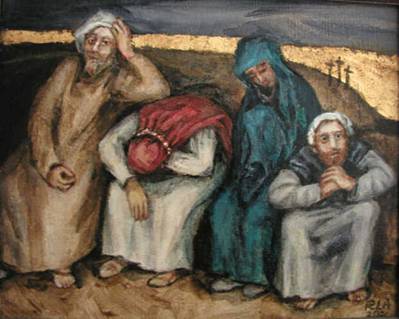
holy-saturdayIf this week’s readings contain any one warning about the human condition it is that too often we are concerned about honor.  In the gospel account it is connected with desiring seats of honor. There is nothing wrong with honor or being honored; what is disordered is when a person seeks the bestowal of honor as a right, something earned, or demanded. Then honor is just the surface symptom of Pride – a sin as deadly as they come and as old as time. As Proverb 16 tells us, “Pride goes before disaster, and a haughty spirit before a fall.” (Pr 16:18). Continue reading