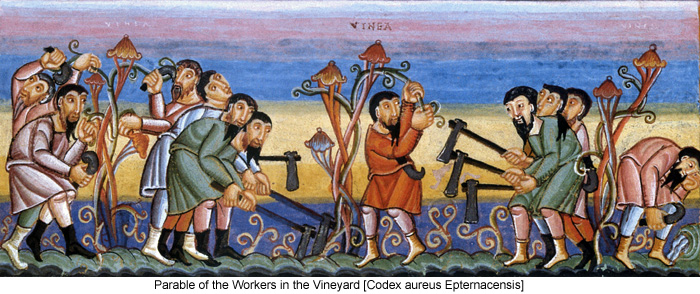
Caught in the Midst of Assumptions. It is interesting that it is the “manager” or “steward” (epitropos), not the owner, who calls the workers and “gives them their pay/reward” (misthos). They are the ones who dispense what the owner considers right and just. They are also the ones who take the flak from those who disagree. I think we can all relate to being the one thrust into the middle of something not necessarily of our own making. Continue reading
Monthly Archives: September 2014
Usual or Just?
Commentary. 1 “The kingdom of heaven is like a landowner who went out at dawn to hire laborers for his vineyard. 2 After agreeing with them for the usual daily wage, he sent them into his vineyard. 3 Going out about nine o‘clock, he saw others standing idle in the marketplace, 4 and he said to them, ‘You too go into my vineyard, and I will give you what is just.’ 5 So they went off. (And) he went out again around noon, and around three o‘clock, and did likewise. 6 Going out about five o‘clock, he found others standing around, and said to them, ‘Why do you stand here idle all day?’ 7 They answered, ‘Because no one has hired us.’ He said to them, ‘You too go into my vineyard.’ Continue reading
Colliding Worlds and Grace
Long (Matthew, Westminster Bible Companion) writes concerning the rich man story, which also applies to our text: “… we must realize that, when the young man encounters Jesus, two very different worlds collide: this world, with all its prevailing customs and values, and the radical new way of life called for in the kingdom of heaven.” [p. 220]
This radical life comes at a price. Peter understands that and so he asks, “what about us who have already given up everything,” Jesus points to the life within the kingdom and then concludes that the called-for reversal will also be evident in the order of blessing on entering the kingdom: “But many who are first will be last, and the last will be first.” (Mt 19:30) Continue reading
Assumptions about blessings
Matthew 20:1–16 1 “The kingdom of heaven is like a landowner who went out at dawn to hire laborers for his vineyard. 2 After agreeing with them for the usual daily wage, he sent them into his vineyard….
Context. In the Matthean narrative we are firmly ensconced in the midst of Jesus’ instructions, not of the crowds, but of the disciples, preparing them for not only his death and resurrection, but also for their mission to world. In other words Jesus is preparing them to be disciples – and preparing them to serve the new People of God being formed. Continue reading
A Posture in Life
Who among us wants to be known as a condescending person? I suspect that the likely answer is “no one among us.” In modern American English usage it has an almost exclusively negative connotation. Merriam-Webster definition of condescending is “showing or characterized by a patronizing or superior attitude toward others; showing that you believe you are more intelligent or better than other people.” In other words, a condescending person probably thinks that we should be considered honored that they would stoop from their position of power, privilege, and prestige to speak to us. I mean, really, is there a world in which being condescending is something we would want to imitate? Continue reading
The Triumph of the Cross
In the earliest days of Christianity, believers did not display the cross as a sign of their faith. The cross was the Roman implement for executing its worst criminals. The earliest Christians were well aware that the cross was a symbol in tension: humiliation of the manner of Jesus’ death and the triumph over sin which Jesus’ dying accomplished. In addition there was, what seemed to non-believers, the contradiction that a crucified man could also be God. And so, the earliest generations of Christians generally avoided depicting the body of Christ on the cross. Ironically, the oldest representation of the crucified Christ has been identified as a graffiti found on a wall in Rome in the second century C.E. In this blasphemous caricature, a pagan artist carved an outline of a man with a donkey’s head hanging on a cross. Another figure is paying homage and the caption reads, “Alexamenos worships his God.” Along with some other factors, divisions within Christianity over the nature of Jesus, the symbol of the cross was rarely seen in public until the fourth century. Continue reading
Born again? Born from above?
John 3:3 Jesus answered and said to him[Nicodemus], “Amen, amen, I say to you, no one can see the kingdom of God without being born anōthen”.
Born anōthen. The expression gennēthē anōthen can be translated as “born again” or “born from above.” Some bibles opt for the “again” (TLW), some opt for “again” with a footnote to explain there is an alternative (RSV, NIV, TEV, NASB, ESV, KJV). Others opt for “from above” without explanation (NAB, NJB) or with explanation as to the alternative (NSRV, CEV). Continue reading
Lifted up to Eternal Life
Picking up the dialogue between Nicodemus and Jesus in John 3, we hear
11 Amen, amen, I say to you, we speak of what we know and we testify to what we have seen, but you people do not accept our testimony. 12 If I tell you about earthly things and you do not believe, how will you believe if I tell you about heavenly things? 13 No one has gone up to heaven except the one who has come down from heaven, the Son of Man. 14 And just as Moses lifted up the serpent in the desert, so must the Son of Man be lifted up, 15 so that everyone who believes in him may have eternal life.” Continue reading
A different context in which to hear
Our gospel is given a different context in which to hear it proclaimed. The context is provided in using The Book of Numbers 21:4-9:
With their patience worn out by the journey, the people complained against God and Moses, “Why have you brought us up from Egypt to die in this desert, where there is no food or water? We are disgusted with this wretched food!” In punishment the LORD sent among the people saraph serpents, which bit the people so that many of them died. Then the people came to Moses and said, “We have sinned in complaining against the LORD and you. Pray the LORD to take the serpents from us.” So Moses prayed for the people, and the LORD said to Moses, “Make a saraph and mount it on a pole, and if any who have been bitten look at it, they will live.” Moses accordingly made a bronze serpent and mounted it on a pole, and whenever anyone who had been bitten by a serpent looked at the bronze serpent, he lived. Continue reading
How will we win them?
“If your brother sins against you, go and tell him his fault between you and him alone. If he listens to you, you have won over your brother. If he does not listen, take one or two others along with you, so that ‘every fact may be established on the testimony of two or three witnesses.’ If he refuses to listen to them, tell the church.” (Matthew 18:15-17)