The Good Shepherd: about

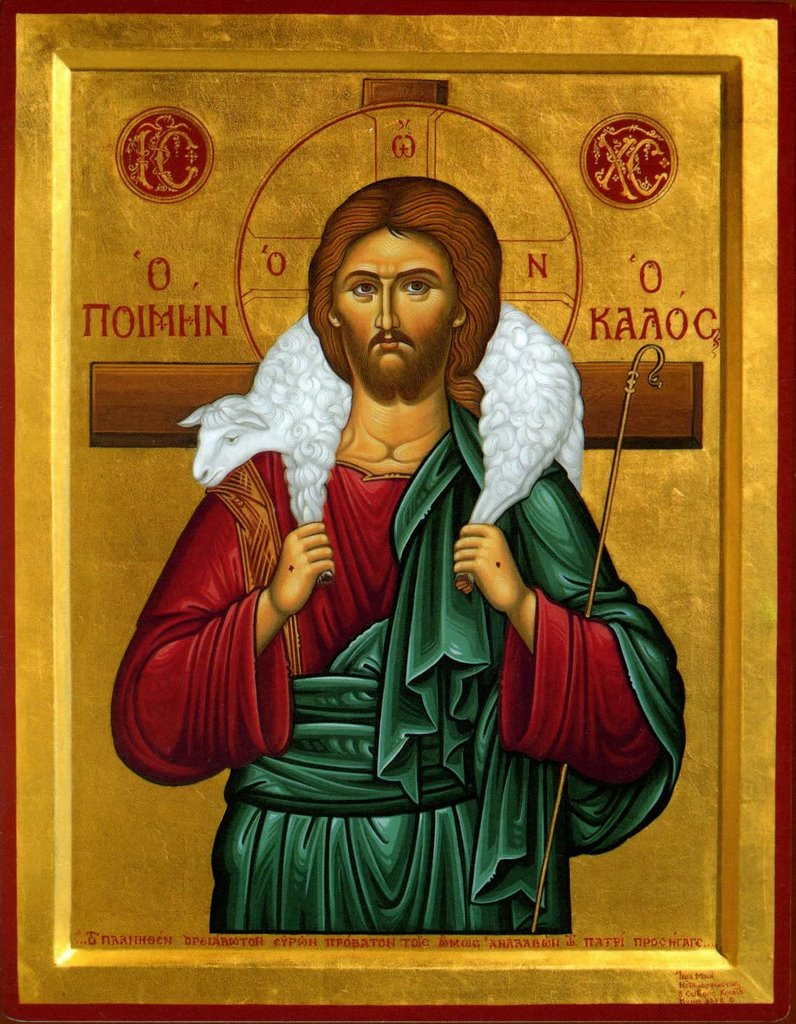
Christ the Good ShepherdSome thoughts about shepherds. Fr. James Martin, SJ, in his book Jesus: A Pilgrimage notes that most of Jesus’ parables are agricultural in nature, with some nod toward those who harvest the seas for their living; very few are rooted in his own livelihood, carpentry (or more specifically, tecton, a general term for one who works in the building/craft trades). Yet Jesus grew up in Nazareth amongst his neighbors who labored in those areas. Thus, Jesus, while himself not a farmer or fisherman would be familiar through his extended relationships. We are left to speculate the “common knowledge” about shepherds and the care of sheep and what ideas Jesus might have held. Continue reading

The Good Shepherd: context

Christ the Good Shepherd1 “Amen, amen, I say to you, whoever does not enter a sheepfold through the gate but climbs over elsewhere is a thief and a robber. 2 But whoever enters through the gate is the shepherd of the sheep.   3 The gatekeeper opens it for him, and the sheep hear his voice, as he calls his own sheep by name and leads them out. 4 When he has driven out all his own, he walks ahead of them, and the sheep follow him, because they recognize his voice. 5 But they will not follow a stranger; they will run away from him, because they do not recognize the voice of strangers.” 6 Although Jesus used this figure of speech, they did not realize what he was trying to tell them. 7 So Jesus said again, “Amen, amen, I say to you, I am the gate for the sheep. 8 All who came (before me) are thieves and robbers, but the sheep did not listen to them. 9 I am the gate. Whoever enters through me will be saved, and will come in and go out and find pasture. 10 A thief comes only to steal and slaughter and destroy; I came so that they might have life and have it more abundantly. Continue reading

Who could love us?

I AM the Good Shepherd3[Note: I am away on vacation! I though I would repost this – it seemed to fit the readings for today] 

I suspect that most of us here share a fundamental experience with sheep. First we confuse lambs and sheep. Most of us think about lambs who seem wonderfully cute, are gentle of spirit, and how can you not love them? I mean, really. And our experience is mostly limited to the petting zoo/farm context. I suspect that as children we turned to our moms and said: “Mom can we have one? I promise to feed him and take care of him….. please…!!”

I assume most of us here share another attribute – we are all city slickers, urban folk, and suburbanites. Which are all good things… but does not necessarily give us great insight into the lives of sheep or shepherds. Continue reading

Getting your bearings

he_qi_road_to_emmausEveryone is on a journey, but we are not always able to recognize it, to describe it, or to give it meaning. I can tell you from experience that you can transit the entire Pacific Ocean in a submarine and never experience motion or turbulence. It is more monastic enclosure than cruise liner. Be the journey marked by submarine, cruise liner, airplane, or other means, we all arrive at the same destination. But there are lots of things that can happen out in the broad expanse of the Pacific, just as things befall us in life. Just as things befall the disciples in today’s gospel. Continue reading

What now: witnesses

Luke-upper-roomPointing to the life in the Early Church. Since these disciples are to continue Jesus’ ministry, perhaps it is not surprising that they are to proclaim the salvific message “in his name.” In fact, what is done in the “name” of Jesus surfaces as an important motif in Acts. Luke will portray a community very much oriented around Jesus (1:1, 21–22)—with salvation offered to “everyone who calls on the name of the Lord” (= Jesus; cf. 2:21, 36), and people directed to be baptized “in the name of Jesus Christ” (2:38), appropriating the blessings available through and signaling their allegiance to him. Subsequently in Acts Christians heal (3:6, 16; 4:10, 30; 19:13), preach (4:12; 5:28, 40), and are baptized (8:16; 10:48; 19:5) in the name of Jesus; suffer for his name (5:41; 9:16; 21:13); and are those “who call upon the name” of Jesus (9:14, 21; 22:16). The mission role of the disciples is summarized in the words, “You are witnesses of these things.” Continue reading

Now what: proof

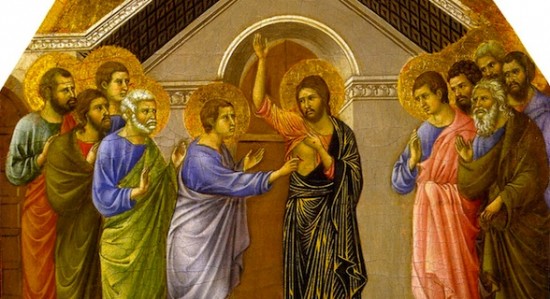
Luke-upper-roomOffering Proof. Jesus does not rebuke them for their lack of faith but offers two proofs of his own materiality as evidence of his resurrected existence. Negating two among the several possible categories for imagining the afterlife—one barbaric, the other more sophisticated—Luke first shows that Jesus’ disciples do not mistake him for a cadaver brought back to life (v.37), then confirms that Jesus is not an “immortal soul” free from bodily existence. It is why Jesus assures them with the phrase egō emini autos – “it is I myself” – or in modern English, “It’s really me!” Continue reading

Now what: terrified

Luke-upper-roomJesus had predicted his passion and death – and that those predictions have come to pass is all too apparent to the small community of disciples sequestered away in the upper room, unsure of all that has passed, and even more unsure of what awaits them. But Jesus had also predicted his resurrection. In this Lucan narrative Jesus manifests himself not only to selected individuals (vv. 31, 34) but to the whole company of his followers. Their reaction is less than stellar: But they were startled and terrified and thought that they were seeing a ghost. Only in the later Lucan account of the Ascension (vv.50–53) do fear, amazement, and doubt (vv.37, 41) give way to worship, great joy, and obedience. Continue reading

Now what – context

Luke-upper-room35 Then the two recounted what had taken place on the way and how he was made known to them in the breaking of the bread. 36 While they were still speaking about this, he stood in their midst and said to them, “Peace be with you.” 37 But they were startled and terrified and thought that they were seeing a ghost. 38 Then he said to them, “Why are you troubled? And why do questions arise in your hearts? 39 Look at my hands and my feet, that it is I myself. Touch me and see, because a ghost does not have flesh and bones as you can see I have.” 40 And as he said this, he showed them his hands and his feet. 41 While they were still incredulous for joy and were amazed, he asked them, “Have you anything here to eat?” 42 They gave him a piece of baked fish; 43 he took it and ate it in front of them. 44 He said to them, “These are my words that I spoke to you while I was still with you, that everything written about me in the law of Moses and in the prophets and psalms must be fulfilled.” 45 Then he opened their minds to understand the scriptures. 46 And he said to them, “Thus it is written that the Messiah would suffer and rise from the dead on the third day 47 and that repentance, for the forgiveness of sins, would be preached in his name to all the nations, beginning from Jerusalem. 48 You are witnesses of these things. 49 And (behold) I am sending the promise of my Father upon you; but stay in the city until you are clothed with power from on high.” Continue reading

The Divine Prom

christ-dancing-christianLast week I wrote that if Lent was about making “room for God” – and that is a good start – then the Easter season and beyond should be about coming to realize that God is the entire room! “God should be not merely the reference point but the whole context out of which we operate. God is not merely the source of our existence, he is the substance of our existence, the very life we have, and without God we would be lifeless, even if we are alive. Put another way, if Jesus is not Lord of all, he is not Lord at all.” Continue reading