God’s Kingdom Come

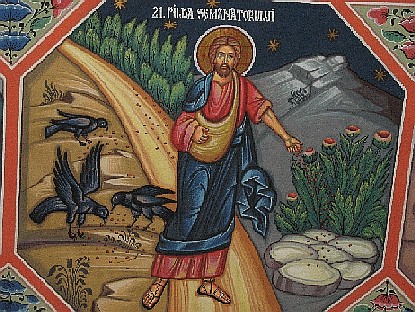
Sower“This is how it is with the kingdom of God; it is as if a man were to scatter seed on the land and would sleep and rise night and day and the seed would sprout and grow, he knows not how. Of its own accord the land yields fruit, first the blade, then the ear, then the full grain in the ear.” (Mark 4:26-28)

Sometimes I think we are too quick to be comforted by the Scriptures we hear in church and consider in Bible Study, like the parable above. Maybe it is about the wonder of faith or the need to be ready to bring in the harvest. Or it might be about our complete inability to control the coming kingdom as though our believing (or not) affects its coming. This second possibility is uncomfortable because it leaves us vulnerable. God’s kingdom comes apart from our efforts, cannot be controlled or influenced, and can only be received as a gift. In this sense, faith is apparently a lot more like falling in love than making a decision. Because faith, like love, is something that comes from the outside and grabs hold of you, whether you want it to or not. Continue reading

The Kingdom: from a seed

mustard_seedThe Parable of the Mustard Seed

30 He said, “To what shall we compare the kingdom of God, or what parable can we use for it? 31 It is like a mustard seed that, when it is sown in the ground, is the smallest of all the seeds on the earth. 32 But once it is sown, it springs up and becomes the largest of plants and puts forth large branches, so that the birds of the sky can dwell in its shade.” (Mark 4:40-32) Continue reading

Words that surprise

I love etymology – the study of the origin of words. Today’s word from Merriam-Webster is “bellwether.”  I have to admit I was surprised at the spelling. I never gave much thought to a word I know and hear, but rarely have seen written. I assumed it was “bellweather.”  Of course growing up I also thought the second month of the year was “Febuary” – think about it. Few people distinctly pronounce the “r” in February.

Before reading on, do you have any guesses as to the origin of the word? I am generally, “OK” if it is a Latin derivation, but Old English always surprises…Nonetheless – the origin of “bellwether”:  “We usually think of sheep more as followers than leaders, but in a flock one sheep must lead the way. Long ago, it was common practice for shepherds to hang a bell around the neck of one sheep in their flock, thereby designating it the lead sheep. This animal was called the bellwether, a word formed by a combination of the Middle English words belle (meaning “bell”) and wether (a noun that refers to a male sheep that has been castrated). It eventually followed that bellwether would come to refer to someone who takes initiative or who actively establishes a trend that is taken up by others. This usage first appeared in English in the 13th century.” (Merriam-Webster Word of Day for June 10, 2015)

Who knew?  Well… based on search for images to accompanying this post, I am perhaps the last soul on the face of the earth to know!

The Kingdom: of its own accord

parable_SowerMark alone records the parable of the “Seed that Grows Itself”

26 He said, “This is how it is with the kingdom of God; it is as if a man were to scatter seed on the land 27 and would sleep and rise night and day and the seed would sprout and grow, he knows not how. 28 Of its own accord the land yields fruit, first the blade, then the ear, then the full grain in the ear. 29 And when the grain is ripe, he wields the sickle at once, for the harvest has come.” Continue reading

The Kingdom: context

parable_Sower26 He said, “This is how it is with the kingdom of God; it is as if a man were to scatter seed on the land 27 and would sleep and rise night and day and the seed would sprout and grow, he knows not how. 28 Of its own accord the land yields fruit, first the blade, then the ear, then the full grain in the ear. 29 And when the grain is ripe, he wields the sickle at once, for the harvest has come.” 30 He said, “To what shall we compare the kingdom of God, or what parable can we use for it? 31 It is like a mustard seed that, when it is sown in the ground, is the smallest of all the seeds on the earth. 32 But once it is sown, it springs up and becomes the largest of plants and puts forth large branches, so that the birds of the sky can dwell in its shade.” 33 With many such parables he spoke the word to them as they were able to understand it. 34 Without parables he did not speak to them, but to his own disciples he explained everything in private. (Mark 4) Continue reading

Seeing with wonderment

wondermentI think my favorite comic strip of all time is “Calvin and Hobbes.” It was a simple comic strip featuring Calvin, a preternaturally bright six year-old, and Hobbes, his imaginary tiger friend. The comic strip managed to infuse wondering (and wandering) on a cosmic scale into an ageless world of lazy Sunday afternoons, space adventures, and tales of befuddled babysitters, teachers, and parents. What I most enjoyed about Calvin and Hobbes was that it reminded me of our innate human ability to be surprised, to imagine, and enter into mystery – and to do it with an amazing, incredibly open wonderment. Calvin’s openness to the mystery of it all allowed him entry to even the theological arts where he mused about the combination of predestination with procrastination, finally concluding, “God put me on this earth to accomplish a certain number of things. Right now I am so far behind that I will never die.” Continue reading

On the Sidewalk

forgivenessSunday is a day when it is easy to find a priest if you want to mention, ask, or chat about something. Most topics are simple and straight forward, but once in a while someone asks a question that is very different from the others. It is then that the conversation is too important to have on the sidewalk but is better suited to a moment when time is more available and others are not waiting to chat or to simply offer their greetings.

Some time ago, a person asked if I thought there are “times we need to forgive God?” My first reaction was, “Sorry, could you repeat that?” Definitely one of those “can we talk about this in the office?” questions. That is when the person let me know they were a visitor. The best I could offer in the moment was, “I will have to think about that.” Continue reading

Solemnity of Corpus Christi

Corpus Christi12 On the first day of the Feast of Unleavened Bread, when they sacrificed the Passover lamb, his disciples said to him, “Where do you want us to go and prepare for you to eat the Passover?” 13 He sent two of his disciples and said to them, “Go into the city and a man will meet you, carrying a jar of water. Follow him. 14 Wherever he enters, say to the master of the house, ‘The Teacher says, “Where is my guest room where I may eat the Passover with my disciples?”’ 15 Then he will show you a large upper room furnished and ready. Make the preparations for us there.” 16 The disciples then went off, entered the city, and found it just as he had told them; and they prepared the Passover. 17 When it was evening, he came with the Twelve. 18 And as they reclined at table and were eating, Jesus said, “Amen, I say to you, one of you will betray me, one who is eating with me.” 19 They began to be distressed and to say to him, one by one, “Surely it is not I?” 20 He said to them, “One of the Twelve, the one who dips with me into the dish. 21 For the Son of Man indeed goes, as it is written of him, but woe to that man by whom the Son of Man is betrayed. It would be better for that man if he had never been born.” 22 While they were eating, he took bread, said the blessing, broke it, and gave it to them, and said, “Take it; this is my body.” 23 Then he took a cup, gave thanks, and gave it to them, and they all drank from it. 24 He said to them, “This is my blood of the covenant, which will be shed for many. 25 Amen, I say to you, I shall not drink again the fruit of the vine until the day when I drink it new in the kingdom of God.” 26 Then, after singing a hymn, they went out to the Mount of Olives. (Mark 14:12-25) Continue reading