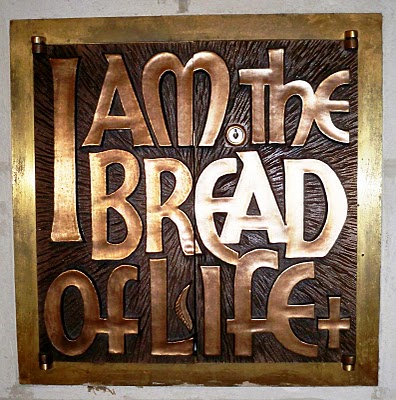
51 I am the living bread that came down from heaven; whoever eats this bread will live forever; and the bread that I will give is my flesh for the life of the world.” 52 The Jews quarreled among themselves, saying, “How can this man give us (his) flesh to eat?” 53 Jesus said to them, “Amen, amen, I say to you, unless you eat the flesh of the Son of Man and drink his blood, you do not have life within you. 54 Whoever eats my flesh and drinks my blood has eternal life, and I will raise him on the last day. 55 For my flesh is true food, and my blood is true drink. 56 Whoever eats my flesh and drinks my blood remains in me and I in him. 57 Just as the living Father sent me and I have life because of the Father, so also the one who feeds on me will have life because of me. 58 This is the bread that came down from heaven. Unlike your ancestors who ate and still died, whoever eats this bread will live forever.” (John 6:51-58) Continue reading
Monthly Archives: August 2015
Do you get it?
Ever been in a conversation with someone – usually not an easy conversation – when the other person, exasperated with you, the conversation, or whatever just blurts out, “You just don’t get it, do you?” ….and “boom” there it is… the end of the conversation. Continue reading
Tipping our faith
There are little things that can make a big difference. That is the gist of the sub-title of Malcolm Gladwell’s best-selling book, “Tipping Point.” As Gladwell points out, it is the context, the people, the nature of the thing itself, and other factors, which contribute to a tipping point. Merriam-Webster defines “tipping point” as “the critical point in a situation, process, or system beyond which a significant and often unstoppable effect or change takes place.” Continue reading
Bread of life: eating
Eating the Living Bread. 47 Amen, amen, I say to you, whoever believes has eternal life. 48 I am the bread of life. 49 Your ancestors ate the manna in the desert, but they died; 50 this is the bread that comes down from heaven so that one may eat it and not die. 51 I am the living bread that came down from heaven; whoever eats this bread will live forever; and the bread that I will give is my flesh for the life of the world.”
The expression “Amen, amen, I say to you” (v. 47) also signals the beginning of a new section in the discourse (as before in 5:19, 24–25; 6:32). Yet this section opens with a reprise of familiar Johannine themes: The believer receives eternal life (6:27, 40); Jesus is the bread of life (6:35). These themes provide the theological grounding for what follows. As in 5:19–30, here the Fourth Evangelist advances Jesus’ argument by placing what Jesus has said previously in a new context. The interweaving and overlapping of theological themes evident here and throughout Jesus’ discourses help to create a cohesiveness of theological perspective throughout the Fourth Gospel Continue reading
Bread of life: drawn
Coming to the Lord. 43 Jesus answered and said to them, “Stop murmuring among yourselves. 44 No one can come to me unless the Father who sent me draw him, and I will raise him on the last day.
Jesus now addresses the crowd for a second time and tells then to stop their grumbling. Then he repeats the saying of v.37, but in a slightly stronger form. In v.37 the word “come” (hēxei) is future, active voice and means that the person (subject) will be in the process of “coming.” But in v.44 the subject is God who will helkysē (draw, haul by force – EDNT v.1:435) the person to him. Continue reading
Bread of life: grumbling
The Grumbling. 41 The Jews murmured about him because he said, “I am the bread that came down from heaven,” 42 and they said, “Is this not Jesus, the son of Joseph? Do we not know his father and mother? Then how can he say, ‘I have come down from heaven’?”
Jesus’ words were not what the people wanted to hear. From the miraculous feeding of the 5,000 to the crowd’s references to mana in the desert, the context has been about bread they could eat. However, from v.35 onward, it is clear that Jesus’ meaning is about belief in himself, the one provides bread from heaven that last forever. The people are beginning to understand that they are not getting more bread and that this person before them is claiming to be someone greater than Moses. They rebel against the claims implied in what he said, feeling that they know very well who he is. In the face of this Jesus emphatically repeats his words. And the people grumble some more. Continue reading
Bread of life: losing nothing
A Missing Piece. The sequence of Sunday gospels does leave out vv. 35-41. The text from the 18th Sunday centers around Jesus challenging the people’s motivation for coming to Jesus. He tells them they only came to see more signs, eat their fill, but not really “work” for the bread that is eternal. The people not only do not understand Jesus’ point, but become bogged down in “what do I have to do to get it” as though they could accomplish this on their own talents and perseverance. Jesus response is that all one need do is believe – and the conversation returns to “show us another sign” and they up the ante – “and make it better than the one Moses did in the desert.” Dodd notes that “The ‘signs’ which the people expect from the Messiah are mere miracles; yet when they see a miracle they fail to see the ‘sign’; for to the evangelist a σημεῖον is not, in essence, a miraculous act, but a significant act, one which, for the seeing eye and the understanding mind, symbolizes eternal realities.” It is at this juncture that returns to the theme of “bread from heaven” only not the one, like the manna in the desert that will spoil, but one that last forever. Continue reading
Bread of life: context
41 The Jews murmured about him because he said, “I am the bread that came down from heaven,” 42 and they said, “Is this not Jesus, the son of Joseph? Do we not know his father and mother? Then how can he say, ‘I have come down from heaven’?” 43 Jesus answered and said to them, “Stop murmuring among yourselves. 44 No one can come to me unless the Father who sent me draw him, and I will raise him on the last day. 45 It is written in the prophets: ‘They shall all be taught by God.’ Everyone who listens to my Father and learns from him comes to me. 46 Not that anyone has seen the Father except the one who is from God; he has seen the Father. 47 Amen, amen, I say to you, whoever believes has eternal life. 48 I am the bread of life. 49 Your ancestors ate the manna in the desert, but they died; 50 this is the bread that comes down from heaven so that one may eat it and not die. 51 I am the living bread that came down from heaven; whoever eats this bread will live forever; and the bread that I will give is my flesh for the life of the world.” (John 6:41-51) Continue reading
Good things and best things
A few Super Bowls past, Snickers candy bars began a clever ad campaign. One ad showed 4 people in a car driving through desert landscape. Three of the people were young men in their 20’s, but the fourth was a high maintenance complaining passenger (played by Aretha Franklin) who was moaning about everything – “Can you turn up the AC? I’m dying back here.” When a passenger in the front tells them that the AC is on high, “Can’t you feel it?” He is rewarded with a smack on the back of the head, “Can you feel that?” The backseat companion encourages the complainer to eat a snickers because “When you’re hungry you turn into a diva.” After eating a Snickers candy bar provided by the concerned friend, the diva is transformed back into themselves and indicates that they are “better” …. But still their old selves, just one not complaining at the moment. Continue reading
Something about angels
I think most people know that the expression, “City of Angels”, refers to Los Angeles, CA. But did you know that the name is only the shortened form of the original city name, which grew up around one of the Franciscan missions? The original name of the pioneer town was, “El Pueblo de Nuestra Señora la Reina de los Ángeles de Porciúncula,” (in English, “City of Our Lady the Queen of Angels of the little Portion”). Both “Our Lady Queen of the Angels” and “the little Portion” are steeped in the earliest history of the Franciscan Order. For that we return to the 13 th century and the life of St. Francis of Assisi. Continue reading