A Shared Vision

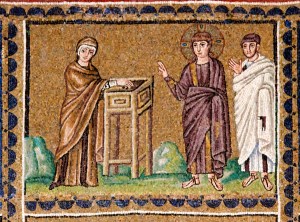
Sant'Apollinare Nuovo, RavennaOur gospel is known as the story of the Widow’s Mite. As you just heard, a widow donates two small coins, while wealthy people donate much more. A common explanation of the story is that Jesus praises the poor widow and holds her up as an example to us all because she gave “her whole livelihood.” So even though the rich people gave more, it was just for show and only from their chump change. Not the widow, she is “all in” in what she gives to God. The moral of the story is that small sacrifices of the poor mean more to God than the extravagant donations of the rich. And so I could have a seat at this point, leave you to think about your weekly offering, your APA pledge… are you giving chump change, or are your contributing your whole livelihood? I could (hey I just did!) but there is more here than meets the eye. Continue reading

Why the Incarnation

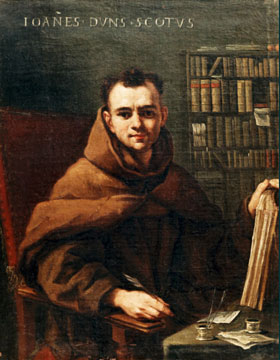
Duns Scotus1On November 8th, the Church and the Franciscan world celebrate the feast of Blessed John Duns Scotus, a friar and medieval theologian/philosopher.  Not a household name, Scotus is best known for his philosophical writings, but it is his theological perspective that has left the most impact.  His theological writings on Mary form the basis for how we understand the Feast of the Immaculate Conception, and his writings on the preeminence of Christ are the basis for the celebration of the Solemnity of Christ the King. Continue reading

Bl. John Duns Scotus

Duns Scotus1November 8th is the feast day of Blessed John Duns Scotus, a Franciscan friar from Scotland noted for his theological and philosophical work in the high-middle ages (late 13th and early 14th centuries). Scotus’ work was in the generation that followed Thomas of Aquinas and Bonaventure. His work was complex and nuanced, and he is generally considered to be one of the three most important philosopher-theologians of his time. He was given the medieval accolade Doctor Subtilis (Subtle Doctor) for his penetrating and subtle manner of thought. Continue reading

Contagious Gratitude

GratitudeI don’t remember – it has been so long now – but somewhere, sometime ago, I began to start emails, letters, cards and the like with the same phrase: “May the grace and peace of Christ be with you.” It is an expression that begins many of St. Paul’s letters, in one form or another, e.g., Galatians 1:3. It is not a scripted beginning; there is a great deal of intention about it. There are times when I am in a hurry, responding to emails, that I am reminded at the end to return to the beginning and insert the greeting. It often leads to editing of the email if there is some part that does not have grace or peace about it. Continue reading
Widow’s mite: exit

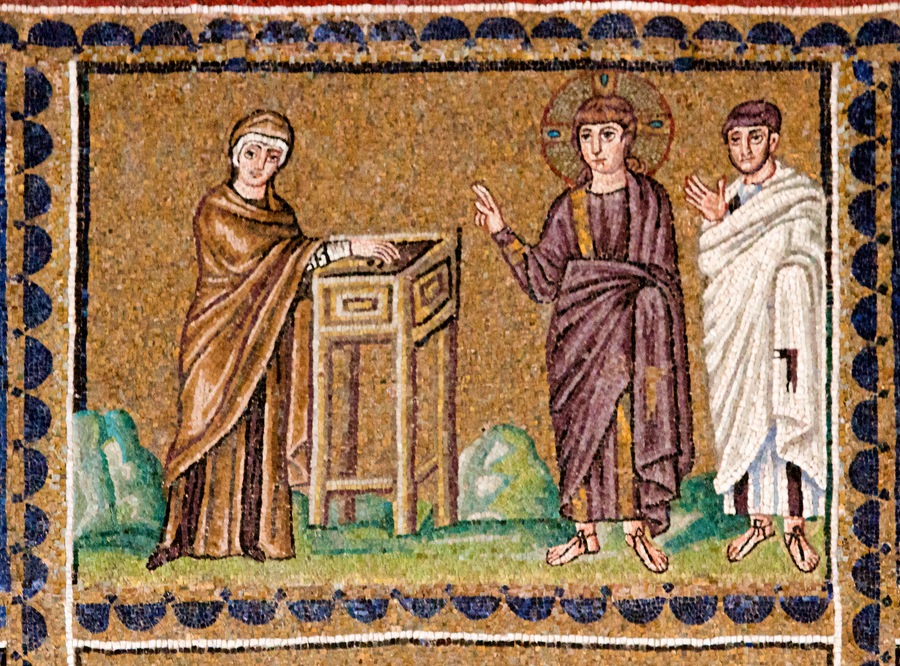
Sant'Apollinare Nuovo, RavennaThe Poor Widow and Jesus. 41 He sat down opposite the treasury and observed how the crowd put money into the treasury. Many rich people put in large sums. 42 A poor widow also came and put in two small coins worth a few cents. 43 Calling his disciples to himself, he said to them, ‘Amen, I say to you, this poor widow put in more than all the other contributors to the treasury. 44 For they have all contributed from their surplus wealth, but she, from her poverty, has contributed all she had, her whole livelihood.’

We are conditioned to consider that Jesus is continuing his castigation of the scribes (religious leaders who use their position for their own gain) and their social counterparts, many rich people. By juxtaposition we then infer that the poor widow is praised for her giving of her whole livelihood and placing here full dependence upon God. We infer that, and perhaps rightly so, but there are many Continue reading

Widow’s Mite: devouring

Sant'Apollinare Nuovo, RavennaInjustice via God’s Name. 40 They devour the houses of widows and, as a pretext, recite lengthy prayers. They will receive a very severe condemnation.

Perkins [682] notes that the charge that the scribes “devour the houses of widows” (v. 40) also seems more characteristic of prophetic charges against the rich than of a particular role played by scribes. Some interpreters have hypothesized that scribes might have acted as guardians for widows who lacked male relatives. Others suggest that they may have accepted hospitality from widows under the pretense of piety in order to support their tastes for wealth and power. When he sent them out to preach, Jesus prohibited his own disciples from accumulating wealth or moving from the first household to take them in (6:8–10). Jesus also constantly warned his own disciples against seeking honor rather than serving others (9:33–35; 10:42–45). Mark’s Roman/Gentile readers were not likely to have had dealings with scribes, but they could recognize the same characteristics among others. The wandering Cynic philosophers who frequented Greco-Roman cities often castigated other philosophers whose wealthy patrons provided luxurious clothes, sumptuous food, and social honor. Continue reading

Widow’s mite: scribes

Sant'Apollinare Nuovo, Ravenna38 In the course of his teaching he said, ‘Beware of the scribes, who like to go around in long robes and accept greetings in the marketplaces, 39 seats of honor in synagogues, and places of honor at banquets. 40 They devour the houses of widows and, as a pretext, recite lengthy prayers. They will receive a very severe condemnation.’

There is always a pause when I read this passage. Being a Franciscan Friar, I go around in long robes, inevitably accept greetings as I move out and about, whether I want it or not, I end up in the places of honor at banquets, and in the church, and I occupy the ‘big chair’ reserved for the presider at Mass. During Mass, some parishioners might accuse me of reciting lengthy homilies  (hopefully not as a pretext). The only part for which I am hopefully safe is devouring the houses of widows. Perhaps it is cautionary pause. Continue reading

Widow’s Mite: poverty

Sant'Apollinare Nuovo, Ravenna42 A poor widow also came and put in two small coins worth a few cents.

Widows. Lurking in the background of our reading is the first-century Jewish system of levirate marriages (Gen 38 and Deut 25:5-10). In short if a man dies without leaving a son, his widow is forbidden to marry outside his family. One of her deceased husband’s brothers must assume the duty of the levir, taking her as his wife. The first male of this second union is considered the son of the deceased brother. Continue reading

Widow’s Mite: context

Sant'Apollinare Nuovo, Ravenna38 In the course of his teaching he said, ‘Beware of the scribes, who like to go around in long robes and accept greetings in the marketplaces, 39 seats of honor in synagogues, and places of honor at banquets. 40 They devour the houses of widows and, as a pretext, recite lengthy prayers. They will receive a very severe condemnation.’ 41 He sat down opposite the treasury and observed how the crowd put money into the treasury. Many rich people put in large sums. 42 A poor widow also came and put in two small coins worth a few cents. 43 Calling his disciples to himself, he said to them, ‘Amen, I say to you, this poor widow put in more than all the other contributors to the treasury. 44 For they have all contributed from their surplus wealth, but she, from her poverty, has contributed all she had, her whole livelihood.’ (Mark 12:38–44) Continue reading

Saints, known and unknown

angelico-saints-martyrsToday we celebrate, remember, and honor all the saints, known and unknown. Back in the earliest days of the Church, martyrs were especially esteemed. The local church celebrated the anniversary of a martyr’s death in the name of Christ – on the anniversary date and in the place of martyrdom – it was all part of what people just knew. By the 4th century the list of martyrs was very much longer and the Church was caught between its desire to remember and celebrate the martyr’s witness and death, an ever-expanding geography, and the practical matter of finding days to set aside to celebrate. Very soon there was a movement to find a common day to celebrate martyrs that were important to the Church while leaving the local communities to set aside days for martyrs that loomed larger in local memory. Continue reading