
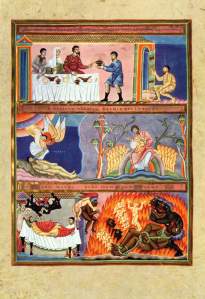
19 “There was a rich man who dressed in purple garments and fine linen and dined sumptuously each day. 20 And lying at his door was a poor man named Lazarus, covered with sores, 21 who would gladly have eaten his fill of the scraps that fell from the rich man’s table. Dogs even used to come and lick his sores. 22 When the poor man died, he was carried away by angels to the bosom of Abraham. The rich man also died and was buried, 23 and from the netherworld, where he was in torment, he raised his eyes and saw Abraham far off and Lazarus at his side. 24 And he cried out, ‘Father Abraham, have pity on me. Send Lazarus to dip the tip of his finger in water and cool my tongue, for I am suffering torment in these flames.’ 25 Abraham replied, ‘My child, remember that you received what was good during your lifetime while Lazarus likewise received what was bad; but now he is comforted here, whereas you are tormented. 26 Moreover, between us and you a great chasm is established to prevent anyone from crossing who might wish to go from our side to yours or from your side to ours.’ 27 He said, ‘Then I beg you, father, send him to my father’s house, 28 for I have five brothers, so that he may warn them, lest they too come to this place of torment.’ 29 But Abraham replied, ‘They have Moses and the prophets. Let them listen to them.’ 30 He said, ‘Oh no, father Abraham, but if someone from the dead goes to them, they will repent.’ 31 Then Abraham said, ‘If they will not listen to Moses and the prophets, neither will they be persuaded if someone should rise from the dead.’” Continue reading
Monthly Archives: December 2015
Year of Mercy
Pope Francis has announced a Year of Mercy that began last Tuesday, December 8th . The Holy Father has asked that it be a church-wide celebration and reflection on God’s mercy, so that we can intentionally be sources of that Mercy in the world.
The logo of the celebration comes from Luke 6:36, “Be merciful as the Father is merciful,” that appears alongside an image that deserves some inspection and reflection. The logo is oddly shaped – rather looking like an almond. The almond shape, called a mandorla, was a feature of early and medieval iconography. When used with the image of Christ, it invites the viewer to reflect on the two natures of Christ, divine and human. The differing color bands of blue, increasingly darker as one moves inward is also a recurring theme in these icons. It reflects what is called the “apophatic way” on reflecting on God. In the apophatic way, it acknowledges that there is mystery at the center of the way – a mystery that is, in the end, impenetrable, but nonetheless calls us ever inward in reflection. At the center of the darkest color, where Jesus’ feet are positioned, is the great mystery of the Incarnation – that in the person of Jesus, humanity and divinity are joined: “And the Word became flesh and made his dwelling among us, and we saw his glory, the glory as of the Father’s only Son, full of grace and truth.” (John 1:14) Continue reading
Guadalupe
Today it is common to find villages, towns, cities, and even districts in Mexico, Central and South America named “Guadalupe.” But in the year 1531 there was no such place in Mexico. So, I have always wondered why the appearance of the Blessed Virgin Mary is referred to as “Our Lady of Guadalupe.”
Guadalupe is the name of an area, a city, a river, and a Marian shrine in Spain. The word itself comes from a mixture of Arabic and Latin roots. Remember that Spain was occupied in part and whole by an Islamic regime from 720 CE until 1492 CE, hence many words have Arabic origin. The Arabic wadi (seasonal river bed) became the Spanish “quadi” having the same meaning. “Quadi” seems to have been combined with the Latin lupus (wolf) to come up with Guadalupe. Continue reading
Prodigal Son: coming to ourselves
Final Thoughts (from Culpepper, 304-5)
It is no hyperbole to say that this parable is a gem; all of its facets deserve to be considered. It is no simple simile with a single point but a compressed slice of life with complexity and texture. In the following paragraphs, we will take note of various of the parable’s facets, but in preaching the interpreter should probably avoid such a “shotgun” approach and develop only one or two themes for emphasis. Let the parable be one of those beloved texts that always repays a return visit. Continue reading
Prodigal Son: the father
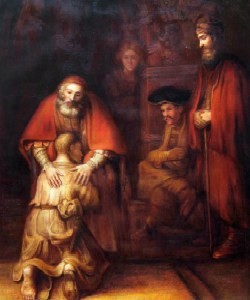
The Homecoming of the Son and Welcome by His Father. Tashjian notes “As Westerners we cannot really understand what the father has done unless we put ourselves in the context of Eastern culture and way of thinking. The son had dishonored his father and the village by taking everything and leaving. When he returns in tattered clothes, bare-footed and semi-starved, he would have to get to the family residence by walking through the narrow streets of the village and facing the raised eyebrows, the cold stares, the disgusted looks of the town people. So when the son is still far off, before he has entered the outskirts of the village, the father sees him and decides immediately what he must do. In compassion for his son and to spare him the pain of walking through the gauntlet of the town alone, he runs to him, falls on his neck, and kisses him.” Continue reading
Prodigal Son: what was lost
The Departure of the Younger Son. The parable begins with the younger son asking for what he considers his share of the inheritance – something that is for the father to decide. In the asking, the son communicates that he does not view the inheritance as a gift given because of his father’s good graces; rather he sees it as his due.
Kenneth Bailey, a NT scholar who lived for years in the Middle East, asked many people in the Near East cultures how one is to understand the younger son’s request. The answer is consistent and harsh: the son would rather have his father dead so as to gain the inheritance. In an honor/shame society it would be appropriate to ask, “What father having been asked by a son to give him inheritance…” Again the Lucan answer is not the answer of the society. The father grants the request. Where the younger son asks for “the share of your estate (ousia) that should come to me.” Luke tells us that the father “divided between them his property (bios, literally “life” – see note on 15:12).” Continue reading
Prodigal Son: inherit
11 Then he said, “A man had two sons, 12 and the younger son said to his father, ‘Father, give me the share of your estate that should come to me.’ So the father divided the property between them. 13After a few days, the younger son collected all his belongings and set off to a distant country where he squandered his inheritance on a life of dissipation. 14 When he had freely spent everything, a severe famine struck that country, and he found himself in dire need. 15 So he hired himself out to one of the local citizens who sent him to his farm to tend the swine. 16And he longed to eat his fill of the pods on which the swine fed, but nobody gave him any. 17Coming to his senses he thought, ‘How many of my father’s hired workers have more than enough food to eat, but here am I, dying from hunger. 18I shall get up and go to my father and I shall say to him, “Father, I have sinned against heaven and against you. 19I no longer deserve to be called your son; treat me as you would treat one of your hired workers.”‘ 20So he got up and went back to his father. While he was still a long way off, his father caught sight of him, and was filled with compassion. He ran to his son, embraced him and kissed him. 21His son said to him, ‘Father, I have sinned against heaven and against you; I no longer deserve to be called your son.’ 22But his father ordered his servants, ‘Quickly bring the finest robe and put it on him; put a ring on his finger and sandals on his feet. 23 Take the fattened calf and slaughter it. Then let us celebrate with a feast, 24 because this son of mine was dead, and has come to life again; he was lost, and has been found.’ Then the celebration began. 25Now the older son had been out in the field and, on his way back, as he neared the house, he heard the sound of music and dancing. 26He called one of the servants and asked what this might mean. 27 The servant said to him, ‘Your brother has returned and your father has slaughtered the fattened calf because he has him back safe and sound.’ 28He became angry, and when he refused to enter the house, his father came out and pleaded with him. 29 He said to his father in reply, ‘Look, all these years I served you and not once did I disobey your orders; yet you never gave me even a young goat to feast on with my friends. 30 But when your son returns who swallowed up your property with prostitutes, for him you slaughter the fattened calf.’ 31 He said to him, ‘My son, you are here with me always; everything I have is yours. 32 But now we must celebrate and rejoice, because your brother was dead and has come to life again; he was lost and has been found.’” Continue reading
The Immaculate Conception
It’s important to understand what the doctrine of the Immaculate Conception is and what it is not. Some people think the term refers to Christ’s conception in Mary’s womb without the intervention of a human father; but that is the Virgin Birth. Others think the Immaculate Conception means Mary was conceived “by the power of the Holy Spirit,” in the way Jesus was, but that, too, is incorrect. The Immaculate Conception means that Mary, whose conception was brought about the normal way, was conceived without original sin or its stain—that’s what “immaculate” means: without stain. The essence of original sin consists in the deprivation of sanctifying grace, and its stain is a corrupt nature. Mary was preserved from these defects by God’s grace; from the first instant of her existence she was in the state of sanctifying grace and was free from the corrupt nature original sin brings. Continue reading
Prodigal Son: context
Luke 15 is one of the most unique chapters in the Gospels in that it consists of three memorable parables: the Lost Sheep, the Lost Coin, and the Prodigal Son. Many commentators locate these three parables (Luke 15) within a larger section of Luke that asks the question “who will participate in the reign of God?” (13:10-17:10). The section includes the foundational formation of the disciples – but often via the encounter with the Pharisees in which the assumptions of right relationship with God are put to the question. The Pharisees and others in the Jewish religious leadership assume folks such as tax collectors and sinners are outside the “faithful remnant” that awaits the return of the Messiah. At issue is the question of fellowship in the community of God’s people. Each encounter in this larger section seems to be an opportunity to form the disciples (and anyone who would listen) in the understanding of the reign of God. Continue reading
A Road Map
This past May I was visiting friends and relatives in the Washington DC area. I got to spend a couple of days out in Loudoun County, Virginia, to the north and west out along the Potomac River. I used to own a home out in those parts in a little hamlet two wrong turns off the dirt road. After growing up in Florida and always living near the ocean, suddenly I was inland and living on the first ridge of the Blue Ridge Mountains. I also managed to set up house in a country without a public swimming pool. After I-can’t-remember-how-many years of swimming, I suddenly needed a new sport. Continue reading