
I was not a young man when I was ordained. I had served as a naval officer on nuclear submarines, worked in the private sector, started companies, sold companies, and all the while been active as a lay volunteer in many aspects of ministerial service to young, old, sick, dying, healthy and all the things that make up parish life.
In a story for another time, I left all that aside for just a while (so I thought) to become a lay missioner. I served for three years in the slums of Nairobi in aspects of ministerial service to young, old, sick, dying, healthy and all the things that make up parish life – in the largest slum in sub-Saharan Africa and with Kenyans and with refugees from the interhamwe of Rwanda.
Life for me was changed. Continue reading
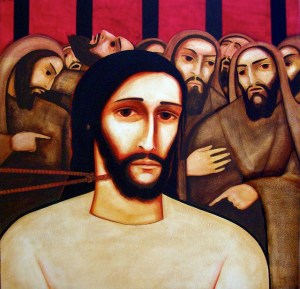 Up to this point in the narrative the chief priests, scribes, and leaders have been the ones who have been active throughout the arrest, hearing and trials of Jesus. While in the privacy of the Sanhedrin gathering, the charges brought against Jesus by this group were religious. Once the assembly moved to the public forum involving Pilate, the charges became secular – “misleading our people; he opposes the payment of taxes to Caesar and maintains that he is the Messiah, a king.” (23:2) In the start of this section, “the people” are now present. Previously the people have supported Jesus (cf. 19:47-48, 20:1, 20:6, 20:19, 21:38) – what will they do now?
 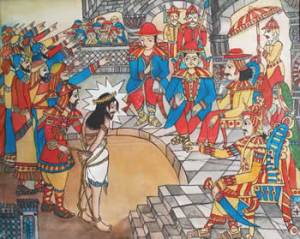 Alan Culpepper commented that reading the arrest and trials of Jesus is, for him, like watching film footage of John Kennedy’s motorcade winding through Dallas in 1963 or the 1986 launch of the Challenger space shuttle. We know what is coming, we know we have no power to undo them, but are compelled to watch because we honor the loss of great people doing what was theirs to do.
 Where in the scene of Peter’s Denial (Luke 22:54-65), the focus and center of the narrative was Peter, here the focus returns to Jesus. Is this trial (hearing, meeting) by the religious authorities of Jerusalem, the role of Jesus as prophet and Messiah is at the forefront of the narrative. Jesus had foretold the primary events of this scene—both Peter’s threefold denial before the crowing of the cock (v. 34; vv. 56–61) and his own maltreatment (esp. 18:32; cf. 20:10–11 and 22:63–65).
  The arrest of Jesus leads into three successive and connected scenes: Peter’s denial (vv. 54-62), the mocking of Jesus (vv. 63-65), and the trial before the religious authorities (vv. 66-71). What is interesting is that in the midst of the Passion narrative of Jesus, there is the scene in all four gospels that concentrate on Peter and his response. Luke’s account is unique in the following respects: sequence – in that the denials occur in the courtyard before the mocking and interrogation; structure – Luke does not connect the denial as a caused by the trial; and detail – such as the servant girl sitting at the fireside where there is light to clearly recognize Peter – and most vividly, it is Luke that reports Jesus looked Peter “dead in the eye,” bringing the full gravitas of the denials to Peter.
 Of course we all know that after the meal with his disciples that Jesus went to the Garden of Gethsemane. Actually, no gospel says that. Matthew and Mark wrote that he went to a garden. John says he went to Gethsemane. Fuse them all together and you get the “Garden of Gethsemane.” What does Luke say? Luke only calls it “the place.” There is no garden specifically mentioned nor is Gethsemane. Is it important? Well, it is a reminder to be attentive to the text before you and not meld the familiar stories and scenes from other sacred writers. Each sacred writer has something distinctive that can be missed if one fuses all the details from other accounts.
  “When I was a child I used to walk five miles to school in the snow, just to let them know that I was too sick to come to school that day.” So my father used to tell me. Hmmm…? Really – but hey, dad was really old, right? He probably grew up in the ice age and maybe the weather was very different back then. Such are the stories of our youth as parents try to teach us the lessons of life, sometimes wrapped in yarns, tall-tales, and memories of a different time and place. I still wonder how the to-and-from the store was uphill both ways.
 Introduction to The Lucan Passion Narrative: The passion narratives provide the climax for each of the four gospels, catching up themes that weave their way through the evangelists’ entire portrayal of Jesus life and bringing them to a dramatic completion. In deft strokes the evangelists tell us of the final hours of Jesus’ life – his last meal with his disciples; his arrest in Gethsemane; his interrogation by the religious leaders; the trial before Pilate; and finally the heart clutching scenes of Jesus’ crucifixion, death and burial.
  friarmusings