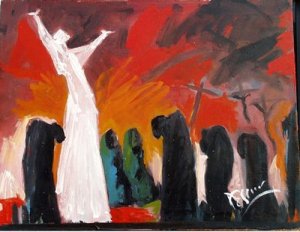
 As a liturgical season, Lent is rather straightforward. It is kinda’ easy to write about. There is Ash Wednesday to dramatically mark its beginning, and we all know we are moving relentlessly towards Easter. We count the days even as we mark Lent’s beginning. The Ashes make a visible mark upon us, reminding us that we are dust and to dust we shall return – but that is not the end of the story. We are reminded to repent and believe in the Gospel – but that is not the end goal. We are encouraged to pray, fast, and give alms – but those practices are meant to make room in our lives for God that we too may rise to the newness of life at Eastertide.
Perhaps some will wonder why I did not write, “the newness of life at Easter.” Isn’t Easter that day when we celebrate Jesus’ being raised from dead? Isn’t Easter the finish line, the ultimate, the highest of the high holy days, the pinnacle of the Church’s liturgical celebrations? No, yes, yes, and yes. Easter is not the finish line. Allow me some poetic license here, but Easter is to Eastertide, what Ash Wednesday is to Lent. It is the day we begin to count.
Eastertide is the 50-day season beginning on Easter Sunday with a dramatic mark in the celebration of the Resurrection of Christ, relentlessly moving to Pentecost Sunday. Easter and Pentecost correspond to two Jewish holy days, the first day of Pesach and the holiday of Shavu’ot. In the Jewish tradition, the days between these holidays are known as Counting of the Omer. The idea of counting each day represents spiritual preparation and anticipation for the giving of the Law to Moses on Mount Sinai.
Easter is not the finish line, but the “Ash Wednesday” of Eastertide when we again begin to count, to spiritually prepare and anticipate the giving of the Spirit on Pentecost. If in Lent we have traditional practices to help prepare us to celebrate the Risen Christ, what are we practicing in Eastertide? I think the answer is profoundly simple: we practice what we witnessed on Easter – resurrection.
The Catholic writer, Megan McKenna, has a wonderful vignette about practicing resurrection in her book, Not Counting Women and Children: Neglected Stories from the Bible. She had shared in a Bible study, “that life happens when we are interrupted, and that some of the most powerful acts of resurrection happen to the least likely people; that we are the people of resurrection and hope, called to live passionately and compassionately with others, to defy death, to forgive, and to bring others back into the community, to do something that is life-giving, that fights death and needless suffering.” It is at this point that someone asks, somewhat harshly, “Have you ever brought someone back from the dead.” I love her answer: “My response was, ‘Yes … Every time I bring hope into a situation, every time I bring joy that shatters despair, every time I forgive others and give them back dignity and the possibility of a future with me and others in the community, every time I listen to others and affirm them and their life, every time I speak the truth in public, every time I confront injustice — yes — I bring people back from the dead.”’
If in Lent we made room for God, here in Eastertide we work with Christ, practicing what he has already shown us: newness of life. And so we practice resurrection in our own lives by introducing joy, forgiveness, listening, justice, compassion… and so much more. And we count the days to Pentecost when the Spirit is given that we may take the honed skills of resurrection into a waiting world.


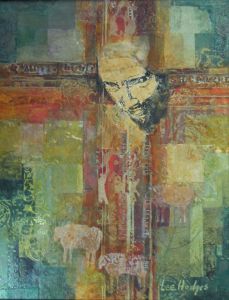 Here on this 4th Sunday in Easter, our diocese and the US Bishops’ conference have asked us to speak about vocations to the priestly life. To echo the voice of the Good Shepherd calling those to a life of dedicated service of the community of God – to follow Christ more closely through life as an ordained priest. And to answer this call in troubled times. A time in our life when the church faces questions about a growing worldwide crisis caused by priests and bishops that has continued to flow onto the headlines of the world’s newspaper for almost 15 years now. It is a time when the question lingers on the periphery “Why would anyone want to become or remain Catholic today?” and its more focused parallel: “Why would a man want to become or remain a priest today?”
  Two days ago, the 256-page, 60,000-word papal exhortation, The Joy of Love, was released to the waiting world. Since then, I have been asked for comments, quotes, opinions, and insight. Here is about all that I can respond: “Thanks for asking, but I haven’t had the chance to read it.” … or think about it, or pray about it, or muse about its content. So, have I read Pope Francis’ exhortation? Not yet.
 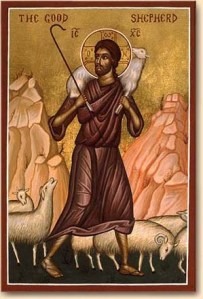 Being Given. In v.29 it is clear that it is the Father who has given the sheep to Jesus. This small part of one verse, when reflected upon can be a quite challenging revelation. We are part of Jesus’ flock because of what God has done, not because of anything we have done, (cf. “You did not choose me but I chose you””15:16a). Can we refuse to be God’s gift to Jesus? Jesus is clear that “the Jews” to whom he is speaking do not belong to his sheep. Why not? Clearly they have heard Jesus words – yet they refuse to listen and follow. What is the word they refuse to hear? It simply this: “God has given you to Jesus.”
 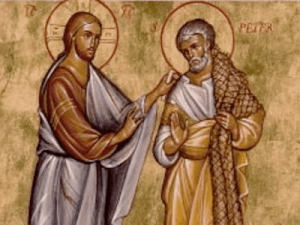 What kind of leader do we want? Certainly a good question here in the midst of an election year with the presidential nominations dominating the news cycle. It is always a good question for the Church. I have lived during the pontificates of seven popes and in my lifetime we have certainly had a wide variety of types and styles of leaders. In our history, we have had 266 of popes. We have had some spectacularly amazing leaders, saints in the making, and we have had some spectacularly horrific leaders, who would have been quite at home in Game of Thrones (so I hear, I actually haven’t seen it…). All took up the Keys of Peter, with the same job description given Peter: feed my sheep; tend my lambs. The Pope is the most visible of leaders in the Church, but not the only ones with that same job description. The simple mandate, “feed my sheep; tend my lambs” applies to priests, pastors, parents, principals, police, and anyone who would lead – anyone who would answer the call to minister in the Holy Name of Jesus.
  15 When they had finished breakfast, Jesus said to Simon Peter, “Simon, son of John, do you love me more than these?” He said to him, “Yes, Lord, you know that I love you.” He said to him, “Feed my lambs.” 16 He then said to him a second time, “Simon, son of John, do you love me?” He said to him, “Yes, Lord, you know that I love you.” He said to him, “Tend my sheep.” 17 He said to him the third time, “Simon, son of John, do you love me?” Peter was distressed that he had said to him a third time, “Do you love me?” and he said to him, “Lord, you know everything; you know that I love you.” (Jesus) said to him, “Feed my sheep.
  friarmusings