
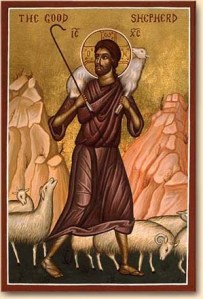
In the gospel reading for today we heard Jesus tell some bystanders who wanted Jesus to plainly say that he was the Messiah. Jesus replied: “But you do not believe because you are not among my sheep. My sheep hear my voice; I know them, and they follow me. I give them eternal life, and they shall never perish.”
How about us? Are we among his sheep? Granted in other places in the New Testament there are other indicators of membership within the flock, but today’s indicator is whether we hear the voice of the Good Shepherd. But let me nuance that criteria just a shade. What voice are you most familiar with in life? What voice or voices linger in your mind most of the time? Mom? Dad? Your spouse? Your supervisor? An amazing mentor, coach, or teacher? Your favorite podcaster? Denizens of the media, pop culture, Madison Avenue, the lure of fame and recognition, or the siren’s call of riches and wealth? The secular voice of temptation to a different moral compass?
There are many voices we have heard, are hearing and will hear. Some are good and some are not so good. Oftentimes we can talk ourselves into believing that the many “voices” or influences that we encounter on a daily basis do not affect us. Perhaps. Perhaps not. There are powerful influences in the world and, whether we want to believe it or not, some of them do affect us.
Sheep are easily taught and conditioned. They learn the voice of their shepherd because it was common practice for shepherds to regularly speak to their sheep. Once the sheep became used to the shepherd’s voice, they would turn and follow him when he called. So it is with us. We will follow the voice of that which we are most familiar. Whatever it is that we immerse ourselves in each and every day will grow on us and draw us, even unknowingly, to follow.
This begs the question, “What are you most familiar with?” Ideally, we spend sufficient time in God’s Word, learning His language, tone and voice. Ideally, we dedicate some portion of our day, every day, to silent contemplation of God. As we do this, we build a habit of hearing Him speak and we become comfortable with and comforted by His voice.
Once this habit is established in us, it will be much easier to go about our busy day hearing God whenever He chooses to speak. We will immediately recognize it is Him and we will follow.
Reflect, today, upon that which calls to you the loudest. Don’t let the many other voices in our world drown out God’s voice. Instead, prepare yourself for the moments He chooses to speak. And when He does speak, let that voice grab your attention so that you can follow.
Image credit: Pexels CC-0
 Jesus Knows – Do We Follow? 27 My sheep hear my voice; I know them, and they follow me. 28 I give them eternal life, and they shall never perish. No one can take them out of my hand. 29 My Father, who has given them to me, is greater than all, and no one can take them out of the Father’s hand.
