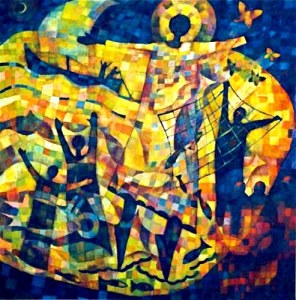
 “I have come to set the earth on fire, and how I wish it were already blazing!” It probably seems that way in California this year. There have been 3,624 wildfires so far this year in that state. The Soberanes Fire in Monterey County is only 50% contained and has already consumed almost 70,000 acres, killed one person, and destroyed 57 homes. Jesus’ words are far too present and real.
The pristine forests in wilderness areas contain something just out of sight. These wildfires are made worse by the dead wood and organic materials that accumulate on the forest floor, adding to the underbrush. It all fuel. It just needs the right spark. It seems that Jesus is saying he is the spark and let the wildfires rage. Seriously? Isn’t it Jesus who tells us to love our enemies and do good to those who hate us Does not Jesus bless the peacemakers? Aren’t those the Jesus quotes we have on our refrigerators magnets? Does anyone really have a refrigerator magnet that says, “I have come to set the earth on fire, and how I wish it were already blazing!” Where is Jesus the peacemaker? But then Jesus takes on that image when he asks: “Do you think that I have come to establish peace on the earth?” Of course, our answer is: “Well, …actually, …yes.” Jesus’ response is “Nope. I am bringing the purifying fire!”
In the Old Testament, the purifying fire Jesus seems to reference is most often associated with the fire that burns away impure religious practices. Not impure as in “not liturgically correct,” but rather impure in that they tended to make religion a source of false comfort, false peace – the thought that right religious practice and beliefs should exempt you from the suffering or disaster or poverty or even death all around you. The purifying fire was to burn away that which accumulated in the life of the church, the life of the believer, that kept you from life, from the hard realities in which we sometimes live, from working to be the ones who work for peace and for justice. The purifying fire was meant to burn away our images of who we want God to be, so that we could be who God wants us to be.
How are we to bring this purifying fire into our lives? There is the wildfire strategy: just let the forest grow as it wants, let the underbrush accumulate, and wait for the spark. Let nature take its course.
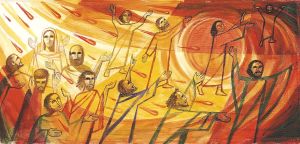
It seems to me that Christian life is not waiting for the wildfire. Not waiting for the fire of Pentecost to descend upon you, waiting for the Word of God to speak specifically to you, give you the life plan, or to present the one, life-changing moment when it all becomes clear because now the forest has burned and now you can truly see. Indeed, wildfire has the power to destroy and the power to foster regeneration and new growth. But waiting for the wildfire just makes you a lousy steward of gifts God has given you. And wasn’t that the point of last week’s gospel? Being a good and faithful steward?
Wildfire is one strategy, very dramatic and costly, but then there is the controlled burn strategy. Controlled burns are a way of stewarding the land we have been called to tend. In controlled burning, firefighters, farmers, or forestry professionals intentionally start fires in grasslands, fields, forests, and woodlands to eliminate undergrowth and overgrowth that can suppress healthy vegetation, harm wildlife habitat, and provide fuel for wildfires. Controlled burning can also replenish vital nutrients and help prevent the wildfires that ravage so much land and endanger lives.
I remember the 1988 Yellowstone National Park fires: almost 800,000 acres burned despite the efforts of 25,000 firefighters and $120 million in expenses. One of the positive outcomes of the 1988 Yellowstone forest tragedy was a change in fire management policy and greater awareness of potential fire activity throughout America’s national parks. A number of policies were modified, but one significant change opened the door for a more aggressive controlled burns program in the nation’s forests and parks. National parks implementing this strategy have realized increased fire fighter safety, greater control when a wildfire does break out, and a lower rate of wildfires exploding out of control.
There is a lesson to be learned for us. It seems to me that the Christian life is to bring the controlled burn of Jesus to our lives. The thing about the passage of Time is that it can soften the memories of days now past. By contrast it can make today feel particularly ominous, as if we’re living next to a parched forest. In electoral politics we could scarcely imagine wider dissatisfaction – or greater gaps in perception. Our leading presidential candidates have earned unfavorable polling ratings among the highest ever reported. Partisan animosity runs at historically high levels. Polling shows that Democrats and Republicans regard one another more negatively than they have in twenty-five years. Almost daily our social media friends refer to friending and unfriending people over political disagreements. Divisions abound. The forest floor of our lives, just out of sight, have all kinds of fuel, just waiting for the right spark: politics, race, religion, social class, wealth, privilege, access, sexual identity, education, and a host of other factors. This life needs people of good will and abiding faith to begin the daily, never-ending work of the controlled burn.
I always wondered why the Church paired this gospel with the other readings for today. They speak of perseverance, as St. Paul says: “Since we are surrounded by so great a cloud of witnesses, let us rid ourselves of every burden and sin that clings to us and persevere in running the race that lies before us while keeping our eyes fixed on Jesus.” There is the race: the controlled burn in our lives. It never ends. It is a process that is hard to begin and harder to sustain. Too often the wildfires of life rush upon us, and if we survive, we have the work of rebuilding – if we can.
So? What lies on the forest floor of your life? Make a list. It is a start. It is the gospel.
With the grace of God, may we begin and persevere in the work of controlled burn in our lives that we may burn away our images of who we want God to be, so that we will become who God wants us to be. Then we might just clearly see the Kingdom of God.

 It is a gathering unlike any other. Isaiah describes it as people coming from all corners of the world – every make and model, color and variety. Citizens of every nation from east and west, north and south. All streaming to Jerusalem, to God’s holy mountain bring their offerings of worship. All invited by God, all coming to the Lord God, all of them seeing the glory of God.
 Monday morning, I was on my way to the retirement home of some Franciscan Sisters to celebrate the Solemnity of the Assumption. On the front seat next to me was my cell phone; it made the buzzing sound it does when a text has come in. It was 10:43 am. Something told me to pull over to the side of the street. The text was only three words: “Water in house.”
  “Teacher, which commandment in the law is the greatest?” He said to him, “You shall love the Lord, your God, with all your heart, with all your soul, and with all your mind. This is the greatest and the first commandment. The second is like it: You shall love your neighbor as yourself. The whole law and the prophets depend on these two commandments.” (Mt 22:36-40)
  Alan Culpepper, at the end of his commentary [277-78], provides an interesting story from Franz Kafka:
 Re-posted from last year….
 The Family Leadership Summit is an annual affair that promotes its conservative Evangelical Christian identity and values around the family. Given that it is Iowa based, it is no surprise that in 2015 the Republican-Party hopefuls were on the podium and present at “town hall” meetings. Given the audience and agenda, it should come as no surprise what kind of questions you are going to face – and, as any good speaker would pay attention to, what kind of language the audience is waiting to hear in any response. The questions came as no surprise: “What is your relationship to Jesus Christ? Are you saved? How does your faith form your political world view?”
  friarmusings