The Importance of Celebrating

The last time this happened was 2006. We had to know it would roll around again. We could have seen it coming, given it some thought, been better prepared. After all this is Advent, a time when we are encouraged to stay alert! Still, it is almost here. And the inevitable questions will be coming.

It was 2006 when the fourth Sunday of Advent fell on December 24. And yes, that means Christmas Day falls on a Monday. I can already hear the wheels turning in some folk’s brain…maybe this means we can get a Christmas two-fer! I’m waiting for an email from one of the faithful asking about the possibilities of attending one Mass and “getting credit” for two. They’ll ask if they attended a Mass on Sunday the 24, say the 4 pm Christmas Eve Mass, since it was technically still Sunday, and we have a Sunday evening Mass normally at 5:30 pm, couldn’t that count as a fulfilling the obligation for both the fourth Sunday of Advent and Christmas? Answer: no. Does the Church really expect people to come to Mass two days in a row? Answer: yes. Aren’t fourth Advent and Christmas really celebrating the same thing? Answer: no. Continue reading

Testimony: about yourself

john-the-baptistThe questioners from Jerusalem were in a difficult position. So far all they had elicited from John had been a string of denials; they had no positive statement to put in their report. Yet John was preaching, drawing crowds in the wilderness, and baptizing. They must have something to say about him. So they turn the matter over to John. Instead of making another suggestion they ask him what he thinks about himself. They must have some answer to take back to those who had sent them. Continue reading

Testimony: by John

john-the-baptistJohn’s testimony to Jesus will lead others to faith, but it is also offered as evidence in a trial. John’s interrogators in this passage are not curious passersby, but are a delegation sent by official Judaism (vv. 19, 22). The expression “the Jews” (hoi Ioudaioi, v. 19) occurs repeatedly in the Fourth Gospel and has a wide range of meanings. Its most common usage, as in v.19, is as a synonym for the Jewish religious establishment, which is the source of most of the opposition to Jesus’ ministry in John. Here it likely refers to representative from Jerusalem leadership who quite naturally are going to make inquiries about what may well be a new religious movement – especially if there are messianic claims. There was a history of such movements and claims leading to religious disappointment and political ruin. Once John the Baptist acquired a following, the questions were sure to come. The first one was simple and straight forward. Continue reading

Testimony: sent from God

john-the-baptistA man named John was sent from God (v.6) Into this overarching narrative of the grand plan of salvation, we have the curious insertion of John the Baptist. We should note that this fourth gospel never uses the moniker “the Baptist” or “the Baptizer” – in fact John is never called the “forerunner” or “herald.” John has one role and one role only: witness (v.7). Leon Morris suggests that this is a response to a late 1st century controversy about the role and place of John the Baptist in the story of Christianity. “We should recall that some had baptized in John’s name as far afield as Ephesus (Acts 19:3), and they may have gone further. The great Apollos is first introduced as one who “knew only the baptism of John” (Acts 18:25). Our author does not enter directly into controversy with such people, but he insists more than any of the other Evangelists on the subordinate place of the Baptist. One of the aims of this Gospel plainly was to show how clearly and consistently John had pointed people to Jesus.” (Morris, 78) John the Evangelist does not directly confront the claims of the Baptist’s followers, but he insists more than any of the other Evangelists on the subordinate place of the Baptist. One of the aims of this Gospel plainly was to show how clearly and consistently John the Baptist had pointed people to Jesus. Continue reading

Changing the Lord’s Prayer?

Recently, Pope Francis offered that the church should modify the translation of the “Our Father” to clear up the confusion around the phrase “lead us not into temptation.” “That is not a good translation,” the Pope said. The phrase in question appear in Matthew 6:13 and Luke 11:4 as μὴ εἰσενέγκῃς ἡμᾶς εἰς πειρασμόν. The Greek verb for lead is “eisphero” and the original Greek word for testing or temptation is “peirasmos.” Continue reading

Testimony: memra

prologue-johnIf the 4th Gospel is indeed more about how God reveals God’s self in the person of Jesus, then we need to realize that Jesus was not born into a time of theological vacuum. Jewish theology was robust and with a history of succeeding and competing rabbinic schools. The followers of Jesus and the people of his time were Jews who were raised and lived this theology. It provided the framework for their daily lives and shaped their expectations about the Messiah, the Anointed One, who was to come. Among the gospels, John’s is the writings whose work expresses the fulfillment of those expectations and provides the theology for those that would follow Jesus. The basis of the theology is evident from the opening: John 1:1 “In the beginning was the Word, and the Word was with God, and Word was God…” Continue reading

Testimony: Gospel context

prologue-johnThe 3rd Sunday in Advent continues to feature John the Baptist as the herald and forerunner of the Messiah, using the 4th gospel. John the Evangelist has deftly changed the narrative presented in the Synoptic Gospels. Here in the fourth gospel the story of Jesus is not ultimately a story about Jesus; it is the story of God as God reveals God’s self in the person of Jesus. Thus the narrative is well placed in Advent at the head of the liturgical year: “In the beginning…Continue reading

Testimony: Advent context

john-the-baptistThe 3rd Sunday in Advent continues to feature John the Baptist as the herald and forerunner of the Messiah. The Reading for the Third Sunday of Lent is John 1:6-8, 19-28 (shown below in bold italics) – but it seemed good to me to also show the more continuous context of the Gospel according to John:

1 In the beginning was the Word, and the Word was with God, and the Word was God. 2 He was in the beginning with God. 3 All things came to be through him, and without him nothing came to be. What came to be 4 through him was life, and this life was the light of the human race; 5 the light shines in the darkness, and the darkness has not overcome it. 6 A man named John was sent from God. 7 He came for testimony, to testify to the light, so that all might believe through him. 8 He was not the light, but came to testify to the light. Continue reading

The One Coming: John’s message

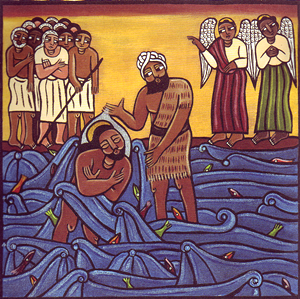
Baptism-Jesus“One mightier than I is coming after me. I am not worthy to stoop and loosen the thongs of his sandals. 8 I have baptized you with water; he will baptize you with the Holy Spirit.”

John’s message is telescoped to focus upon a single theme, the proclamation of a person still to come who will baptize the people with the Holy Spirit. As seen in the Notes, it is not clear what Mark means by this expression, nor is it clear that John understands the very messianic terms he uses – at least in their fullness. In referring to this new Baptizer, whose dignity overshadowed his own, John avoided traditional messianic terms. The precise identity of the Coming One remained hidden, apparently, even from John. Continue reading