
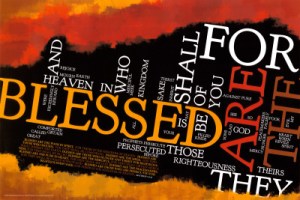
 “Blessed are you who are poor, for the kingdom of God is yours.” (Luke 6:20)
Almost a quarter of a century ago, I was in the midst of formation to become a lay missioner with Franciscan Mission Service as a prelude to my time in Kenya. Fr. Joe Nangle, a Franciscan friar, was our speaker that morning. We had begun day with the Eucharist and the gospel was the same gospel we heard this morning. “Blessed are you who are poor… for yours is the kingdom of God.” Fr Joe told us that if he could only have one verse of Sacred Scripture for our formation, this would be it. Within in were the two great challenges to all Christians, but perhaps especially so for Christians from the affluent countries of the world: to learn to see the poor and to learn to see the kingdom of God in the world. And then he told us this story. Continue reading
 The playwright Oscar Wilde once wrote, “I can resist anything except temptation.” The humor of the remark is mixed with a sad recognition that we fail so often to resist the temptations that come our way each day and from every direction. Of course, there are temptations and then there are temptations writ large. What are people’s greatest temptations? Why? What are their “favorite” sins – indicated by frequency and repetition? Why do we so often find ourselves in the same position as St. Paul? “What I do, I do
 This passage is the introduction to a new major section of the book of Luke (6:17-9:50). While previous passages have dealt with the early ministries of John the Baptizer and Jesus, and have only referred to the teachings of Jesus, here for the first time the actual content of his teaching to the crowds is presented. Also, for the first time, teachings are addressed directly to Jesus’ disciples. There has been a steady progression within Luke from a focus on God’s work in the world in Jesus (the infancy narratives, chs. 1-2), to the preparation for Jesus’ ministry by John the Baptizer (3:1-20), to Jesus himself and his own preparation for ministry (3:21-4:13). Then Luke begins to highlight how Jesus and his teachings were received, beginning with the hometown folks in Nazareth (4:14-30) and concluding with the choosing of the twelve, who were among those who responded by leaving everything to follow him (6:12-16). In this section, Luke begins expanding that dimension of response by focusing on Jesus’ teaching related to the “ethics of the Kingdom,” the responsibilities and consequences of being disciples. Luke continues this focus on discipleship until the journey toward Jerusalem begins (9:51), where it takes on a slightly different tone.
  “Bless me Father, for I have sinned….” Among the most frequently confessed sins are anger, being judgmental, and impatience. “Patience is a virtue.” We’re all familiar with that expression. Patience is listed by St. Paul in Galatians 5:22-23 as among the fruit of the Spirit. So, there’s no disputing that the Christian ought to be patient. But is impatience a sin? W. H. Auden, the English-American poet, wrote “Perhaps there is only one cardinal sin: impatience. Because of impatience we were driven out of Paradise, because of impatience we cannot return.” Insightful about the human condition to be sure, but not sure that has standing in the world of moral theology.
  “from now on you will be catching men” Literally, the next line reads: “from the now, you shall be catching alive (zogreo) people.” The similar phrase in Matthew and Mark reads: “I will make you (to become) fishermen [halieus] of people.” (This word for “fishermen” is used in v. 2 of our text.)
  friarmusings