 Did you know that nearly one quarter of McDonald’s Filet-of-Fish sandwich sales take place during Lent, when many fast-food customers are abstaining from meat? “That’s exactly what the McDonald’s operator who first put the cheese-topped sandwich on his menu had in mind back in 1962. When Cincinnati McDonald’s franchise owner Lou Groen noticed that his heavily Catholic clientele was avoiding his restaurant on Fridays, he suggested to McDonald’s owner Ray Kroc that they add introduce a fish sandwich. That led to a wager between Groen and McDonald’s chief Ray Kroc, who had his own meatless idea. “He called his sandwich the Hula Burger,” Groen said. “It was a cold bun and a slice of pineapple and that was it. Ray said to me, ‘Well, Lou, I’m going to put your fish sandwich on (a menu) for a Friday. But I’m going to put my special sandwich on, too. Whichever sells the most, that’s the one we’ll go with.’ Friday came and the word came out. I won hands down. I sold 350 fish sandwiches that day. Ray never did tell me how his sandwich did.”
The Filet-of-Fish won, the rest is history, Groen’s restaurant thrived, and since then, the sandwich has been McDonald’s fixture, all year long.
Clark, Paul (February 20, 2007). “No fish story: Sandwich saved his McDonald’s”. USA Today.

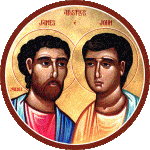 In today’s gospel, Jesus tells his disciples of his dying and rising. I suspect that the disciples, not having categories of understanding to realize that Resurrection is being pointed to, simply nod and imagine “rising” of the new earthly kingdom – the restoration of the throne of David. At which point, the mother of the sons of Zebedee asks Jesus for positions of privilege, power, and honor. At that point, as my friend, Fr. Bill would say, Jesus is “patiently exasperated.”
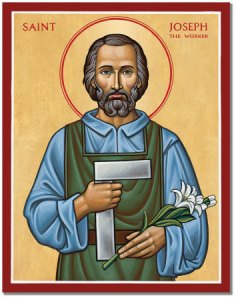 Devotion to St. Joseph, spouse of Mary, can be traced back to the beginning of the Church, with a local feast dedicated to St. Joseph confirmed in Egypt as early as the 4th century. One of the earliest dates for honoring St. Joseph was July 20. On the Byzantine calendar St. Joseph is commemorated on December 26 with many Eastern Churches celebrating Joseph as “Holy Righteous Joseph the Betrothed.”
 This coming Sunday marks the
  This is the 2nd Sunday of Lent and each year on this day our gospel is taken from one of the accounts of the Transfiguration – this year we take it from Luke. It is the same gospel we hear every August 6th on the Feast of the Transfiguration. This year I began to wonder why we proclaim this gospel on this Sunday. Last week, proclaiming the gospel of Jesus’ temptation in the desert – well, that seems like a perfectly good start to the Lenten season. But why read the Transfiguration – why here on this 2nd Sunday of Lent? Is there a meaning, particularly Lenten, that we should hear and understand – apart from the meaning and message we would consider on August 6th?
  Last week I wrote about making your Lenten Plan, so maybe this week we can think about the age-old question: So… “What are you giving up for Lent?” Isn’t that always the question? As if that is the reason for the season. Growing up, everything I remember about Lent circled around the acts of self-denial – what food, entertainment, or habit one would give up, and how hard it was to deny oneself of that thing. It was not always made clear that the denial was meant to help one think about God and Christ’s sacrifice.
  This coming Sunday marks the
  When the devil had finished every temptation, he departed from him for a time (Lk 4:13). Technically, the translation should be that Satan departed from Jesus for a more favorable time. In other words, it was not a one-and-that’s-it temptation for Jesus. Satan was coming back for another try. And if Satan was coming back to tempt Jesus, there is no reason to think that our life will be free of temptation.
  Our gospel highlights the three spiritual practices of Lent: prayer, fasting, and almsgiving. The readings all warn of not being gloomy about it all, not being ostentatious so that you’re sure to be noticed, and not to announce your generosity so that all might acknowledge your faithful giving. It calls into question not the tradition of the Lenten practices, but the meaning, intention, and purpose you assign to your practice.
  friarmusings