
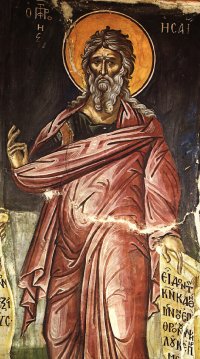
 Isaiah, one of the greatest of the prophets, appeared at a critical moment in Israel’s history. To say that his ministry was part of one of the most complicated periods, is an understatement. During his time, the promised land had already split asunder. The people were no longer ruled under Jerusalem and the throne of David. Most of the tribes of Jacob formed the Northern Kingdom (referred to as Israel in this period) with the remaining tribes still loyal to Jerusalem and the throne of David – referred to as Judah.
Beyond the borders was the ever-looming threat of the Assyrian Empire whose capita city was Nineveh. It was in the area of modern-day Mosul in Northern Iraq. Compared to Israel, it is to the northeast at some distance.
 One of the most famous and insightful sentences in Christian history comes from the first page of Saint Augustine’s Confessions. As the book unfolds, Augustine describes his extensive experiences with unfulfilled desire. And so as if to give his conclusion beforehand, in the very first paragraph of the book he writes, “Thou has made us for Thyself, and our hearts are restless until they find their rest in Thee.” An insatiable craving, a psychic abyss, unsatisfied desire and desires, and the deep longing for a faraway land — all these point to and find fulfillment in God alone, despite our many failed experiments with all sorts of substitutes.
 Risk is one of those things we don’t think about, are adverse to in different measures. It is unavoidable. We would rather not have any, and yet are surrounded by it, and sometimes we are so focused on it that we can think of little else. It has always been one of the things I wonder about. Its one of the things financial advisors try to discern about your investment posture: risk avoidance or acceptance. It’s something people wonder about submariners. Its one of the things economists specialize in. It is part of life and is unavoidable – so sometimes it is easier to ignore. But I like to read about it from time to time.
 This coming Sunday, the 4th Sunday of Easter, is known as “Good Shepherd Sunday,” because of the gospel that is proclaimed:
 A while back I read a classic summer beach novel – you know the ones: easy to read, entertaining, no heavy lifting required … and no I don’t remember the title. But I remember this, there are good guys being chased by bad guys. The good guys are only armed with their wit, imagination, guile, luck, and their paranoid friend who believes every conspiracy theory is true. The premise is that everything in the world has a radio frequency identification (RFID) chip embedded in it. When the good guys decide to use cash only so that they stay off the grid, it doesn’t matter because their credit cards and driver’s licenses have RFID chip that, although still unused in their wallets and purses, are detected by the RFID scanner at the checkout counter. As the novel races along the bad guys track the good guys via RFID. The good guys keep emptying their lives getting rid of toll road passes, cell phones, driver’s licenses, credit cards, passports, access badges for work, the groceries and clothes they just purchased for cash… and still the bad guys keep coming. Holy guacamole! There is no place to hide! The bad guys can pick then out of a crowd of a gazillion people. As we read, we cheer for the good guys, we get involved, as if we really and deeply know them. It is as though we can really see them!
 By the spring of 1213, four years after the founding of the “order,” Francis’ reputation had risen to the attention of the Italian aristocracy – not just in Assisi but throughout central Italy. The order was beginning to attract men from the higher social classes. Sons of merchants like Francis, sons of the landed wealthy, sons of ruling households, men with established careers in law, music and the arts, and also ordained priests. They joined the already formed group of men from middle and lower backgrounds in muddling through what it meant to follow Christ in the manner of Francis. G.K. Chesterton’s later definition of the Catholic Church – “here comes everybody” – was being lived out in Francis’ day.
  “So now I tell you, have nothing to do with these men, and let them go. For if this endeavor or this activity is of human origin, it will destroy itself. But if it comes from God, you will not be able to destroy them; you may even find yourselves fighting against God” (Acts 5:38-39)
 friarmusings