The Holy Spirit

This coming Sunday is the 4th Sunday of Advent and the story of the Visitation when Mary went from Nazareth to the hill country near Jerusalem to visit Elizabeth and her husband Zechariah, who for many years, had prayed to conceive and have a child. During the Annunciation, the Angel Gabriel had informed Mary: “And behold, Elizabeth, your relative, has also conceived a son in her old age, and this is the sixth month for her who was called barren.” (Luke 1:36) And so Mary sets out in haste to visit. Continue reading

Who is this Child?

This is how the birth of Jesus Christ came about…” What follows in today’s gospel, provides a wonderful answer to the Advent question: who is coming? The gospel reading provides its contribution to the larger answer: Jesus Christ (v.18), son of Mary (v.18), adopted son of Joseph (v20), son of David (v.20), named Jesus (v.21), the one who will save his people from their sins (v.21), and Emmanuel…God with us (v.22).

Continue reading

Luke’s Narrative leading to the Nativity

This coming Sunday is the 4th Sunday of Advent. In previous posts we explored the background of the first reading from the Prophet Micah: “But you, Bethlehem-Ephrathah too small to be among the clans of Judah, From you shall come forth for me one who is to be ruler in Israel” But before delving into our gospel text, it is good to recall the flow of Luke’s narrative: an interweaving of the stories of births of the herald of the Messiah, John the Baptist, and the Messiah, Jesus to tell a single story of redemption. Continue reading

Genealogy of Hope

The gospel for today is St. Matthew’s genealogy of Jesus. It is Matthew’s way of showing how Jesus fulfills the Old Testament storyline and takes up the first 17 verses of the gospel – and since Matthew’s gospel is almost always the first book of the New Testament, one could say it is the first 17 verses of the entire New Testament! … and I am sure most people skip it and move on to the Nativity and Infancy narratives.

Genealogies in the Old Testament are always working to communicate multiple layers of information to readers. Genealogies obviously trace family trees, but they also help us follow priestly and royal lines through Israel’s story. You can see each of these types of genealogies in the first nine chapters of Chronicles. In fact, there’s little doubt that the author of Matthew had the book of Chronicles and its genealogies in mind when he wrote his own Gospel account and began it with a genealogy.

Okay… But why does this genealogy matter?

Continue reading

Bethlehem and the Prophet Micah

This coming Sunday is the 4th Sunday of Advent. In the previous post we explored how the village of Bethlehem was viewed in the time of Jesus’ birth. Today, we consider Bethlehem and the Prophet Micah, an eighth century BC figure (and a contemporary of the prophet Isaiah). Micah prophesied during the reign of Ahaz of whom 2 Chronicles 28 records: “He did not do what was right in the sight of the LORD as David his father had done” – and then recounts his many sins and transgressions. Micah shared his people’s disillusionment with the king but encouraged them to hope for a future, worthy messiah. Rather than tolerate the sins of the leaders the Word of the Lord came to Micah to announce that the messiah would end the corruption of the judicial system, idolatry in the Temple and inauthentic worship and establish righteousness for all. Continue reading

An Odd Story of Blessing

The first reading today probably strikes you as an odd one to choose leading up to Christmas – at least until you arrive at the final verse of the reading: “A star shall advance from Jacob, and a staff shall rise from Israel” (Num 24:17). I suspect most people read that and think, “Oh, makes sense now, Balaam is talking about the Star of Bethlehem.” Maybe. Let’s consider the backstory that brings us to this verse.

Continue reading

Closer to the Nativity

The Season of Advent offers us readings that begin with apocalyptic scenes of Jesus’ prediction of the coming destruction of the Temple and the signs of “end times.” It is a gospel taken from Holy Week and seemed a bit out of place in Advent. But one message of the readings was “pay attention” for the signs of a promised age to come. The Season of Advent is a season in preparation of the “three comings of Christ” – in history past with his birth in Bethlehem, in history future at his second coming, and in the present at our reception of Him into our hearts. The gospels for Advent have moved us from the promise of a Messiah to the herald’s ministry of announcing his arrival via John the Baptist in the readings from the 2nd and 3rd Sundays of Advent. We then come to the 4th Sunday of Advent in lectionary cycle C. Continue reading

Gaudete in Domino semper

The prophets Zephaniah and John the Baptist are not the two most joyful characters in all of Scripture, yet we hear from them both today. They are paired with the great Advent refrain from the Letter to the Philippians: “Gaudete in Domino semper,” –  “Rejoice in the Lord always. I shall say it again: rejoice!” This is Gaudete Sunday. Everything about today’s readings call to the people of God to get excited, be demonstrative, and above all be joyful, celebrate, and rejoice. Even the dour, prophet of doom, Zephaniah can’t restrain himself and tells us “Shout for joy…Sing joyfully… Be glad and exult with all your heart!” The book of Zephaniah is only three chapters long, filled with death, doom, fire, flood, pestilence and plague – yet even he tells us to shout for joy!

Continue reading

Agnus Day’s on 3rd Advent

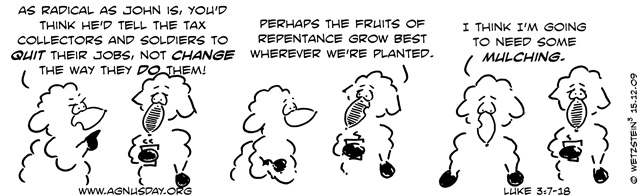
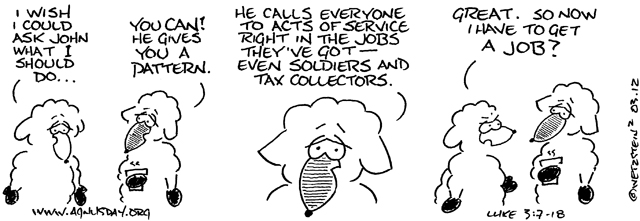
Today is the 3rd Sunday in Advent in Year C of the Lectionary cycle. Following upon John the Baptist’s stern warning of the coming day of judgement, people cry out “Teacher, what should be do?” (Luke 3:12). There are lots of commentaries on this passage, but here on Guadete Sunday, let me offer a bit of “joy” from the folks at Agnus Day and their perspective.

The Theology of History

In Christian biblical studies, “the theology of history” refers to the understanding of history as shaped by God’s purpose and action. Unlike secular views of history, which may see events as random or solely influenced by human actions and natural processes, the theology of history views events within the context of God’s overarching plan, especially as it is revealed in Scripture. This perspective assumes that history unfolds according to God’s will and that each event has theological significance as part of a divine narrative. The key aspects of the theology of history in Christian thought are: Continue reading