Behind the Scene

In the gospel reading for today we share the story of the two disciples on that first Easter heading home discouraged by the events that had unfolded with the death of Jesus. By the time that Cleopas and his unnamed companion had walked with Jesus the seven miles from Jerusalem to Emmaus, the evening darkness had descended upon them. When Jesus acted as if he would continue walking, they implored him, “stay with us, for the day is almost over.” And so they had dinner at Emmaus.

During the day the men hadn’t recognized the resurrected Jesus, but at dinner “their eyes were opened” in the breaking of the bread and they understood what had happened. They immediately returned to Jerusalem and told how Jesus was recognized by them when he broke the bread. They added their testimony to the earlier testimony of the women who’d visited the empty tomb.

Continue reading

So I send you

This coming Sunday is the 2nd Sunday of Easter, Divine Mercy Sunday. The gospel is taken from John 20:19-31, the scene in the Upper Room on the evening of the Resurrection. In today’s post we consider the phrase, “As the Father has sent me, so I send you.  The Fourth Gospel often speaks of Jesus being sent into the world by the Father: to do his will (6:38–39; 8:29), to speak his words (3:34; 8:28; 12:49; 14:24; 17:8), to perform his works (4:34; 5:36; 9:4) and win salvation for all who believe (3:16–17). 

That these same actions would be expected of the disciples, continuing the words and works of Jesus, is foreshadowed at various places in the Gospel.

Continue reading

Holy Water

An empty church in Heerlen, Netherlands, is set to receive a second life, with plans underway to convert the vacant building into a public swimming pool called Holy Water. The St. Francis of Assisi Church was last used as a space for religious activity in 2023, and Dutch architecture firms MVRDV and Zecc Architecten were tapped to design the renovation of the building. The plans will preserve the church’s historic features while giving it a new way to serve the community.

The project’s website says: “A swimming pool will be added to the nave, and current designs show the pool with an adjustable flooring to create different depths. If raised all the way for special events, the floor will hold a shallow layer of water to create the illusion of walking on water while reflecting the interior of the church.”

In the United States, the Catholic Church learned to remove all religious elements of a church once it is deconsecrated. There were stories of an early sale of a church in Portland where the the space was turned into a night club and the confessionals become “phone booths.” Could be apocryphal, but it is something to consider.

One person speculated that the pews would become pool-side benches, the ambo/pulpit a lifeguard stand, the confessionals changing booths, and the list went on.

It is sad that the facility is not longer needed or maintained as a church. But as a former competitive swimmer….

The Passing of Pope Francis

The rite confirming the death and the placement of Pope Francis’s body in the coffin took place on the evening of Monday 21 April in the ground-floor chapel of the Casa Santa Marta. The official declaration of death was read aloud. The act was validated by Cardinal Kevin Farrell, Camerlengo of the Holy Roman Church. The ceremony lasted just under an hour. Seals were also placed on the papal apartment on the third floor of the Apostolic Palace and on the apartment on the second floor of Casa Santa Marta, where the Pope had resided.

The Holy See Press Office announced on today that Pope Francis’ funeral Mass will take place on Saturday, April 26, 2025, at 10:00 AM in St. Peter’s Square. Cardinal Giovanni Battista Re, Dean of the College of Cardinals, will preside at the Mass, which will be concelebrated by Patriarchs, Cardinals, Archbishops, Bishops, and priests from across the globe. The Eucharistic celebration will conclude with the Ultima commendatio and the Valedictio, marking the beginning of the Novemdiales, or nine days of mourning and Masses for the repose of Pope Francis’ soul. The late Pope’s body will then be taken into St. Peter’s Basilica and then to the Basilica of St. Mary Major for entombment.


Image credit: Vatican News

A Life of Lasting Joy

In the gospel reading today we encounter a well known scene. It is Sunday morning in the first light of the day, the third day since the crucifixion. Mary Magdalene is there to complete the burial rituals to honor the corpse of Jesus – only to discover an empty tomb. She was already grieving, carrying that pain and loss until the completion of the Sabbath, and now this – someone has taken the body of Jesus; a final insult and desecration. It is too much. She is in tears.

She encounters two angels who ask her why she is crying. There is no reaction to the encounter itself. She is taken in her grief. She shows no concern for angels, but only asks where someone might have moved the body. They have no answer and so she moves on encountering a person she takes to be the gardener. Like the disciples on the road to Emmaus, or Peter and the disciples later at the Sea of Galilee, she doesn’t recognize Jesus,

Continue reading

Peace be with you

This coming Sunday is the 2nd Sunday of Easter, Divine Mercy Sunday. The gospel is taken from John 20:19-31, the scene in the Upper Room on the evening of the Resurrection. . 

19 On the evening of that first day of the week, when the doors were locked, where the disciples were, for fear of the Jews, Jesus came and stood in their midst and said to them, “Peace be with you.” 20 When he had said this, he showed them his hands and his side. The disciples rejoiced when they saw the Lord. 21 (Jesus) said to them again, “Peace be with you. As the Father has sent me, so I send you.”

Continue reading

Apostle Signs Nike Endorsement Deal

Around Easter each year friends and family send me all kinds of Easter-themed images, memes, articles, and what-not. I am always amazed at the creativity and imagination of some folks, for example:

The (fake) Press Release from Nike:


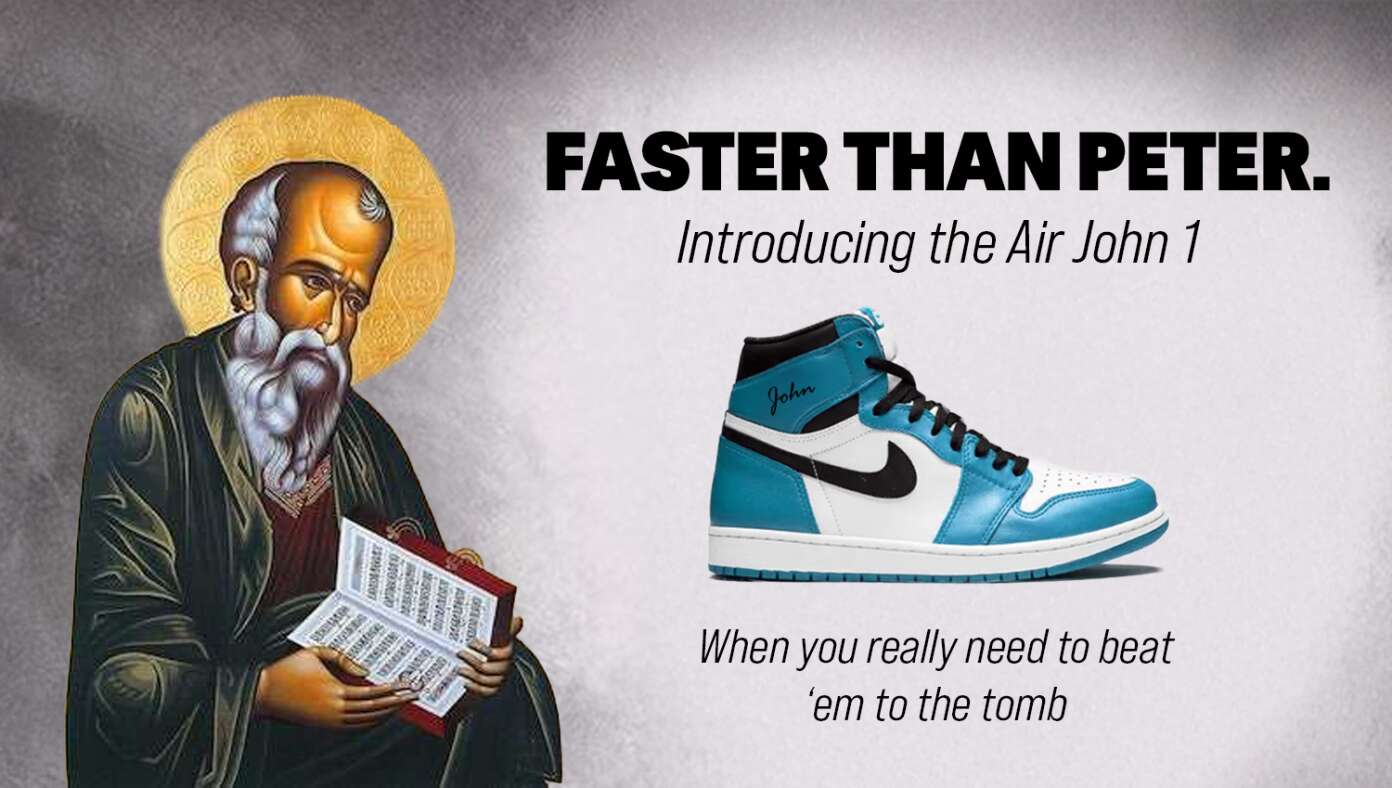
JUDEA — Saint John the Apostle has reportedly signed a lucrative six figure deal with Nike following his win against Saint Peter in a footrace to the tomb of Jesus.

Saint Peter has continually maintained that it was not a race, and that they were just excited to learn if Jesus had indeed risen. However, that hasn’t put a stopper on Saint John’s growing fame as a sprinter. Nike decided to strike while the iron is hot.

“We’re proud to have signed John to an official endorsement deal,” said Nike CEO Tiberius Calceus. “We’re also excited to announce a collaboration with the apostle on the brand-new Nike Air John 1, the shoe for beloved winners. Run like John with a pair of Air John 1’s today.”


Image and text courtesy of Babylon Bee

Resurrection Faith

Today’s gospel from St. Matthew  is familiar to all readers: Jesus has been crucified, died, and laid within a tomb guarded by soldiers and watched by Mary Magdalene and “the other Mary.” The Sabbath has passed and dawn approaches on the first day of a new week.

The gospel accounts of the empty tomb are fairly similar. Women (names and number of women differ) come to the tomb early on Sunday morning. The stone is rolled away and the tomb is empty. Some of the gospels have an angelic messenger who speaks to the women.

There is great diversity in the accounts of the appearances of the risen Christ. It is difficult to harmonize any of them. Perhaps there is a message in that: Our contemporary experiences of the risen Christ will differ. There are those who visibly see a white light and others don’t. There are those who experience Christ in a radical transformation, A “born-again” event in their lives. There are those for whom Christ has been such a reality throughout their lives that they can’t think of a moment when Christ wasn’t present to them or when there was a great turning point in their lives. How the risen Christ comes to people differ – then and now. Our stories about the risen Christ’s presence in our lives differ – and in that lack of uniformity there is witness to the breadth of humanity.  

The woman left the empty tomb “fearful yet overjoyed” only to encounter the Risen Christ telling them: “Do not be afraid.” A good message for us. Resurrection faith does not arise on the basis of evidence, of which the chief priests and soldiers had plenty, but on the basis of the experienced presence of the risen Christ, by testimony of those to whom he appeared, and by his own continuing presence among his disciples – on the Easter morning and in all the days since.

We need to be a people unafraid to proclaim a radical resurrection faith in the present, not just a historical event. We need to tell it with joy!

He is risen! Alleluia!


Image credit: Christ’s Appearance to Mary after the Resurrection | Alexander Ivanov | Russian Museum | PD-US

Chameleon of a Word

Collaborate is a well known word. You can collaborate with your work project members and that is a good thing. You can collaborate with the enemy and that is not so good a thing. But that is not the “chameleon” element that captured my interest thanks to the good people at Merriam Webster’s “Word of the Day.”

The origin of the word “collaborate” comes from the Latin com” meaning “with, together, or jointly,” teamed up with the verb laborare (“to labor”) to form the Late Latin word collaborare (“to labor together”) … ahhhh, excuse me….. wait a minute. What happened to the “m” in “com?” And that is the chameleon element.

The Latin prefix “com” has a habit of changing its appearance depending on what it’s next to. For example, if the word it precedes begins with “l”, com- becomes col-; if next to an “r”, become cor- as in corroborate.

Just an interesting tidbit from the world of words … which makes you wonder about “tidbit.” The primary mean of which is “a choice morsel of food” but can also “chameleon” its way to a choice or juicy tidbit of news.

The “bit” part comes the Old English bita (a morsel of food) which likely comes from the Middle Dutch bete or the Old Norse biti. But what about the “tid” part? That is less clear. The best guess of the etymologists is that is come from titmouse. Which is an interesting word since it is not a mouse at all, but a small bird the size of a chickadee. The “mouse” portion is likely a derived from a linguistic variation, mose, referring any of various small Eurasian songbirds. That variation goes back to the Old English māse, derived from the Germanic *maisōn- which has nothing to do with the modern French word for house.

I should probably stop there lest I be lost in the never ending origin of words.

We mourn his passing

This was the pontiff who took the name “Francis” in homage to Catholicism’s most iconic and beloved saint, the “little poor man” of Assisi; the pope who rejected the marble and gold of the Papal Apartments in favor of the Domus Santa Marta, a modest hotel on Vatican grounds; the pope who returned to the clerical residence where he’d stayed prior to his election to pack his own bag and to pay his own bill. His pontificate that followed was consistent to its start.

May his soul and all the souls of the faithful rest in peace.