
On the evening of the first day

This coming Sunday is the 2nd Sunday of Easter, Divine Mercy Sunday. The gospel is taken from John 20:19-31, the scene in the Upper Room on the evening of the Resurrection. Our gospel contains the second and third appearances of the risen Jesus in John’s gospel. These three appearances take place in Jerusalem.  There is a fourth and final appearance of Jesus later in a section referred to as the “Epilogue” of John.  This appearance is at the “Sea of Tiberias” in Galilee (John 21).

In the Johannine narrative our gospel occurs on what has been a full day: “On the evening of that first day of the week.”  It was just that morning that Mary Magdalene had visited the tomb and confessed, “They have taken the Lord from the tomb, and we don’t know where they put him” (20:2) – ironically echoing one the decisive misunderstanding of Jesus’ ministry: from where did Jesus come and where is he going (e.g. 7:33-36, 8:21-23).  Mary became the first disciple of the good news of the empty tomb conveying the word to Peter and “the one whom Jesus loved.” Slowly the implications of the empty tomb and the burial linens come to the disciples and they begin to understand – each in differing ways and to varying degrees. The disciple whom Jesus loved “saw and believed” (20:8), however “they did not yet understand the scripture that he had to rise from the dead” (v.9).

At this point, it is perhaps that their faith is as complete as faith in the empty tomb can be, but as many commentators have noted, to assign to the disciples a full belief in the Resurrection is to rush the story. Resurrection faith begins when Mary encounters Jesus in the garden and he is revealed as the Risen Christ and Good shepherd – he knows his sheep by name and they respond to his voice (10:3-4, 12,16, 24; cf Is 43:1). In telling Mary “stop holding onto me” (v.17) Jesus lets Mary (and the reader) know that the unfolding of the events of the hour are continuing.

In the course of these posts we will consider the key words/phrases of “peace”, “sent”, “he breathed on them and said to them, “Receive the holy Spirit”, “Whose sins you forgive are forgiven them, and whose sins you retain are retained.” and more


Image credit: Maesta altar piece, Duccio di Buoninsegna, 1308, Museo dell’Opera Metropolitana del Duomo, Siena | Public Domain
A Story in Three Acts

It seems to me that if we have been attentive and following all the events of Holy Week, it is possible to discern a play written in three acts. The curtain rises with a prelude: an intimate act of Mary anointing Jesus’ feet. An act rich in meaning and done in love. Then begins Act 1. It is a scene worthy of a large screen. Palm Sunday as the disciples and believers welcome Jesus into Jerusalem, the royal city, the long-awaited Messiah King.

Act 1 continues with a quiet scene, away from the bustling crowds of Passover, with a last meal with his closest friends and disciples. It is then, at the most sacred table fellowship of the Jewish faith, that Jesus shows the disciples the meaning of the proto-Eucharist just celebrated. On bended knee Jesus washes the feet of his disciples. It was an embodied parable of what it means to be a Eucharistic people: love and service. As the curtain falls on Act 1 and when we consider the meaning of Act 1, it is clear, it is love portrayed.

Continue reading

Easter Sunday – The Empty Tomb

While the details within and among the gospels vary, all record that Jesus’ body, after his death on the cross, was laid in a tomb provided by Joseph of Arimathea. All four gospels then come to their crowning point in the account of the Resurrection, but each in its own way. They all agree that women came to the tomb:

  • After the sabbath, as the first day of the week was dawning” (Matthew 28:1)
  • When the sabbath was over…Very early when the sun had risen, on the first day of the week” (Mark 16:1-2)
  • But at daybreak on the first day of the week” (Luke 24:1)
  • On the first day of the week…early in the morning, while it was still dark” (John 20:1)

All agree that the Sabbath was complete and it was the first day of the week – Sunday in the Christian reckoning. One might notice that the synoptic gospels (Matthew, Mark, and Luke) all report that the sun was rising in the dawn of this new day, however, John reports that it was still dark. One needs to remember that John uses “dark” to describe unknowing, unbelief and things similar rather than time of day. In the Johannine gospel “unknowing” is an apt description of Mary Magdalene and the disciples.

If you would like to read more about the Johannine narrative of Easter Mornring, click the button below


Image credit: Canva | George Corrigan | CC-0

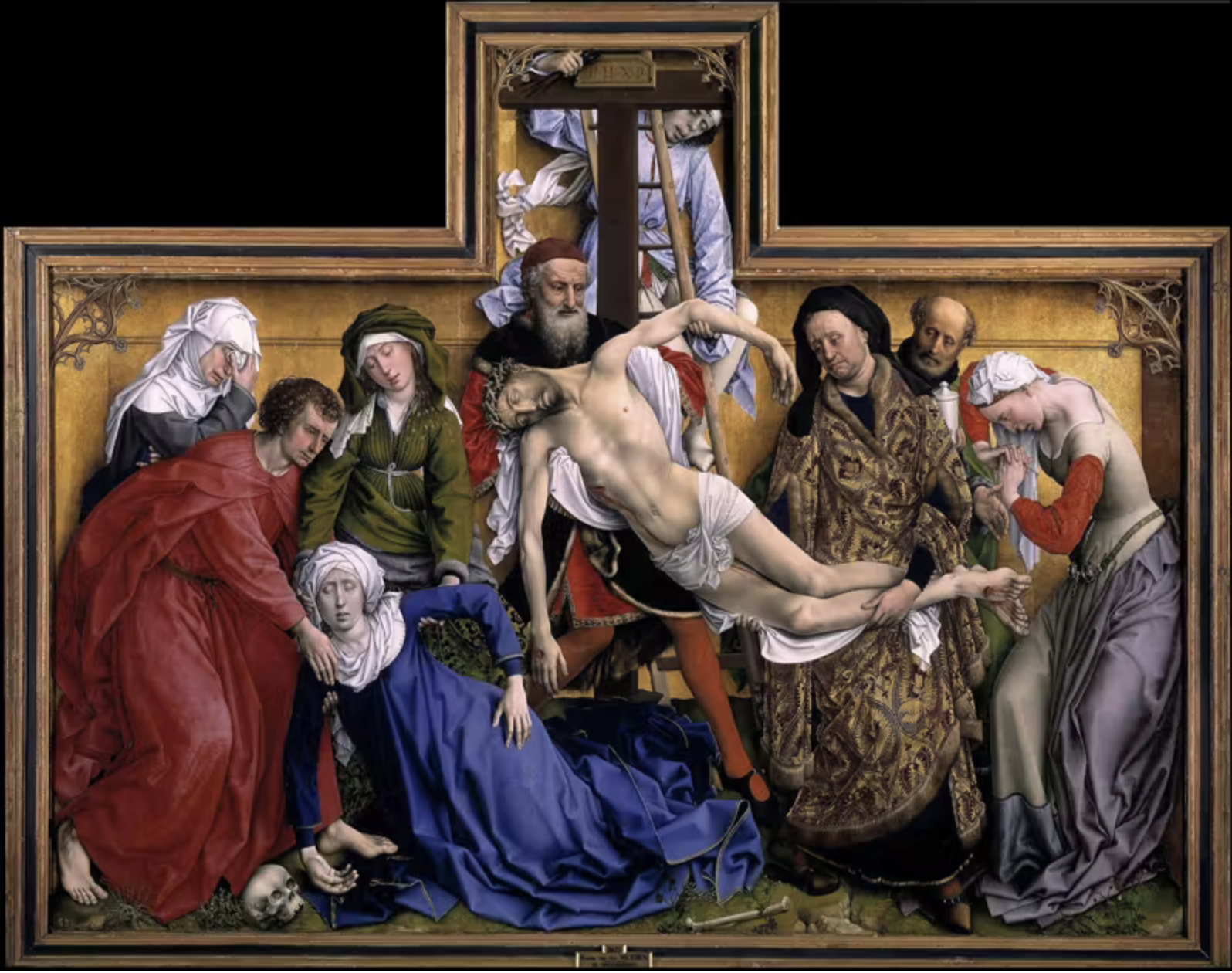
Descent from the Cross

Museum of the Bible in Washington DC has a beautiful exhibition, Descent from the Cross. This exhibition explores how 21 artists across five centuries, multiple genres, and mixed media have visualized the scene in The Gospel of John, chapter 19, the moment Jesus is removed from the cross. This moment, traditionally called “Deposition” or “Descent from the Cross,” is not described in the Bible. There are no details explaining the process or who was present. Because of this, artists across the centuries have interpreted this emotional moment in unique and varying ways, each filling in the blanks with what they think might have happened. It has become a popular scene in art history, and thus a part of our shared visual language.

The earliest-known renderings of the scene appeared in the ninth century and soon became part of a cycle through the life of Christ and his passion, later known as the Stations of the Cross. But perhaps the most influential depiction was painted by Flemish master painter Rogier van der Weyden in 1435. The unique shape of the composition and the cramped “box” that the characters occupy create a theatrical look, like that of a stage play or a diorama. The sharp angles and rich details reflect the late Gothic, early Renaissance styles of northern Europe, and the crossbows seen in the corners honor the patron of this piece, the Leuven Guild of Archers.

Museum of the Bible

You can see the exhibit virtually at the Museum’s website by clicking the button below.


Image credit: Descent from the Cross | Rogier van der Weyden, ca. 1435 | Museo del Prado, Madrid | PD-US

In the darkness

There have been many a Good Friday in the course of my life. I have heard the Passion narrative. I led the Passion narrative during Good Friday liturgies. Over the many years of Bible study I have covered the Passion narrative more than a few times. And now thru the gift of my friends Jerry and Maureen, I experienced Good Friday in a way not to ever be forgotten.

Continue reading

The Presence of God

It seems to me that over the last year in homilies, bible studies and our OCIA classes for the folks entering the Catholic Church on Saturday evening at the Easter Vigil – that I have returned to a consistent theme: the efforts and the extent to which God strives to be present to us. One overarching theme of the Old Testament is a story of God drawing near and the people, hesitant to draw close and even eventually stepping back, keeping God at a distance. “Return to God” – a constant cry of Moses, Joshua, the Judges and Prophets of Israel – the signs of God’s care and compassion are everywhere. God wants to be close to us.

Holy Thursday’s first reading is taken from the story of Exodus. In that book the signs of God’s presence are everywhere: in the miracles done attempting to persuade Pharaoh, the great sign of the Passover, the parting of the Red Sea, leading the people through the wilderness as a pillar of fire by night and a cloud during the day. While encamped at Sinai after the “Golden Calf” incident, God instructed Moses to build the Tent of Meeting – literally a place where God could meet the people. The Tent was with them during the 40 years in the wilderness, and came with them into the Promised Land. Did you know that later the Tent was replaced by the great Temple in Jerusalem.  There is a description in First Chronicles of the dedication of this new “Tent of Meeting.”  During the dedication the glory of God is seen filling the Temple – the presence of God among people. Throughout the Hebrew Scriptures, God continually showed his people signs pointing to his presence, revealing His desire to be close to them. I could go on and on, but I think you get the point. All the while the people hesitated to draw close; they eventually drift away despite all the signs, the warnings of the prophets, and so much more.

All the while the compassion of God remained: the desire to be close to us.

Continue reading

The Gospel for Holy Thursday

The gospel reading for the Mass of the Lord’s Supper on Holy Thursday evening is always taken from the Gospel of John 13:1-15. This week I have been posting about the Passion, but here on Holy Thursday, rather than posting the biblical commentary over days, if you are interested to read short commentary on text, simply click the button below.


Image credit: Image credit: “The Last Supper,” by Ugolino da Siena, circa 1325-30, Italian. (Metropolitan Museum of Art) | Public Domain

Death on a Cross

Luke adds a poignant detail to his description of Jesus’ journey to the cross; with him march two criminals. Jesus, who had been described by his opponents as a “friend of tax collectors and sinners” (Lk 7:34), would not only live with such friends but die with them. 

32 Now two others, both criminals, were led away with him to be executed. 33 When they came to the place called the Skull, they crucified him and the criminals there, one on his right, the other on his left. 34 (Then Jesus said, “Father, forgive them, they know not what they do.”) They divided his garments by casting lots. 35 The people stood by and watched; the rulers, meanwhile, sneered at him and said, “He saved others, let him save himself if he is the chosen one, the Messiah of God.” 36 Even the soldiers jeered at him. As they approached to offer him wine 37 they called out, “If you are King of the Jews, save yourself.” 38 Above him there was an inscription that read, “This is the King of the Jews.” 

Continue reading

Triduum: a love story

A reflection for the Readings on Spy Wednesday: Holy Week is a story told in three acts.

Act 1: Love Portrayed.  All Lent we have seen Love Portrayed:  Jesus transfigured on the mountain top. The glory of God revealed and yet what would seem to be the final scene of the play is but the beginning. We’ve more to hear, more to see. Especially in the daily gospels we have acts of love. A man born blind who now sees. Lessons on unlimited forgiveness. Teachings on the great commandments of loving God and neighbor. And so many more scenes of love portrayed.  The disciples believe because they have seen and heard the power of God in the world.

Love is portrayed by the people of the city of God, Jerusalem, who welcome Jesus with palm branches waved and laid upon the road as one who greets the arriving king. Cries of “Hosanna…. hosanna in the highest”  The cry reserved for the Messiah.  Their love is portrayed in the hopes they pray the Nazarene can fulfill.  All believe – in the enthusiasm of the moment it is easy to believe.

Continue reading

Condemned to Death

Up to this point in the narrative the chief priests, scribes, and leaders have been the ones who have been active throughout the arrest, hearing and trials of Jesus. While in the privacy of the Sanhedrin gathering, the charges brought against Jesus by this group were religious.  Once the assembly moved to the public forum involving Pilate, the charges became secular – “misleading our people; he opposes the payment of taxes to Caesar and maintains that he is the Messiah, a king.” (23:2)  In the start of this section, “the people” are now present. Previously the people have supported Jesus – what will they do now?

Continue reading