The Prophet Isaiah lived in times there were indeed troubled: foreign armies at the walls of the city, kings that had led the people astray from Covenant faithfulness, relying on alliances, warriors and gold to fend off the invaders from nations far larger than Israel. Yet for Isaiah, the vision of God’s majesty was so overwhelming that military and political power faded into insignificance. He constantly called the people back to a reliance on God’s promises and away from vain attempts to find security in human plans and intrigues. Isaiah insisted on the ethical behavior that was required of human beings who wished to live in the presence of such a holy God. Inevitably the people failed and Isaiah then delivered the message of judgment upon the people… but always with a parallel message of hope. It was never too late to turn to God.
It is a pattern present in the opening chapters of Isaiah and some 60-odd chapters later it continues to be the message. In today’s first reading, I find great comfort in one of Isaiah’s messages of hope:
“Thus says the LORD: Lo, I am about to create new heavens and a new earth; The things of the past shall not be remembered or come to mind. Instead, there shall always be rejoicing and happiness in what I create” (Is 65:17-18)
The things of the past: things we’d love to forget, but whose regret lingers – what we’ve done and what we’ve failed to do. Things we have confessed and been forgiven – and yet we remember. Even for we who, however imperfectly have turned to God, Isaiah’s message is that there will come a day when the things of the past shall not be remembered or come to mind. Then in a new and deeper way he can join the Psalm refrain: “I will praise you, Lord, for you have rescued me.” (Ps 30:2) Rescued me from myself.
When discussing the rise of militarism in Japan’s Meiji Era, it was mentioned in passing that Japan adopted a British model for its Navy and a Prussian model for its Army. Japan’s preference for Prussian/German military models was not accidental or sudden. It grew directly out of choices, experiences, and disappointments made during the late Tokugawa and early Meiji years.
By the late Tokugawa Shogunate period there were groups that were imperial loyalists and wanted to end the rule of the shoguns and reform the nation under the Emperor. The tensions ultimately lead to the Boshin War (1868–1869) which pitted the imperial loyalists (primarily the Satsuma, Choshu, and Tosa domains) against the Tokugawa shogunate and its allied northern domains. The Shogunate forces had taken on French military methods, tactics, and weapons. They failed to save the Tokugawa Shogunat.
The victorious imperial loyalists who formed the Meiji Era drew lessons from their opponent’s defeat: (1) military reform could not be separated from political legitimacy and national unity, (2) the shogun supporters had adopted methods tied to a fallen regime (losers in the Franco-Prussian War). This stigma mattered enormously in Meiji political culture.
What Japan saw in Prussia was a small-to-mid-sized state defeating a great power with victory through universal conscription, a professional general staff, transportation and mobilization planning, and tight civil–military integration. To Meiji leaders, Prussia looked like Japan: late-developing, resource-conscious, and surrounded by potential enemies. Of supreme importance was that Japan needed a land army first, to suppress internal revolts and deter Russia and China.
Prussia offered something France and Britain did not: a theory of the army’s constitutional role. The key ideas were that the army serves the state (in this case, the Emperor); the officer corps embodies loyalty, discipline, and moral authority; and civilian politicians do not micromanage military doctrine. These principles aligned seamlessly with Emperor-centered legitimacy, fear of partisan politics, and the desire to prevent another “shogunate.” The Army would be a servant to the Emperor and therefore the State. Japan did not simply copy Prussia. It chose Prussia because Prussia solved Japan’s Meiji-era problems.
The Meiji Constitution encoded Prussian assumptions with the army and navy answering directly to the Emperor; military ministers required active-duty officers, and the Diet (Parliament) had limited control over defense policy. This arrangement prevented party politics from controlling the military and reflected Prussian constitutional monarchy rather than British parliamentary supremacy.
In the short term, Japan rapidly created a modern, disciplined army that experienced success in the Sino-Japanese War (1894–95) and Russo-Japanese War (1904–05). But along with that success came an environment where the seeds of later insubordination and factionalism were sown.
The military had weak civilian oversight (the military occupied 4 seats in the cabinet and held a virtual veto over any decisions by civil government),
Military autonomy was institutionalized by the failure/inability of the civil government to control military operations or hold military leadership responsible (examples include the Mukden Incident in 1931, the Marco Polo Bridge incident in 1937 and the Nomanhan Incident in 1939). The Marco Polo incident was the action that began the 2nd Sino-Japanese War which was the start of the larger Asia-Pacific War, and
Radical factions within the military had little qualms about assassinating civil leaders, including the Prime Minister, that they felt were obstructing their aims.
Ironically, the very features that appealed to the first generation of Meiji leaders were the root causes that destabilized civilian government in the 1930s and contributed to the start of the Asia-Pacific War.
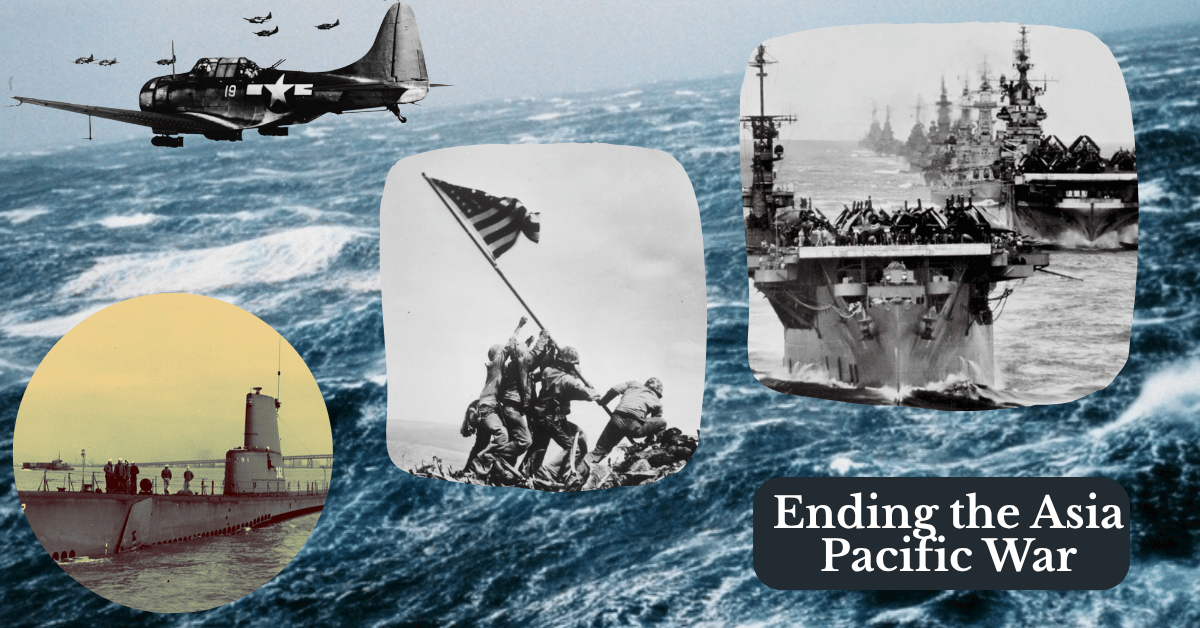
Image credit: various photographs from Naval Aviation Museum, National World War II Museum, and US Navy Archive.
The gospel reading for 5th Sunday in Lent, Lectionary Cycle A, is the account of the raising of Lazarus from the dead (John 11:1-45). The account follows the story of the healing of the man born blind (John 9:1-41). In the commentary on that gospel it was explained that the miracles (called “signs” / semeia) in the gospel according to John point beyond themselves to the divine – not just the divine as a vague power, but to a person. They identify Jesus as the light and life of the world, the bread of life from heaven, and the Logos who, through the semeia/signs, reveals his own glory, which is also the glory of God his Father, since he and the Father are one and since he does the Father’s will and works. These signs are given that we might believe (Jn 20:26). For John, sin is the failure to believe and accept the consequential changes in one’s life. All the characters of John 9 (on-lookers, neighbors, parents, the Pharisees and other religious leaders) are judged in their failure to acknowledge Jesus as Lord and Savior and to subsequently become witnesses to Jesus as the glory of God. Continue reading →

 friarmusings