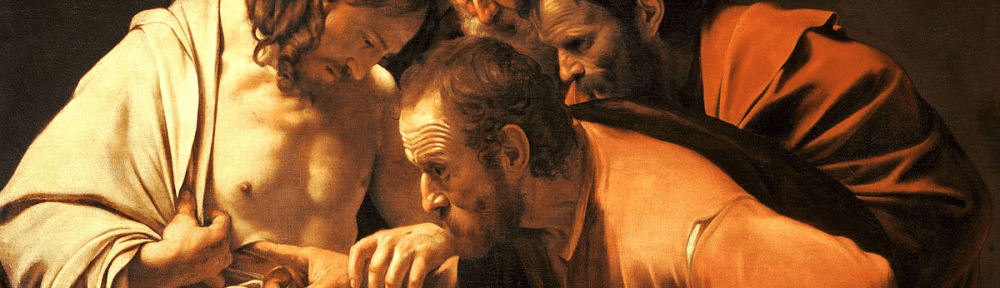
Today is the Feast of St. Thomas the Apostles. The readings include the well known account from John 20:24-29 when Thomas, in response to the testimony of the other apostles, says: “Unless I see the mark of the nails in his hands and put my finger into the nailmarks and put my hand into his side, I will not believe.” And from that episode these days he is “Doubting Thomas.” The story of Thomas’ initial refusal to believe is, of course, as old as the Gospel of John itself from the late first century. But the nickname “Doubting Thomas” and the idiomatic expression developed much later.
The Church Fathers were much more interested in what Thomas became than in his moment of hesitation. For example, John Chrysostom emphasizes Thomas’s confession, “My Lord and my God.” Augustine says that Thomas “saw one thing and believed another” i.e, he saw Christ’s humanity but confessed his divinity. Gregory the Great wrote: “The disbelief of Thomas has done more for our faith than the faith of the believing disciples” because Thomas’s careful examination became stronger evidence for later believers. None of them reduce Thomas to a permanent label. For them, the climax of the story is not doubt. It is faith.
In the Middle Ages the episode became enormously popular in art, drama, and preaching. It was usually called “The Incredulity of Thomas” (Incredulitas Thomae). This remained the standard title for centuries. The expression “a doubting Thomas” as a common English idiom appeared in the late nineteenth century, with the earliest documented English usage around 1883.
Ironically, the nickname misses John’s point; he is not primarily interested in Thomas’s doubt. The story ends with one of the highest Christological confessions in the New Testament: “My Lord and my God!” (Jn 20:28). Thomas’s story occupies only six verses (20:24–29), while Christian tradition remembers him for a single week of unbelief rather than, according to ancient tradition, decades of faithful missionary work culminating in martyrdom in India.
So, is there a more appropriate moniker? When the apostles tell Thomas that they have seen the Lord (v.25) the Greek is: Heōrakamen ton Kyrion. The verb heōrakamen is in the perfect tense and so does not simply mean “we saw him.” The perfect tense is an ongoing, continuing experience which is best understood as “We have seen him, and that experience continues to shape us.” The apostles are giving testimony.
Thomas’ reply is equally important: “Unless I see… unless I put my finger… unless I put my hand… I will not believe.” The last phrase is literally, “I certainly will not believe.” He does not say: “Jesus cannot have risen.” Nor does he argue that resurrection is impossible. Rather, he is saying: “I will not believe your testimony unless I myself experience what you experienced.”
This becomes even more interesting in the broader context of John’s Gospel. One of John’s major themes is witness (martyria). John the Baptist bears witness. The Scriptures bear witness. The works of Jesus bear witness. The Father bears witness. The Beloved Disciple bears witness. Eventually, the apostles bear witness. Thomas represents the first Christian who is asked to believe through the testimony of others. That sounds remarkably familiar. Because that is precisely the position every Christian after the apostolic generation occupies.
Is Thomas doubting the Resurrection? In one sense, yes. He has not yet come to believe Jesus has risen. But in another sense, the immediate object of his doubt is: Can I trust the testimony of these men? Remember the circumstances. Only a few days earlier these same Apostles had all fled, they were hiding behind locked doors, they were frightened, confused, and emotionally devastated. Now they suddenly claim: “We have seen the Lord.”
Thomas has to wonder if this is wishful thinking, group delusion or something else. What Thomas essentially says is “That is an extraordinary claim. I need more than your word.”
In the gospel account from this point the structure of the story provides that Jesus appears and invites Thomas to touch his wounds, but without touching Jesus, Thomas responds: “My Lord and my God!”
Then Jesus says “Blessed are those who have touched.” … wait, no He does not say that. He says: “Blessed are those who have not seen and have believed.” Jesus is contrasting those who have seen with those who believe without seeing. That final beatitude is addressed directly to later Christians who must rely upon apostolic testimony.
I think St. John intended a gentle irony. At the beginning of the story, Thomas refuses to trust the testimony of the apostles. By the end of the Gospel, the Church will ask every generation to trust the testimony of Thomas himself. Thomas becomes the witness he initially hesitated to trust.
Doubting Thomas? He was struggling to trust the witness of the very people who claimed to have encountered the risen Lord. In that sense, Thomas is the first person asked to believe because of apostolic testimony. And that is exactly where we stand. None of us has physically seen the risen Christ. We believe because the apostles saw him, were transformed by him, and handed on their witness through the Church.
That leads naturally into the first reading from Letter to the Ephesians: “You are… built upon the foundation of the Apostles and prophets, with Christ Jesus himself as the capstone.” (Eph 2:20)
The pairing of the readings is elegant. Thomas is not only the apostle who comes to faith; he is one of the apostles upon whose witness the Church is built. The Gospel traces his journey from demanding proof to becoming a trustworthy witness himself, while Ephesians reminds us that our own faith rests upon that apostolic foundation. That is a fitting message for the Feast of St. Thomas: we honor not merely a man who overcame doubt, but an apostle whose testimony continues to support the faith of the Church.
Image credit: The Incredulity of Saint Thomas by Caravaggio (Michelangelo Merisi), c. 1602 | Public Domain
Discover more from friarmusings
Subscribe to get the latest posts sent to your email.

