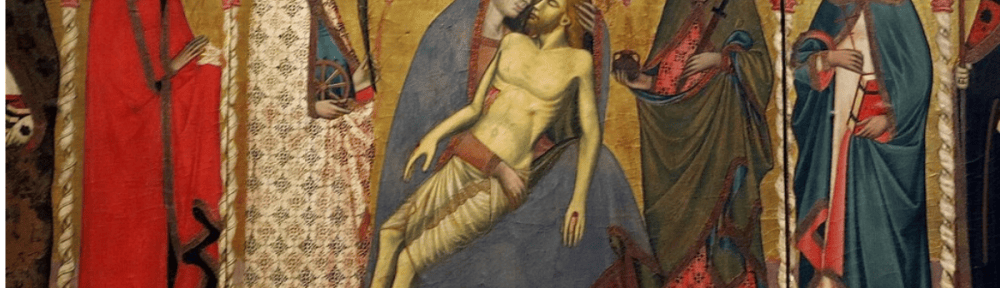
The readings today are from the Memorial of Our Lady of Sorrows which commemorates the Virgin Mary’s suffering during the crucifixion and death of Jesus. Its origins trace back to the 11th–12th centuries, with the Servite Order (founded in 1233) playing a key role in spreading devotion to her sorrows. Celebration of the feast became widespread in the 15th-century, especially in Northern Europe. It spread to Southern Europe and in 1727, Pope Benedict XIII extended it to the entire Latin Church. Today it is celebrated the day after the Feast of the Exaltation of the Holy Cross. The devotion centers on Mary’s seven sorrows:
- The Prophecy of Simeon (Luke 2:34–35): when Mary and Joseph presented Jesus at the Temple, Simeon foretold that a sword would pierce her soul.
- The Flight into Egypt (Matthew 2:13–15): Mary and Joseph fled to escape King Herod’s massacre of infants.
- The Loss of the Child Jesus in the Temple (Luke 2:41–50: Mary and Joseph searched for Jesus for three days before finding him teaching in the Temple.
- Meeting Jesus on the Way to Calvary: Mary encountered Jesus carrying the cross, witnessing his suffering.
- Standing at the Foot of the Cross (John 19:25–27): Mary endured the crucifixion of Jesus, witnessing his death.
- The Taking Down of Jesus from the Cross: Mary received the lifeless body of Jesus after his death.
- The Burial of Jesus (John 19:40–42): Mary laid Jesus in the tomb, symbolizing her final sorrow.
“Son though he was, he learned obedience from what he suffered.” (Heb 5:8) Sometimes one’s faithful “yes” to God becomes part of the cross carried by someone who loves me. Jesus’ suffering is not incidental to Jesus’ obedience. To be clear, this does not mean Jesus began disobedient and gradually learned to behave. “Learned obedience” means that the eternal Son lived human obedience experientially, all the way through suffering and death. His obedience was tested and brought to completion in what he endured. Likewise, “made perfect” doesn’t mean morally defective and then improved; the Greek teleiōtheis carries the sense of being brought to completion, accomplishing fully the vocation before him.
And Jesus’ obedience becomes Mary’s sorrow. At the Annunciation, Mary herself says: “May it be done to me according to your word.” (Lk 1:38) Obedience begins the story, but eventually Jesus’ obedience becomes something Mary herself must suffer.
Jesus’ fidelity to the Father has brought him to the Cross. Mary has not done anything wrong. She isn’t suffering because she resisted God’s will. She is suffering, in part, precisely because the Son she loves has obeyed the Father’s will. There is something profoundly human in that. Sometimes doing what God asks of us causes pain. Not only for us, but for people who love us.
A young person answers a vocation to priesthood or religious life, and parents genuinely support the vocation while simultaneously grieving the life they had imagined for their child and the grandchildren they hoped to hold. Someone in the military accepts a deployment because duty requires it; spouse and children bear part of the cost. Someone decides that integrity requires leaving a lucrative but morally compromised position; the entire family absorbs the financial consequences. Someone tells a difficult truth because conscience will no longer permit silence, and a friendship changes.
Obedience has a radius. Our decisions before God rarely affect only ourselves.
We celebrated the Our Lady of Sorrows because she does not let her sorrows obstruct Jesus’ obedience. Mary’s sorrows arise because she loves someone whose life belongs ultimately to God rather than to her.
From the beginning, with the child Jesus lost in the Jerusalem Temple, Mary begins to discover something every Christian parent eventually has to discover in a different way: the child entrusted to me does not ultimately belong to me. Love must eventually allow the beloved to answer God’s call. Even when that answer costs us something.
At the foot of the Cross on Calvary, Mary stands as witness. She doesn’t rescue Jesus from his vocation. She doesn’t demand that he abandon what brought him there. She doesn’t make his suffering about her suffering. She stands.
Sometimes faithfulness means doing. Sometimes faithfulness means enduring. And sometimes love’s most difficult obedience is simply standing beside someone while they obey God in a way we would never have chosen for them. Sometimes love says: “I would not have chosen this for you. I wish I could take it away. But if this is where faithfulness leads you, I will stand beside you.” That is Mary beneath the Cross.
And this is where our two readings converge. Jesus’ obedience says: “I will do the Father’s will, though it costs me.” Mary’s presence says: “I will remain with you, though your obedience costs me.” Neither abandons the other. Neither abandons God.
Our Lady of Sorrows teaches us another kind of obedience. We don’t have to understand everything, pretend it doesn’t hurt or even know how the story will end. Sometimes love simply asks us to do what Mary did. Stand beside the person we love while both of us remain faithful to God.
Image credit: Dossale d’altare con Cristo in Pietà e Santi | Francesco Bini, 1377 | Museo nazionale di San Matteo | PD-US
Discover more from friarmusings
Subscribe to get the latest posts sent to your email.

