Every Mass is quite remarkable: God speaks to us. We listen to readings from Scripture. At the end, the lector says, “The word of the Lord,” and we respond, “Thanks be to God.” Then the priest will begin a homily. I am often tempted to then simply ask: “Now what? We’ve heard God’s word…. And now what?”
The Gospel is clear: the family of Jesus “are those who hear the word of God and act on it.” (Lk 8:21). Given the context, some think it sounds as Jesus is distancing himself from Mary and his family. But especially in Luke’s Gospel, that can’t be the point. Mary is the exemplar of one who hears God’s word and acts on it. At the Annunciation she completely disrupts whatever plans she had imagined for her life and responds: “May it be done to me according to your word.” (Lk 1:38). Mary lets the Word change her life.
Today’s Gospel comes at the end of a whole series of teachings about hearing. Jesus has just told the Parable of the Sower. The seed is the Word of God. Some seed falls on the path, some among rocks, some among thorns. But the seed that falls on good soil represents those who hear the Word, hold onto it and bear fruit. Then Jesus tells his disciples: “Take care, then, how you hear.” (Lk 8:18) And finally today Jesus is clear that the family of Jesus, that is, disciples “are those who hear the word of God and act on it.” Jesus seems to be saying that hearing is incomplete until something happens afterward.
And Proverbs makes essentially the same point in our first reading: “To do what is right and just is more acceptable to the LORD than sacrifice.” (Prv 21:3) Notice the word: “do”. Not merely know what is right or admire it, or talk about it, but “do.”
Think about all the Scriptures we have heard: the Beatitudes, the Good Samaritan, the Prodigal Son, and more. We know Jesus tells us to forgive, care for the poor, love our enemies, not to judge and to take up our cross and follow him. We’ve heard the Word. We understand what Jesus said….and now what? What happened after I heard Him say it? When was the last time something I heard in Scripture actually changed something I did?
When Jesus spoke about forgiveness, did we finally make the telephone call we’d been avoiding? When Jesus spoke about the poor, did I become more generous? When Jesus spoke about loving our enemies did we begin praying for someone we dislike? When Jesus spoke about so many things, did we stop judging, stop gossiping, say “please forgive me?” That’s the difference between simply hearing Scripture and allowing the Word of God to become fruitful within us.
There is an interesting line in in the first reading from Proverbs: “Those who shut their ears to the cry of the poor will themselves call out and not be answered.” (Prv 21:13) Again, notice the ears. Perhaps hearing God’s Word also teaches us who else we need to hear: the lonely, those needing help or compassion. Maybe even the person who is trying to tell us something about ourselves that we would rather not hear.
We can hear the Word of God proclaimed beautifully in church and still walk outside and close our ears to the people the Word asks us to love. Jesus doesn’t simply say: “Blessed are those who hear.” He says: “My mother and my brothers are those who hear the word of God and act on it.”
In a few moments, we will come to this altar and receive Christ in the Eucharist. And then, at the end of Mass, we will be sent out. We will have heard the Word of God. We will have received the Body of Christ. Then we will walk through those doors and return to our families, our work, our neighborhoods, our ordinary lives. And perhaps that is when today’s Gospel really begins. Because the question isn’t simply: “Did I hear the Word of God today?” The question is: “What will I do differently because I heard it?”
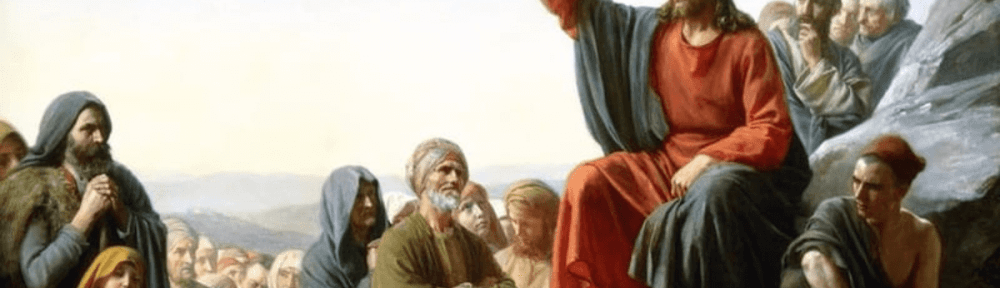
Image credit: Sermon on the Mount | Carl Block, 1887 | Museum of Natural History at Frederlksborg Castle – Hillerod, Denmark | PD-US
Discover more from friarmusings
Subscribe to get the latest posts sent to your email.

