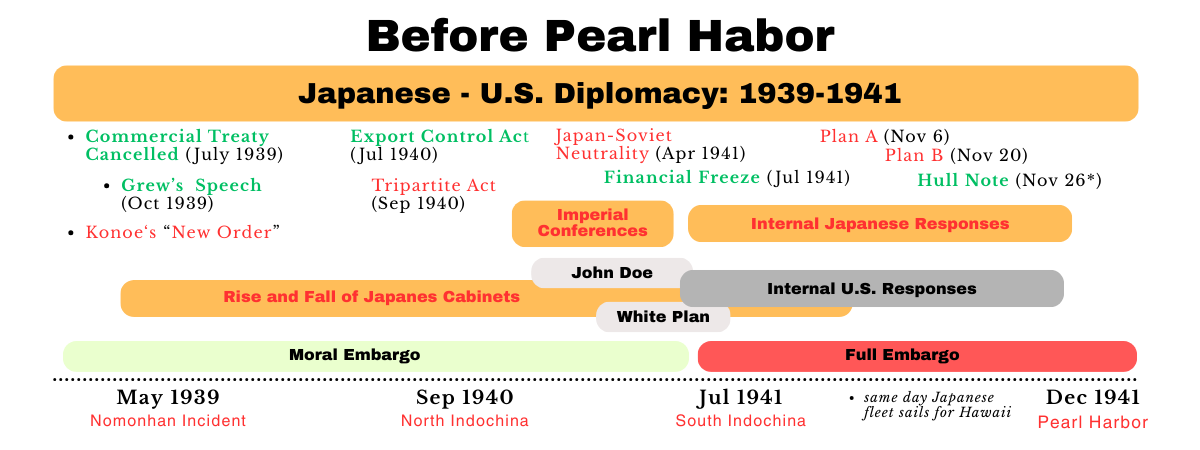
In the flow of this series we have worked our way into 1941 as we covered several key events/periods on the way. There is a lot going on – probably best to “drop a pin” to locate us in this flow of history.
The period of the “moral embargo” (1938 to July 1940) in which U.S. companies were asked to voluntarily limit exports and sales to Japan because of their aggressive behavior in China.
The Export Control Act of July 1940 which stopped the sale of high grade aviation fuel (but not all aviation fuel), scrap iron, raw steel, and other materials. The argument was that these were needed for U.S. stocks – and they were – but it was also intended to stop the sale of these items to Japan. It did not stop bulk oil sales.
In September of 1940 Japan signed the Tripartite Pact, aligning itself with the fascist nations of Nazi Germany and Mussolini’s Italy. In June 1941, Germany invaded Russia.
In April 1941, Japan and the Soviet Union signed a neutrality pact. For the Soviets, free of worry about Japanese invasion in Mongolia or Siberia (as in the 1939 Nomohan Incident) they could move troops and equipment to their western front against Germany. For Japan, it removed concerns over their northern and northwestern flanks, freeing the movement south to resource and oil rich areas to the south.
In the summer of 1941 the Japanese moved into Southern Indochina. The U.S. response was the Financial Freeze implemented in August 1941. Between the freeze and “slow roll” to approve exports, the net effect was a total oil embargo.
Another recent post discussed the unintended consequences of the financial freeze action, not only in Japan’s response, but in the less-than-unified action/reaction with the U.S. Departments of State and Treasury as there were too many “cooks in the kitchen” – Hull, Morgenthau, Hornbeck, Acheson, Grew and the list goes on. We also introduced a lot more background information on Japan’s Prince Konoe who served as Prime Minister for a long swath of time from late 1937 until late 1941. The background is necessary to understand how he will be perceived when the concept of a one-on-one summit with President Roosevelt is floated.
It’s a lot of information to keep straight and if you find it vague, disordered and confusing, so did the real time participants and 1940 and 1941. Presumptions, assumptions, misunderstandings, and more simply left the two nations at cross purposes.
There is a basic concept in communications: instantiation. “Instantiated” and “uninstantiated” communication refers to the difference between a specific, active, and concrete interaction (instantiated) and an abstract, potential, or theoretical idea (uninstantiated). Instead of talking about “a car” in general (abstract), you are talking about “my red Honda Civic” (instantiated) comparable to talking about the general idea of “bravery” without pointing to a specific, real-world example. Which is all just a fancy way of describing U.S. and Japanese diplomatic communications and negotiations. A simple way to describe it is to borrow the iconic words of the Prison Captain speaking to Luke (Paul Newman) in Cool Hand Luke: “What we’ve got here is failure to communicate.” The U.S. would offer general fundamental concepts (Hull’s Four Points) without detailing specific required actions. But then in another round, the actions were very concrete (“withdraw from China”) and did not take into considerations either military ability, public reaction in Japan, and the political liability to a Japanese figure who might support the idea – even as the start of negotiations. The U.S. was well aware of the very recent history of assassinations and even the ill-fated 1936 coup attempt by a radical element of the military.
On the other hand, Japan would ignore the four principles and then offer a response but it was uninstantiated in that the response was always open ended, contingent on some future state of things, e.g., the French Indochina government asks us to leave after they have had free and fair elections (… as we continue to occupy their nation). The U.S. reaction was mostly, “they’re stalling and not to be trusted.” The Japanese reaction was leaving things open ended in order to explore what new concessions would be wrangled. An example was:
U.S. – respect recognized national boundaries and do not interfere in the internal dynamics of another nation. If that sounds like the Treaty of Westphalia in 1648 (for all you history buffs) you’d be correct. It was Hull’s basic approach. From those fundamental principles, Japan “had” to understand that meant withdrawing from China and not interfering.
The Japanese response: we will withdraw from China two years after they settle their own internal struggles between the Nationalists and Communist Chinese factions and if the new government asks us to leave… and since we have agreed to your terms, please send oil now…. and by the way, Manchuria is not part of China. It is the nation of Manchukuo (that no foreign government recognized) and a friend to Japan.
That wasn’t exactly the diplomatic conversation, but it was exactly the dynamic between the principal diplomats. The backroom chatter from within the various U.S. and Japanese factions, ministries and departments only added to the cacophony of misunderstanding.
The purpose of this post was to “drop a pin” so that we could locate ourselves in the series. We are moving from 1940 into 1941. The above style of diplomatic exchange is becoming de facto. Factions within each government are hardening their positions. And cast over all of this are the presumptions, assumptions, misunderstandings that left the two nations at cross purposes only exacerbating the communications.
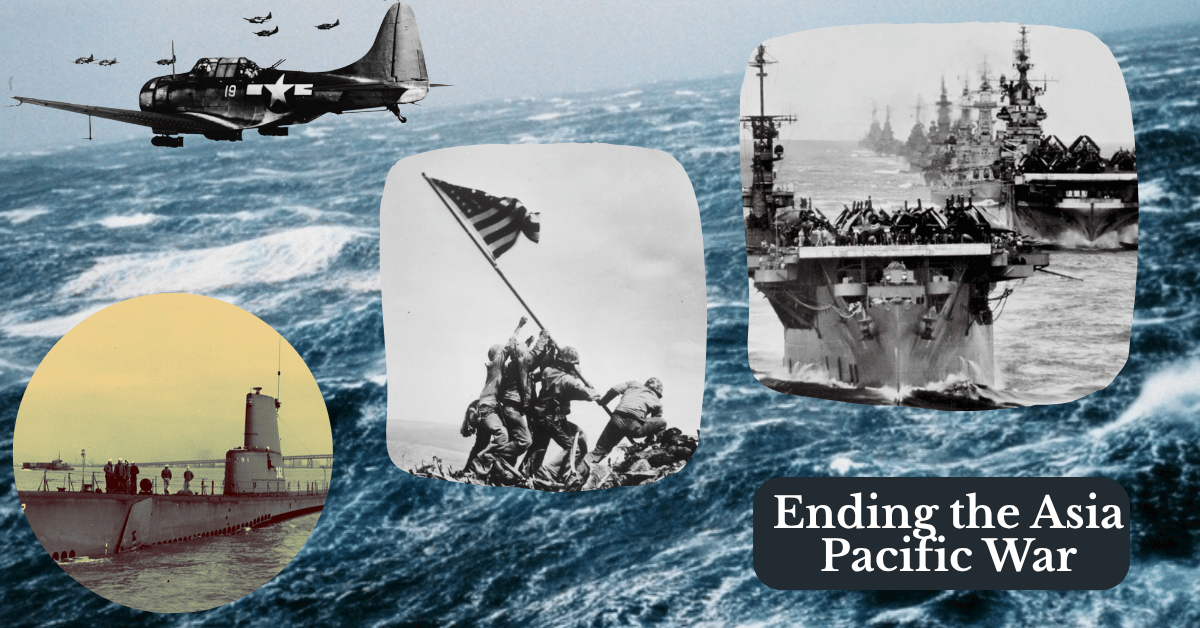
Image credit: various photographs from Naval Aviation Museum, National World War II Museum, and US Navy Archives.
This coming Sunday is the 2nd Sunday in Lent. In yesterday’s post we considered the event of the Transfiguration itself. In today’s post we look at the theological elements of what Matthew likely intends in recounting the event: And he was transfigured before them; his face shone like the sun and his clothes became white as light.
The Transfiguration is a familiar account appearing in all three synoptic gospels. Perhaps it is too familiar and thus we are tempted to accept it and not stop and consider the significance of it. A limited number of modern scholars describe the narrative as a misplaced story of Jesus’ resurrection, his second coming, his heavenly enthronement, and/or his ascension. In other words, Matthew inserted/retrojected a story here for his own narrative purposes. Under such a provision lies some misgivings about miraculous and extraordinary events. But should we really have been surprised by the events of the Transfiguration and their location in the Matthean narrative?
The transfiguration of Jesus is an amazing event but not totally unexpected for Matthew’s readers. After all, Jesus had a miraculous birth, and his ministry began with the divine endorsement of his heavenly Father at the River Jordan baptismal scene (3:17). Jesus had done extraordinary works of compassion, demonstrated power over nature, and had taught the Law with an authority that was above and beyond any earthly authority. He had demonstrated supernatural power by feeding thousands of people with a few loaves of bread. Thus, Jesus’ transfiguration seems consistent with all that has been revealed so far in the gospel. Among the many things Matthew has narrated, we know this: Jesus is the Son of God, the fulfillment of Old Testament patterns and predictions, and he has promised a future Kingdom – a Kingdom whose proclamation and promotion will face continued conflict in Jesus’ remaining time as well as during the ministry of the disciples.
The account of Transfiguration echoes what has come before it in Matthew’s gospel and points to what is still to come. Consider the following:
The transfiguration story recalls the baptism of Jesus and the voice from heaven designates him both the powerful Son of God and the weak suffering Servant (cf. 3:17). This commission is reconfirmed as Jesus begins to instruct his disciples on the meaning and cost of discipleship (16:24–28). Thus it is important that the scene follows the first passion prediction, confirming from heaven what had been questioned by Peter (16:23).
The transfiguration story recalls and confirms Peter’s confession (16:16). Although Peter was divinely inspired to confess, he still did not seem to grasp the full significance of that revelation. The transfiguration is its own witness to the fullness of the revelation.
The transfiguration story connects the confession of Jesus as Son of God and Jesus’ self-identification as Son of Man who suffers, is killed, and is vindicated by God, and will appear as judge at the parousia
The transfiguration is a momentary uncovering of the Son of God’s own intrinsic glory, which has been temporarily veiled and will be revealed again at the resurrection and ascension (John 17:4–5, 24; Phil 2:5–11; Col 1:16–19; Heb 1:1–4). The transfiguration story anticipates the events of the Resurrection.
The transfiguration is an integral part of Matthew’s high Christology and his eschatology. It authenticates both Jesus’ divine identity and God’s plan to occupy this world and rule it forever.
By the transfiguration, the disciples were given a glimpse of not only who Jesus is but also what he will one day bring to this world (see 2 Pet 1:16–18). Moses and Elijah are important figures, but they are not the main actors in the redemptive drama the disciples witness. As the scene ends, Moses and Elijah have exited, and only Jesus remains in the center of the stage. The “listen to him” of the transfiguration will become the “teaching them to observe all things I have commanded you” of the Great Commission (28:18-20)
And thus the transfiguration has significance for us. It gives us a glimpse into our destiny. Transformation begins already in this life. Seeing the glory of the Lord in the Spirit, the disciples are reminded that they were created in the image of him whose glory they see (2 Cor. 3:18). This is not mystical deification but a recovery/re-recognition of the divine likeness. It takes place in the ministry of the Spirit. It is not for an elite few but for all Christians. It is not just a hope for the future (cf. 1 Cor. 15:44ff.) but begins already with the Resurrection and the coming of the Spirit. It carries with it an imperative: “listen to him.” A significance of the transfiguration is that we obtain a glimpse of what we are and are becoming. As St Irenaeus famously said centuries ago: “The glory of God is the human person fully alive.”
Today’s first reading is one of my favorite chapters of the Old Testament: Isaiah 55. It always reminds me of the parable of the Sower and the Seed from the gospels with the Word of God being sent into the world on good and poor soil alike.
Starting in Isaiah 40, the prophet begins to describe the end of the Babylonian Exile period and the triumphant return of the People of God to Jerusalem. By the time the Prophet’s narrative arrives at Isaiah 55, Israel is invited to seek the Lord anew, forsaking the choices and ways that got them into Exile in the first place (Isaiah 55:6-7a). It is not the simple moral imperative, it is a reminder that echoes the beginning of Exodus 20: “I am the LORD your God, who brought you out of the land of Egypt, out of the house of slavery; you shall have no other gods before me” (Exodus 20:2-3). The Lord is now delivering them from Babylon with the same admonishment that the people received in Deuteronomy 34: choose life.
Isaiah has told them that they received what their choices deserved, but now they are encouraged to turn away from that which led them toward death and to turn again to the God of restoration and pardon. It is an OT moment: “Repent and believe in God’s Word” that echo the words of Ash Wednesday: “Repent and believe in the Gospel.” The people hearing Isaiah’s words are called to believe that God’s mercy and pardon triumph over God’s wrath. It is God’s mercy that gives life – and in today’s first reading Isaiah offers an illustration from the world around them.
“Just as from the heavens the rain and snow come down and do not return there till they have watered the earth…”
The heart of the image here is life. The earth is not that which gives life; it is the rain and snow, moisture from above, that causes the earth to proliferate, “making it fertile and fruitful, giving seed to the one who sows and bread to the one who eats.” Without the moisture, fertile and fruitful life shrivels-up. The power and the life is in the rain and snow.
The power and the life is in the Word of God: “So shall my word be that goes forth from my mouth; It shall not return to me void, but shall do my will, achieving the end for which I sent it.” And what is that end? Repentance, faith, and salvation. We participate in this work of God. We don’t add to this work or validate it or accomplish it. This is God’s work done by way of God’s Word proclaimed.
And in Isaiah 55:12, the next verse just outside our reading Isaiah tells them that if the listen to the Word of God, take it as the compass of their journey in life, “Yes, in joy you shall go forth, in peace you shall be brought home; Mountains and hills shall break out in song before you, all trees of the field shall clap their hands.” Even the very earth will give witness to the power and life in the Word of God.
The Word of God has come to you again and again in your lifetime. Have you allowed it to make your life fertile, fruitful, and cooperate in God’s work in this world? Yes? Then in joy may you go forth to let that Word work in you to accomplish its end.
Image credit: Detail of “Sower Went Out to Sow” | Irish Dominican Photography | Brasov, Romania | CC-BY
In previous posts, we have tried to trace the Japanese strategic commitment to the southern strategy focused on the resource rich Southeast Asia mainland and Pacific Islands. The movements into Indochina brought about increasingly more stringent export controls and licensing for Japanese concerns, ratcheted up and hardened positions inside and outside government – especially within Japan where when the “military coughed, the Japanese cabinet developed pneumonia and collapsed.” With each cycle, the military was increasingly dominant in Japanese policy and strategy. There was a lot going on…
The “roadmap” above is nowhere as complex as the underlying reality and labyrinth pathways. Over the next several posts, the conversation will advance along threads that move from January 1941 until Pearl Harbor on December 7, 1941. Those posts are meant to be part of the buildup of background to understand organizations, factions within organizations, government departments, key persons and personalities, and more – all to set the context as we move ahead.
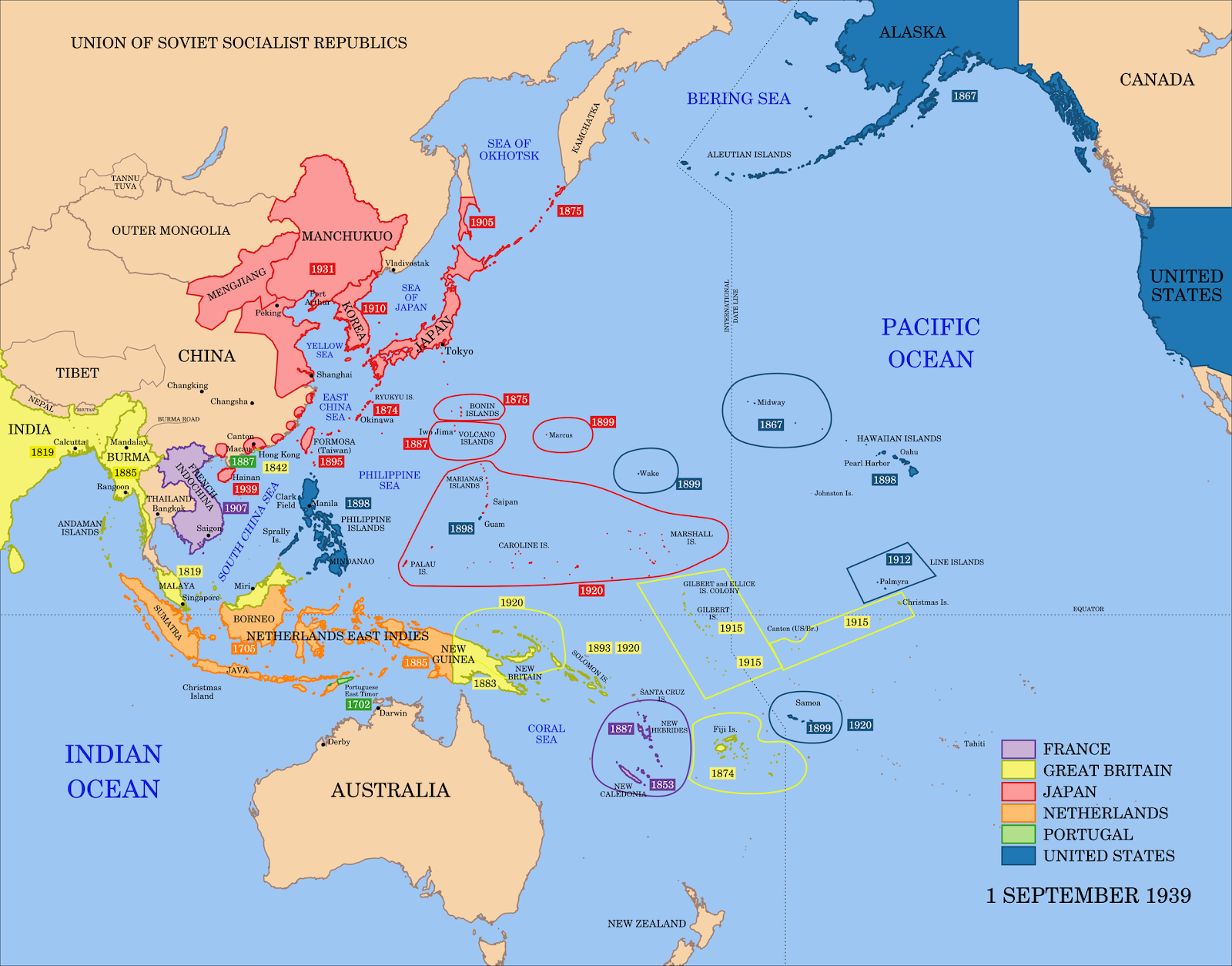
Back in one of the first posts, I asserted that the August 1941 “oil” (full) embargo did not start the war. The war in the Asia-Pacific region was already underway. One only needed to ask the Chinese, Vietnamese and Mongolians, as well as the Koreans. The full embargo of late July 1941 was a calculated political action by the U.S. in reaction to the Japanese occupation/invasion of French Indochina. It was a political action whose hope was to deter Japan from further expansion even further south to Hong Kong, Malay, Java, Borneo and the rest of the Dutch East Indies. Consider the map below (Sep 1939) and then add Indochina (Vietnam) and one can see Japan’s dagger is clearly aiming south.
To focus on only the oil embargo because Japan’s “economy” needed it, one has to remember it was a wartime economy that had already led to the deaths of 7 million Chinese by July 1941. Even if one chooses to only focus exclusively on the full embargo, one can ask:
Was the embargo the decisive reason why Japan attacked Pearl Harbor or just more proximate than a collection of other reasons that was denying Japan unfettered access to war resources?
The U.S. understood the goals for Japan southwest incursion, but did the U.S. truly understand the underlying motivations? I would suggest the U.S. perfectly understood Japan’s motivations and disagreed on moral and political grounds. Japan was fascism in the Asia-Pacific region – aligned to the fascist nations of Europe via the Tripartite Act.
Did the U.S. have a clear understanding of the internal Japanese dynamic that increasingly marginalized any peace/negotiation faction as the military grew in stature and power? This was the shift that was transforming a potential Asia-Pacific trading partner into a deadly rival fixated on status, honor, and establishing its equivalent of the Asia-Pacific Monroe Doctrine.
Was the embargo a virtual declaration of war hoping to draw Japan to military action so that the U.S. could enter the war in Europe? If so, then why was the U.S. so unprepared to fight any war, much less a two-ocean war?
Clearly the December 1941 and early 1942 “blitzkrieg” across Southeast Asia, the Southwest Pacific, and Central Pacific regions accomplished the mission of (a) capturing the resource rich nations and (b) setting a “line of defense” west of Hawaii. Was the attack on Pearl Harbor necessary for the plan to access the resource rich lands to the southwest of Japan? Couldn’t they just have moved south and left a “blocking force” against the Philippines and prevented U.S. resupply?
How did Japan so misjudge the U.S. public’s reaction to Pearl Harbor? Thanks to the movie “Tora!, Tora!, Tora!” we have Admiral Yamamoto, the architect of the Pearl Harbor attack, iconically uttering, “We have awoken the sleeping giant.” He never said that, but he should have because he clearly understood Japan could not win a protracted war.
Most, if not all, of the questions are not simply military moves and political reactions – but they form the milieu in which diplomatic dialogue swims. The external and internal dynamics make the path to diplomatic resolution akin to walking a moonless night in the wilderness with but only a lighted candle to show the way. There is light but its glow only reveals so much of the dark night. And as we will see in a later post, there are lots of things that “go bump in the night.”
Image credit: various photographs from Naval Aviation Museum, National World War II Museum, and US Navy Archive. | Mapworks | Original timeline by G. Corrigan
This coming Sunday is the 2nd Sunday in Lent. In yesterday’s post we reviewed the theme of conflict which is a recurring theme throughout Matthew’s gospel – a conflict which is building heading toward the events of Holy Week, a week in which the faith of the disciples will be sorely tested. In today’s post we consider the event of the Transfiguration itself.
Matthew 17:1-13 is an instructional session for all the disciples – note that in v.10, Peter, James and John have joined the remainder of the group. Just as the preceding scene (16:13-28) juxtapositions the divine transcendence of Peter’s confession of Jesus as Son of God based on a revelation from heaven (16:17) with Jesus’ own teaching about the suffering Son of Man, so also in this scene the confession of the heavenly voice is juxtaposed with Jesus’ self-confession as suffering Son of Man.
The description of the Transfiguration is brief—just the first three verses of Matthew 17. But the incident becomes the context for two significant incidents for the disciples.
In the first, Peter’s hasty response to the glory of the Lord (…make three tents) is corrected by the same heavenly voice heard at Jesus’ baptism (17:4–8; cf. 3:17).
In the second, Jesus once again forbids the disciples to make him known (cf. 16:20), which leads to their question about the future coming of Elijah (17:9–13).
Jesus answers their question cryptically in terms of a past coming of “Elijah,” and when he compares his own future suffering to what has happened to this “Elijah,” the disciples finally grasp that he is speaking of John the Baptist. Thus, the passage contains the transfiguration proper (17:1–3), a lesson on the fulfillment by Jesus of all that is promised in the Hebrew scriptures (17:4–8), and a lesson on the continuity of John the Baptist with Elijah of old and with Jesus himself (17:9–13).
This second phase of the series on the Asia-Pacific War began with a goal of discovering if there was merit to the claims made by some historians that in the summer and autumn of 1941 the United States missed diplomatic opportunities that could have avoided war with Japan and at the same time took a series of economic actions that brought about U.S. involvement in the Second World War. The exploration has taken us from the pre-history to Japan of the early 20th century discovering currents, trends, events, personalities and changes that brought that nation to 1937. Along the way we considered the complex and evolving nature of Japan’s relationships with China, Korea, Russia, and the United States. All of this (and far more) were the ingredients in the mix that formed Japan’s strategic, economic, political, and civil policies.
A Future of the Asia Pacific Region
These policies brought Japan and the U.S. to a crossroad each having different objectives and visions of their roles and future in the Asia-Pacific region. The U.S. was committed to its own Westphalian vision of the world as its fundamental principles: democratic government (without kings or emperors), open markets with fair and free trade (at least in theory), respect for national boundaries and sovereignty (with an aversion to classic colonialism but with a Monroe Doctrine), and non-interference with the internal governance of another country (but trade and the Monroe Doctrine were priorities). Without a doubt that is so general a description it suffers in accuracy, but it has points and exceptions. Some of the exceptions are striking: Admiral Perry’s presence in Tokyo Bay ostensibly to open up trade in the western Pacific, the annexation of Hawaii, the territories of Guam and the Philippines, and its business interests in China. What was a fundamental driver of its Asia-Pacific ambitions? Business. The U.S. was a nation of massive natural resources, industrial power, financial wealth, and at least in a business sense, a drive to be a market leader. It was a country with minimal import needs and massive export capacity.
Japan was an island nation of limited key material natural resources, limited land for agriculture, a net importer of strategic raw materials and in the 20th century was over populated and a net importer of basic foodstuffs, even rice. While in its own history Japan had never been successfully invaded it was always concerned to the point of obsession with its vulnerability to invasion and embargo. The fall of the once great China to its state in the 19th and 20th centuries was a clarion call to protect Japan from the grip of the western colonial powers. This gave way to the transformation of the feudal samurai system to a modern army and navy based on European models, ultimately leading to rise in militarism that was only enhanced by Japan’s defeat of China and Russia within a 10 year period. Now it was ready to take its place and be recognized as a world power with a special sphere of influence in the western Pacific – a role and recognition it never received, only enhancing its sense of vulnerability to the western powers.
Colonialism and Racism
Japan abhorred western colonialism yet it had colonial ambitions for Korea (annexed in 1910) and Manchuria (conquered by 1932 and renamed the independent nation of Manchukuo) for both strategic buffer and for emigration of its people and access to food and raw materials. It participated in world trade but with a wary eye seeing what the “Open Market” policy (a U.S. initiative) had done to China. The Meiji Restoration and Constitution’s governance appeared as liberal democracy akin to Britain – and in many ways it was growing into it – but the military had an outsized place in the nation and without civilian control. The military was responsible only to the Emperor.
When modern people consider the 1942 internment of west coast U.S. citizens of Japanese origins, it is commonly held that it was basic racism and unwarranted fear that motivated the action. It was primarily fear and national politics, but that was just the immediate context for the underlying racism in California – which was present elsewhere. The U.S. federal government had to inject itself into California politics when the state passed laws restricting land ownership and segregating schools that applied only to Japanese. But in 1924, the federal government passed the 1924 Immigration Act which specifically excluded Japanese from U.S. and all territories, e.g. Hawaii. In 1924, 40% of Hawaiian residents were of Japanese origin. The U.S. was just more overt about racism as Japan had its own form.
Japan viewed all westerners as decadent, weak, uncultured and morally inferior. At the same time, this anti-Western racial critique coexisted with hierarchical and discriminatory attitudes toward other Asians, especially Chinese and Koreans, who were frequently described as backward and in need of discipline. The result was a contradictory worldview: Japan opposed Western racism in principle, yet practiced its own racial and cultural hierarchy in Asia, a tension that shaped both its propaganda and its imperial conduct in the 1930s.
A Cautious Eye
These were the two nations that arrived at the crossroads of the 20th century each casting a cautious eye towards the other, each sensing that the other would be the inevitable rival. Early in the century each country, as is prudent, developed “what if” war strategies. Both countries were adherents of Mahan’s theory of naval power (The Influence of Sea Power upon History) and saw in each other threat to their own ambitions. Each nation’s naval war colleges developed and adjusted its Pacific strategies. Virtually every senior naval leader in the Pacific had studied these and contributed to it as new circumstances, technology, and situations arose. As one historian noted: “it was part of their DNA.”
Japan’s army faced west and northwest to expand its colonial ambitions on the Asian mainland. Japan’s navy faced south to the oil rich regions of the Pacific island nations as it also faced east to the U.S. its current major supply of oil and ship building materials. The U.S. navy had missions in the Atlantic and Pacific but only enough assets for a “one-ocean navy”. After World War I, the U.S. interest was controlling navies and the status quo. This led to the 1922 Washington Conference that established limits on capital ships. It also ultimately led to deep divisions with the Imperial Navy. One faction knew it could never match U.S. industrial power and wanted to avoid a naval arms race and was satisfied that the limits were within the Mahanian theory in that the U.S. would have to transit the Pacific Ocean. The other faction was more driven by an ideology of the Navy as the ocean guardian of the Imperial destiny of a greater Asia led by the Emperor. The Washington treaty was a barrier and worse, an insult to national honor.
Key Figures at the Crossroads
By 1937 it seems fair to say that Japan was a nation with an amazing degree of disunity within – and a single key to the unity of the nation as a whole: the Emperor and the idea of kokutai – and these were not clear to West nor it seems to Emperor Hirohito himself as to the role he could play.
Historians do not agree on the role Hirohito played in the path to the Asia Pacific War. He was the Commander-in-Chief of the armed forces, yet his Kwantung Army in Manchuria feels free to do what it wants, not expecting and not receiving punishment for their actions. Emperor Hirohito’s response to incidents such as the Marco Polo Bridge affair was to “fire” the Prime Minister but not to take any action within Army ranks. This does not seem to indicate Hirohito feels he should be an absolute monarch or even the “buck stops here” commander-in-chief. The range of views includes Herbert Bix’s assessment that Hirohito was an active, knowledgeable, directive monarch and had a key role in strategic military decisions. There is historian Stephen Large’s idea of “self-induced neutrality” in which Hirohito knew his power and authority but withheld its use to allow others to lead. The historian Peter Wetzler’s version is that the Emperor periodically put his thumb on the scale but he did not see himself responsible for the result. This version sees Hirohito aware of Japanese atrocities but taking no action to intervene but in the end it was Hirohio’s “thumb on the scale” that ended the war.
And yet the man and his role in Japanese governance was unclear at best to 1940 Washington leaders. But hardly less clear were key government positions. Between July 1937 and December 1941 there were nine different people serving in the role of Foreign Minister. There were six different Prime Ministers in that same period although Prince Konoe served for a total of 12 months and during critical periods.
In that same period Roosevelt was President and Cordell was Secretary of State – but they were not always on the “same page.” Hull was very territorial of his role and believed the role of the President was to set macro-level policy and everything else was the purview of the Secretary of State. But Roosevelt dabbled in foreign policy from time to time. Hull’s irritation with Roosevelt’s “dabbling” in Japan policy between 1937 and 1941 stemmed from the president’s habit of personal, informal, and sometimes contradictory diplomatic initiatives, which Hull feared undercut coherence, leverage, and credibility.
Roosevelt was noted and preferred back-channel and personal diplomacy. Most notably, FDR repeatedly encouraged or entertained the idea of a personal summit with Japanese leaders (especially Prince Konoe in 1941), sometimes through intermediaries or informal messages, without firm preconditions. Roosevelt also floated tentative peace feelers, exploratory trial balloons, and hypothetical compromises often orally, ambiguously, or indirectly rather than through formal diplomatic notes. In addition, FDR occasionally made public statements or private assurances that suggested flexibility (or restraint) that had not been fully coordinated with the State Department.
Hull’s experience was that Japan used negotiations tactically to buy time while consolidating aggression in China and preparing for further expansion. Roosevelt’s informal probes, in Hull’s view, risked sending mixed signals about U.S. resolve and principles, weakened bargaining leverage by suggesting concessions before Japan changed behavior, undermined State Department control over a carefully constructed, principle-based negotiating position, and encouraging Tokyo to believe that persistence or pressure might extract a deal from the president personally
Hull favored clear, written, multilateral, principle-driven diplomacy (non-aggression, territorial integrity, Open Door), whereas Roosevelt favored personal flexibility and strategic ambiguity. To Hull, the president’s “dabbling” threatened to turn diplomacy into improvisation at precisely the moment when clarity and firmness, he believed, were essential.
Even though our “cast of characters” was consistent, Hull was concerned the “message” was not. This added a degree of uncertainty to any dialogue that was compounded by the frequent changes in Japan. As one might imagine this was the tip of the iceberg. More details were provided in the post American Diplomacy in 1937 which describes a lack of unified thinking with the State Department.
The Crosses
There are cross purposes, crossroads, crossed messages and more. In July 1940, the United States initiated significant export restrictions against Japan by passing the Export Control Act which allowed the President to license or prohibit the export of essential defense materials. Roosevelt restricted licenses for high-grade aviation gasoline, lubricating oil, and certain iron and steel scrap. These measures aimed to curb Japanese aggression, specifically in response to pressure on French Indochina, without triggering an immediate, total war-inducing oil embargo. In general, they were also intended to impact Japan’s aggression in China. These actions followed earlier 1938–1939 “moral embargoes” on aircraft and raw materials. All this complicated any foreign policy dialog between nations that were only going to become more difficult.
In November of 1940 retired Admiral Nomura was assigned as Ambassador to the United States. When Emperor Hirohito was in his teens, Nomura was one of his private tutors. He also served as Naval Attache in Washington DC when Franklin Roosevelt was Assistant Secretary of the Navy. They were friends and so it was hoped that the connections to the leaders of the two nations would help communications. But neither the Foreign Ministry nor State Department wanted such channels open and required formal communications through the usual chain.
Ambassador Noruma was also not in the mainstream of senior naval officers as he was known to be a supporter of the 1922 naval treaties. He understood that the U.S. was the nexus between industrial power and ultimate sea power. He was also one of the few senior people who understood that the American public would see any Japanese-U.S. conflict as a battle of fascism vs. democracy, and also if Japan moved against British interests in the Pacific, Britain would be fully supported.
He recognized that the only bulwark to prevent Japanese-US conflict would be if senior naval leadership acknowledged that Japan could not prevail in a protracted war with the United States nor would there be the “decisive battle” that caused the U.S. to negotiate a peace. Once bloodied, the U.S. could bring its industrial power to bear and in the interim the American public would give enduring support to war efforts. All of these positions were mixed at best among senior naval leaders. Among mid and junior naval officers these were discarded as weak thinking. This group was very positive about the Tripartite Pact with Germany and sought distinction in a naval move into the Southwest Pacific.
Nomura made his views known to Navy Minister Oikawa and Fleet Admiral Yamamoto who agreed. Yet former Prime Minister Yonai (a naval officer) warned Nomura that he was being sent as the scapegoat. He warned that Foreign Minister Matsuoka would take credit for any success and blame Nomura for setbacks and failures. At best Matsuoka would sweep into Washington DC with a separate agenda and negotiate as he had done in Berlin and Moscow.
As one dedicated in service to his nation, he accepted the position. And in a harbinger of things to come he was sent without specific policy instructions.
When he arrived in Washington DC his naval attache was Capt. Yokoyama with whom he had served in the Military Mission in Britain years before. Yokoyama shared Nomura’s ideas and perspectives. But the American concerns in that time period were not Japan. The administration was focused on Europe having established a “Europe First” policy. The goals were munitions and supplies to Britain and convoy escort and protection. U.S. Chief of Operations Stark (the title was actually different) bluntly told Nomura that war with Japan was “when, not if.”
This is the diplomatic milieu facing Japan and the United States at the beginning of 1941.
Stay tuned…
Image credit: various photographs from Naval Aviation Museum, National World War II Museum, and US Navy Archives.
On this day in February 1945 on Iwo Jima, four days after the initial landings, Harold G. Schrier led a 40-man patrol up Mount Suribachi with a small American flag provided by Chandler Johnson. After a brief firefight with Japanese defenders, the flag—reportedly obtained from the attack transport USS Missoula (APA‑211)—was raised over the crater. Later that day, a larger eight-foot ensign from the tank landing ship LST‑779 replaced it. As Marines struggled to hoist the second flag, John H. Bradley and fellow servicemen were captured on film by Associated Press photographer Joe Rosenthal, creating one of the most iconic photographs of the twentieth century.
Image credit: Raising the Flag on Iwo Jima, by Joe Rosenthal of the Associated Press |Wikimedia Commons
This coming Sunday is the 2nd Sunday in Lent during Lectionary Cycle A. The Lenten readings have their own pattern. Regardless of the Cycle, the reading of the 1st Sunday in Lent is one of the Temptation in Desert accounts. The account of the Transfiguration is proclaimed on the 2nd Sunday of Lent, while the following three Sundays each reveal something about the covenant or salvific mission of Jesus. The sixth Sunday is always the Palm Sunday/Passion Sunday account.
The “Transfiguration” is the traditional gospel reading for the 2nd Sunday in Lent and is taken from Matthew 17. Jesus and his disciples are no longer in Galilee – they have withdrawn to the area of Tyre and Sidon (15:21). But they have not escaped on-going conflict with different sectors of secular and religious life. Conflict is one of Matthew’s key themes which occur throughout the gospel. This key motif moves the plot and portrays the struggles involved in the advance of the Kingdom (cf. 11:12). At the outset of Matthew’s story, there was conflict between Herod the Great and the infant Messiah just born in Bethlehem (ch 2). John the Baptist announces Jesus and conflict arises between him and Israel’s religious leaders over genuine righteousness (3:7ff). Satan himself tries to tempt Jesus to gratify his human needs and accomplish his messianic mission in ways that were disobedient to the Father (4:1–11).
Once Jesus’ public ministry began, his teaching about righteousness in the Sermon on the Mount clashed with that of the religious leaders (5:20–6:18), and the people were quick to pick up on the contrast (7:28–29). This led to further, more intense controversies about the forgiveness of sins (9:1–8) and Jesus’ associating with sinners (9:9–13). His ministry of exorcism led to the Pharisees’ charges that he was collaborating with the devil (9:34; 12:22–24). Soon he had to warn his followers that their ministries would be attended with much opposition (10:16ff; cf. 24:9).
Many of the people who heard Jesus’ teaching and saw his miracles did not repent and follow him, and he denounced them for their unbelief (11:16–24). The rules of Sabbath observance occasioned a heated dispute (12:1–14); and after that, skeptical religious leaders with evil motives asked Jesus for a sign (12:38; cf. 16:1–4). Jesus’ parables of the Kingdom of Heaven also spoke of conflict engendered by varying responses to the message of the Kingdom (13:19–21, 38–39). Even the people in his own synagogue in Nazareth did not believe in his message (13:53–58). Jesus’ teaching about inner purity clashed with the Pharisaic tradition of ritual purity through washing hands before meals (15:1–20; cf. 16:5–12).
Yet Jesus draws the good from the conflict: he prepares his disciples for mission (Mt 10) and for leadership following his own eventual departure – and the conflict they will face during their ministry. A key aspect of that preparation is that the disciples clearly know the identity of Jesus. This is made clear in Matthew 16:13-21 when Jesus asks his disciples, “Who do people say that the Son of Man is…But who do you say that I am.”
With Jesus’ identity confirmed among the disciples, their formation continues. R.T. France refers to the section surrounding our gospel readings as “Private Ministry In Galilee: Preparing The Disciples” and outlines it as follows:
A. Teaching on Jesus’ mission (16:21–17:27) i. First announcement of Jesus’ suffering and death (16:21–23) ii. Discipleship will also involve suffering (16:24–28) iii.A vision of Jesus’ glory (17:1–13) ⭠our reading iv. The power of faith (17:14–20) v. Second announcement of Jesus’ suffering and death (17:22–23) vi. The question of the temple tax (17:24–27)
B. Teaching on relationships among the disciples (18:1–35) i. True greatness (18:1–5) ii. On stumbling-blocks (18:6–9) iii. Care for the ‘little ones’ (18:10–14) iv. ‘If your brother sins …’ (18:15–20) v. Forgiving personal offenses (18:21–35)
At the beginning of Mt 19, Jesus and the disciples return to Judea.
And sin entered the world. In the second reading, St. Paul is pretty clear that sin entered the world through Adam and Eve. Did you ever stop to think about what exactly was the first sin? Maybe it is as simple as disobedience. “The LORD God gave the man this order: You are free to eat from any of the trees of the garden except the tree of knowledge of good and evil. From that tree you shall not eat; when you eat from it you shall die.” (Gen 2:6-7) That seems awfully clear… lots of trees, lots of fruit, help yourself, but not from that one tree. Awfully clear and awfully tempting. We get to listen to Eve’s thoughts as Satan tempts her: “The woman saw that the tree was good for food, pleasing to the eyes, and desirable for gaining wisdom” (Gen 3:6) I suspect I had many the same thoughts when as a child, I stood before the open refrigerator door staring longingly at the last piece of key lime pie – so good, so pleasing to the eye… and there was mom talking from the next room, “Have a piece of fruit. It’s good for you.” You can guess how that story ends. In my case, it was clearly disobedience, but I am not so sure about Adam and Eve.
Satan is not holding up the most awesome piece of fruit ever known to humankind. Satan is holding up the possibility that Adam and Eve can be something other than what they are – that they are not exactly adequate or secure in their present state. Satan is tempting them to not trust God and long for something they are not. “God knows well that when you eat of it your eyes will be opened and you will be like gods” (Gen 3:5) And there it is “be like gods.” There is the temptation. Maybe the sin is forgetting who they were, who they were created to be – stop trusting God. And sin entered the world through the first Adam.
The Gospel opens with the second Adam (as St. Paul often refers to Jesus.) Immediately following Jesus’ baptism in the River Jordan, the Spirit leads Jesus into the desert. This is no Garden of Eden, there is no abundance of fish, fowl, and fruit – there is hunger. And there is Satan. Sa’tan, the ancient word for “tempter” – and Satan is doing what Satan does. He is not here to get Jesus to be disobedient to his heavenly Father, Satan wants Jesus to be something other than what his Father has sent him to be. Satan wants Jesus to trust a new plan, not the one his Father has established to bring new life to the world.
“If you are the Son of God…” Interestingly, an equally good translation is “Since you are the Son of God…” There’s no doubt Satan knows who he is dealing with. “Since you are the Son of God and you are hungry, turn these stones into bread. In fact, turn all these stones into bread, because it is not just you who are hungry, the whole world is hungry. They are hungry for food, hungry for leadership, hungry to follow the One who will lead them to the kingdom. Think about it. As bread, wouldn’t these stones be good for food and pleasing to the eye?”
At this point this Satan dialogue should sound oddly familiar to a conversation in the Garden of Eden.
“OK, how about this… let’s go to Jerusalem, to the highest tower on the Temple, where everyone can see you, and since you are the Son of God, let the people know. Throw yourself off. Make it spectacular and when the angels come to catch you, then everyone will know and follow you. Isn’t that what your Father wants? For everyone to follow you? Come on… work with me! I can make you great!” It is the same old tactic, forget who you are – trust your own plans rather than God’s plan.
But Jesus remembers who he is. Jesus is the one baptized in the Jordan, who arising from the water hears God say, “This is my beloved Son, with whom I am well pleased.” (Mt 3:17) This is Jesus who is like us in all things but sin. This is Jesus who shows us how to navigate these temptations – by remembering who we are and whose we are. Because once we don’t remember who we are and whose we are, we’ll do all kinds of things to dispel the insecurity that attends this life and to find that sense of security and acceptance that is essential to being happy. We’ll begin to trust our own plans. We will begin to trust ourselves more than we trust in God.
At every temptation Jesus resists, not simply by quoting Scripture in general but by quoting Scripture that reminds him of God’s trustworthiness, the need to depend on God for all good things, and consequently of God’s promise to care for him and all God’s children. This is what Adam and Eve forgot.
Here at the beginning of Lent, these readings ask us to remember who we are. So, let me remind you. You are the beloved children of God. You are beloved sisters and brothers to Jesus. You are the ones who at your baptism were claimed for Christ by the sign of the Cross. You are the ones, in your baptism, anointed to be priest, prophets and kings in this world. You are the ones who this past Wednesday, again claimed your inheritance, your family legacy, your baptismal right as you again wore the sign of the Cross on your forehead. And you remembered to whom you belong. You are the beloved of God.
There are lots of temptations in the world – some bright and shiny as that original apple – but the real danger are the subtle messages and whispers that seek to invite you to forget you are and to whom you belong.
You belong to Christ.
You are beloved.
Never forget that.
Amen.
Image credit:The Temptation in the Wilderness, Briton Rivière (1898) | Public Domain
This coming Sunday is the First Sunday in Lent. In yesterday’s post we considered the second temptation. Today will move on to the third: 8 Then the devil took him up to a very high mountain, and showed him all the kingdoms of the world in their magnificence, 9 and he said to him, “All these I shall give to you, if you will prostrate yourself and worship me.” 10 At this, Jesus said to him, “Get away, Satan! It is written: ‘The Lord, your God, shall you worship and him alone shall you serve.’”
The view from the mountain recalls Moses’ view of the promised land from Mount Nebo (Deut. 34:1–4). The devil’s dominion over all the world, implied here and explicit in Luke 4:6, is stated also in John 12:31 (cf 2 Cor. 4:4; 1 John 5:19). France (2007, 135) considers that Satan’s offer is mere bluff and bluster – or did in fact Satan have some dominion over the world? Several times in the NT Satan will be described in such language, e.g., “ruler of the world” (John 12:31, 14:30, 16:11; 2 Cor 4:4; Eph 6:11-12; 1 John 5:19; Rev 12:9-17). The gospels seem to take for granted that Satan does have such power but that is always seen within the ultimate victory of God.
Ironically it was this very dominion which Jesus had come to claim (Dan. 7:14; cf. Matt. 28:18), and the resulting contest was fierce. The devil was not too subtle in seeking to avoid the conflict by asking for Jesus’ allegiance. Nonetheless, it provided a crucial test of Jesus’ loyalty to his Father, even where it meant renouncing the easy way of allowing the end to justify the means.
Israel had fallen to this temptation again and again, and had renounced their exclusive loyalty to God for the sake of political advantage. At the entry to the promised land the temptation met them in an acute form (Deut. 6:10–15; Jesus’ reply quotes v. 13). But the true Son of God cannot compromise his loyalty, and sharply dismisses the devil, using now for the first time the name which reveals his true purpose, Satan, ‘the enemy’ of God and of God’s purpose of salvation.
There is only one answer: The Lord, your God, shall you worship and him alone shall you serve (Dt 6:13 – with an implication of v.14: You shall not follow other gods). Nothing more need be said and Satan is dismissed curtly leaving no doubt about who is in control. Unlike Luke, Matthew does not say that Satan’s withdrawal is temporary, but as is clear in narratives that follow there are other encounters with the demonic ahead.
Angelic help arrives…
The angelic help of Psalm 91:11, which Jesus refused to call for illegitimately (vv. 6–7), is now appropriately given. Ministered implies particularly the provision of food, and again the experience of Elijah seems to be recalled (1 Kgs 19:5–8). The lessons of the period of hunger have been well learnt, and God’s messengers break the fast that Jesus himself would not break (vv. 3–4).
Final thoughts…
Boring (165) raises an important question and provides some good answers:
Is Satan language passé? The interpreter’s first question today may be whether there is still a place in our thinking for images of Satan, especially since such images can be abused by a literalism that uses “the devil made me do it” as an escape from personal responsibility and that brands its opponents as tools of the devil. Yet, language and imagery of the demonic played an important theological role for Matthew, and it can continue to do so for us. Such imagery provides a way of acknowledging the reality of an evil greater than our own individual inclinations to evil, a supra-personal power often called “systemic evil” today. Another valuable aspect of such language is that it can prevent us from regarding our human opponents as the ultimate enemy, allowing us to see both them and ourselves as being victimized by the power of evil.
Perhaps too quickly we readers consider this passage as a model of “resisting temptation” of greed, lust, and other sins of the earthly realm. In reality, it is a deeper model of discipleship that is on display. The temptation is to misuse Scripture and our gifts for ourselves and our own will and ambition. We are tempted to do our own will rather than the Father’s. Unless the LORD build the house, they labor in vain who build. Unless the LORD guard the city, in vain does the guard keep watch. (Psalm 127:1)
Image credit:The Temptation in the Wilderness, Briton Rivière (1898) | Public Domain


 friarmusings