
Unknown's avatar

About Friar Musings

Franciscan friar and Catholic priest at St. Francis of Assisi in Triangle, VA

What is Necessary?

Much of the Just War Theory conversations (apart from what I have called narrow consequentialism) centers on the deaths of civilian populations. Broadly reading the available literature there seems to be a rating of moral importance in which the moral weight is given to civilians over drafted military over volunteer military. In part, it is the theorist’s way to nuance out the factors involved in thinking through jus bello decisions. For example, if the only way to save 100,000 of our civilians’ lives from terrorist attacks is by bombing another country’s cities and intentionally killing 10,000 of its citizens – would it be an action jus bello? Or, what if some enemy civilians place themselves as voluntary shields around a military target, hoping to deter attacks on it. Have they become combatants? What if they are not voluntary but are being forced into that role as happened in the Battle of Manila? What if citizens, dressed as citizens, are part of a military charge against defended positions such as happened on Saipan? What if citizens have workshops, critical to war production, adjacent to their house as was common in Tokyo and other major industrial cities of Japan? What if only 20% of the homes in a neighborhood have such workshops but the majority of other residents work in the larger factory where home workshop items are assembled into war materials and weapons? 

And if the larger goal is to end the Asia Pacific war to stop the mass deaths of non-Japanese citizens in Japanese-occupied territories, is it proportional and necessary to not intend, but to know that it is inevitable that Japanese civilians will die because of allied military actions that are scaled up to a national level? What if the action is not direct attack by armed forces and weapons, but simply the blockade of the aggressor nation that will result in increasing civilian deaths by starvation until the nations, already militarily defeated, finally politically surrenders?

Continue reading

Japanese “Diplomacy”

When one talks about Japan’s efforts to end the war, there are those who claim there were numerous attempts, all of which were ignored by the Allies. There were indeed several and they were, for the most part, simply “noted.” The Allies then waited to see what might become of the Japanese inquiry.

What one must keep in mind is that diplomats, intermediaries, and private citizens can all be in conversation with important, well-placed individuals of other governments. Those individuals might informally pass along information, but there will be no substantive conversations that have a hope of going anywhere unless the government knows the inquiry was authorized by the Japanese government – not just the Foreign Minister, but the Supreme Council and Emperor – and there is some kind of “term sheet” outlining “this is what we want to talk about” and here is “the opening position.” Otherwise, it is just talk.

Continue reading

What is right

This coming Sunday the gospel is the parable of the Pharisee and the Tax Collector. We hear this parable differently than the first century listener.  We know how the parable ends and we also know how Luke has been describing the Pharisees, thus even at the words one was a Pharisee we know how this will end. Won’t it be that the Pharisee will represent the one who trusts himself and his own righteousness rather than God and the one who judges others and holds them in contempt? But let’s consider how the first century listener might have heard this narrative.

Continue reading

Trust and Human Imperfection

“How could God listen to me after all that I have done?” Not an uncommon question asked of priests. The person asking is a sinner…and a saint…a complex person. Today’s first reading is from St. Paul’s Letter to the Romans, one of the most challenging and complex of all the New Testament books – and addresses an equally complex character in the person of Abraham. Known for his unwavering faith in God he is a person who is not always righteous and forthright; a person who sometimes acts in ways not in accord with the will of God. Consider some moments in the story of Abraham.

Early in his journey, Abraham doubted God’s promise of protection, which led him to lie about his wife Sarah being his sister to Pharaoh in Egypt, putting her in a compromising position. This act showed a lack of trust in God’s ability to protect them.  And this tale was repeated to King Abimelech making one wonder about his honesty and trust in God.

Both Abraham and Sarah laughed when God promised them a child in their old age. While this laughter can be seen as a natural reaction to an incredible promise, it also reflects a degree of doubt or disbelief, a lack of trust that led to actions reflecting that doubt.  At Sarah’s urging Abraham had a son via Sarah’s maidservant, Hagar. He essentially took on a concubine who bore Abraham’s son, Ishmael. The rivalry between Sarah and Hagar, and their descendants, the Israelites and the Ishmaelites, persisted for generations – even to this day.

Abraham’s negotiation with God over the fate of Sodom and Gomorrah could be considered his hesitation to accept God’s judgment without question.

That is one side of the ledger. Abraham’s choices for and with God are a far longer list and one might say, on balance, Abraham “did good” and it was credited to him as righteousness.

Except it isn’t a ledger. 

It is a story that serves as a testament to the idea that faith can coexist with human imperfection. Abraham’s journey, marked by both faith and human flaws, is a central narrative in the Book of Genesis. It is as St. Paul notes it is not about the works, even when called for by God. It is not about the failings – for St. Paul notes, quoting the Psalms: “Blessed are they whose iniquities are forgiven and whose sins are covered. Blessed is the man whose sin the Lord does not record.

It is a story to accept the grace to trust in the One who can justify even the ungodly. It is a story about accepting the grace to take action in the world. It is a story about accepting the grace of forgiveness. It is a story about trusting and continuing the journey.

That’s how God can listen to us after all we have done.


Image credit: Pexels + Canva, CC-BY-SA 3.0

While We Weren’t Paying Attention

One of the things that surprised me about publishing (news, magazine articles, books, etc.) is how little control the author has over the title. That is the domain of the publisher and editors. The title is meant to hook you, to raise your curiosity and interest in the created content by the author. Several years ago I ran across a book with the following title “An Economist Walks Into a Brothel.” The publisher accomplished their mission; I bought the book. It is a book about risk – the ways we assess it and manage it. The first chapter was very interesting … and then it becomes less so. I probably need a publisher’s touch for the title of this post. I wonder how many times I will have changed it before I finally post it.

There is a lot of good information, scholarly articles, theological reflections, and more on just war theory. Some of it focuses on historical development. Some attempts to reinterpret the theory to fit modern context. Since the end of WW II that nature of war has changed whether we were paying attention or not. While always a threat, the likelihood of a “world war” is not (hopefully) on the horizon.  Since the end of World War II the conflicts have been geographically limited – the interested parties might well be many – but the breadth of the conflict is limited to a region or even a single country. Theorists speak in terms of warfare as

  • Intranational
  • Cross border
  • Revolutionary overthrow energized by political systems
  • Etc.

The war in Vietnam in the 60s and 70s was intranational (North v. South Vietnam), was also cross border and revolutionary (Viet Cong), but was not international in scope. The same or similar can be said of other conflicts in the last 80 years. But in the first quarter of this century, conflicts are increasingly urban warfare where proportionality and necessity vs. military advantage are increasingly difficult despite a focus on “rules of engagement” (ROE) for combat missions. The recent experiences of Iraq and Afghanistan are replete with examples.

Consider how different the Asia Pacific War is compared to the conflicts in Korea, Vietnam, Serbia-Croatia, Kuwait, Iraq, Afghanistan, and Syria. These were just the wars involving the United States and don’t address the series of Pakistan-India wars (both of whom possess nuclear weapons) or the varied Israeli-Arab wars. The insurgencies are too many to list here.

In addition, armed combat increasingly involves people who do not have a view of Western just war theory. While some might point to the Geneva Convention as the international law equivalent thereof, such things can simply be ignored and withdrawn from.  Japan withdrew from the League of Nations and the Washington Naval Treaty when it suited their needs. Cross border and internal revolutionary forces are not signatories to any convention and have often demonstrated a pattern (e.g. people traditionally seen as non-combatants acting as suicide bombers, lookouts, scouts, being used as shields, etc.) whose immediate effect is to place the moral burden squarely on the shoulders of the warfighter.


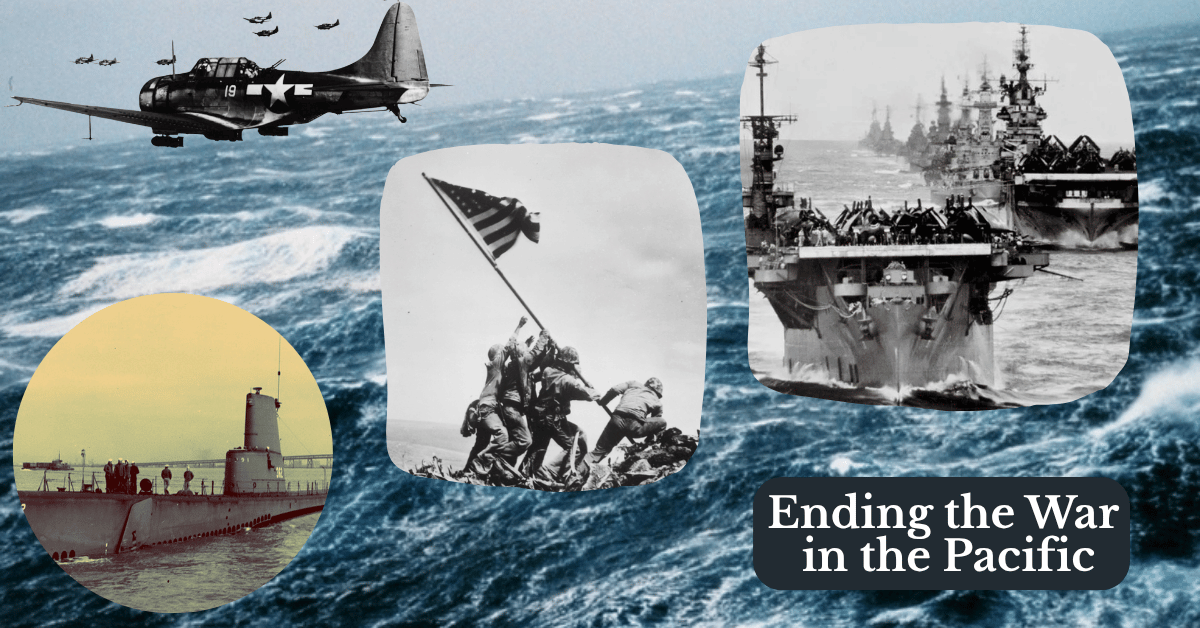
Image credit: various photographs from Naval Aviation Museum, National World War II Museum, and US Navy Archives.

Authorizing Operation Olympic

Truman’s questions and comments during the meeting reflected his own continuing unease over the level of US casualties. The President also expressed concern that an invasion of the homeland by Americans could carry a racial connotation in the minds of the Japanese that would unite them for a fight to the finish. Stimson said there was every indication that this would be the case. At the meeting’s end, Truman said he agreed that the plan presented by the Chiefs was the best choice under the circumstances, but he added that he “had hoped there was a possibility of preventing an Okinawa from one end of Japan to the other.”

Truman gave the go-ahead to continue preparations for the Kyushu operation; he said the decision on a follow-on invasion of Honshu could be made later. The minutes of the meeting indicate that an explicit rationale for this postponement was to enable the President and his advisers to take into account the impact of the Kyushu campaign and the anticipated Soviet entry into the war. 

Continue reading

Persistence, Presumption, and Promise

This coming Sunday the gospel is the parable of the Pharisee and the Tax Collector. This gospel follows the parable of the persistent widow and the unjust judge (18:1-8).  While the common thread is certainly prayer, there are other aspects which bind together these two narratives. One of Luke’s ongoing themes is the inclusivity of the Gospel. In these two parables, prayers are answered by God for a (saintly and probably poor) widow and the sinful (and probably rich) male tax collector. Luke continues to demonstrate that the Reign of God is open to all – a message of keen importance to his Gentile audience.

The two parables are well placed. Alan Culpepper (Luke, 340) notes that “By reading these two parables together, the reader is instructed to pray with the determination of the widow and the humility of the tax collector. Peter Rhea Jones has characterized the complementary themes of the two parables as ‘The promise of persistent prayer’ (18:1-8) and ‘The peril of presumptuous prayer’ (vv. 9-14).”  Each parable is instructive for the disciples of all ages about the nature of Christian prayer.

Continue reading

Will He Find Faith?

I am partial to the Gospel according to Luke. I think his writing is good at telling the story and leaving room for the hearer to work though the implications of it all.  Some of the most memorable parables – the Good Samaritan, the Prodigal Son, Lazarus and the Rich Man, and more are all unique to Luke’s gospel. 

As do many parables, there is a stark contrast between the two main characters. The unjust judge knows what he is supposed to do. Scripture is filled with admonitions for judges to be the defender of justice for the people just like this widow as well as the orphan, stranger and alien among us.  And yet the judge is not faithful to his role and not faithful to God.

Also, Luke is particular about his choice of words and phrases – the small nuances of language find their place in his telling of Jesus’ story.

Today we have one of those small curiosities of language: But when the Son of Man comes, will he find faith on earth? (Luke 18:8).  What the Greek actually says is not “find faith” but “find the faith.” It is the only place in all of Luke’s gospel he uses this phrase.  In fact, it is the only place in all the New Testament. Maybe it’s nothing, but then again, as he often does, maybe Luke is trying to tell us something in this small parable of the persistent widow and the unjust judge. 

Continue reading

Jesus: …will He find faith on earth?

The gospel for the 29th Sunday, the parable of the “Unjust Judge and the Persistent Widow,” concludes with: 7 Will not God then secure the rights of his chosen ones who call out to him day and night? Will he be slow to answer them? 8 I tell you, he will see to it that justice is done for them speedily. But when the Son of Man comes, will he find faith on earth?”

Jesus’ comments make clear the intended parallels: from an unjust judge to God; from the widow to God’s elect.  The term “his chosen ones” (hoi eklektoi), used in Luke-Acts only here, echoes texts such as Isa. 42:1; 43:20; 65:9, 15, 22; Ps. 105:6, 43 (cf. Sir. 47:22), which use the term “chosen” in a context that emphasizes election to serve Yahweh (also refers to Deut. 4:37; 7:7; 1 Chron. 16:13; Ps. 77:31; 88:3). 

Continue reading

The Warfighter

A great deal of the discussion about Just War theory focuses on the state and national polities especially before the war and in the context of the decision to declare war: jus en bellum. The focus is the justice of the cause. What is often overlooked, or at least not often spoken of, is the moral and spiritual burden borne by the warfighter.  Already in the Summa Theologiae (II–II, q.40), Aquinas notes that the individual soldier’s actions must be ordered toward right intention — not hatred, cruelty, or greed. That is not only to avoid sin, but also a recognition of the impact of war is very different on the foot soldier than on the monarch. St. Thomas does not offer more on the topic, but then it was not the focus of his writings.

In cinematic offerings before, during, and after WW II, combat was depicted as heroic: soldiers carrying out their righteous duty to protect their country, complete their mission, and sometimes, take the lives of their enemies. But the cinematic lens of that era rarely focused on what happens after the gunfire stops, after the explosions cease, and after a soldier takes another human’s life. The notable exception is “The Best Years of Our Lives.” The film, which won an Academy Award for Best Picture, follows three servicemen as they re-adjust to civilian life, dealing with issues like unemployment, physical disability, and the emotional toll of war. Movies of this century have more offering of the time after combat ends, leaving behind a harsh and devastating reality: the psychological toll of combat, specifically for those who have taken a life. Moral injuries have been part of the warrior culture throughout human history. There is a perilous journey into war and a perilous journey back. It is a journey that is volatile, uncertain, complex, and ambiguous.

Continue reading