
Unknown's avatar

About Friar Musings

Franciscan friar and Catholic priest at St. Francis of Assisi in Triangle, VA

Warnings and Admonitions

Here in Year C readings, our gospel suddenly moves from Luke 12:49-53 (last week) to this gospel, passing over 12:54-13:21. In between, the warnings and admonitions regarding the coming judgment that began with 12:1 reach their conclusion with a sobering call for repentance. Just as the debtor on the way to court (12:59) is warned to make every effort at reconciliation, so also Jesus uses the sayings about calamity in 13:1–5 and the parable of the unproductive fig tree in 13:6–9 to make the same point: 

  • read the signs of the time and judge correctly; 
  • repent now, the time is short; and
  • be assured of the full measure of judgment.

The sayings from this gospel of Jesus follow upon the parables of the kingdom (Luke 13:18–21) and stress the same points as above, adding, that great effort is required for entrance into the kingdom (Luke 13:24) and that there is an urgency to accept the present opportunity to enter because the narrow door will not remain open indefinitely. 

Continue reading

Distractions and Finishing

In the second reading today from the Letter to the Hebrews, the author tells us “persevere in running the race that lies before us.” It is an apt sports metaphor for life. Perseverance in life – the needed persistence in doing something despite difficulty or delay in achieving success. We know all things in life take preparation and practice. Even then things don’t always go as planned.

In the 1968 Mexico City Olympic Marathon, one of the runners from Tanzania was John Akhwari. During the race he fell, dislocated his kneecap, injured his shoulder, and was bruised and bloodied. After receiving medical attention, he continued the race. He finished more than 1 hour after the winner. By the time he finished, the medals for the Marathon had been awarded. Most people had left as darkness drew over the stadium, but people had heard there was one more competitor on the course, injured but persevering. He entered the stadium to complete the lap that would finish the race – there were still 7,000 spectators remaining. He finished, cheered on by a “great cloud of witnesses” giving him a standing ovation. Later he was asked why had not quit, why he continued, he replied, “My country did not send me 7,000 miles around the world to start the race, but to finish it.”

God did not send you into this life just to start the race, but to be able to join with St. Paul, “I have competed well; I have finished the race; I have kept the faith.” (2 Tim 4:7)

Continue reading

Sgt. John Basilone

By early 1942, Japan had established a vast defensive perimeter across the western Pacific, including the Philippines, Dutch East Indies, and parts of New Guinea. After seizing Tulagi in the southern Solomon Islands in May 1942 the Japanese began construction of an airfield on Guadalcanal an island near the southwest end of the Solomon chain. Completion and operation of this airfield would threaten Allied supply and communication lines between the U.S., Australia, and New Zealand – effectively isolating the Allies from each other and placing Australia at risk of invasion.

The U.S. victory at Midway in June 1942 represented the first time Japanese offensive power had been thwarted and opened the possibility for limited Allied offensives. Admiral Ernest King, Commander in Chief of the US Fleet, proposed an offensive in the Solomon Islands and New Guinea. The Joint Chiefs of Staff approved the plan in July 1942. The first phase was the seizure of Guadalcanal, Tulagi, and surrounding islands to deny Japan their strategic airfield. The Guadalcanal operation was codenamed Operation Watchtower. Military historians have suggested that it should have been called Operation Shoestring. Initially planned as a limited operation by the U.S. Marines to preempt the Japanese airfield on Guadalcanal, it evolved into a protracted campaign that lasted from August 1942 to February 1943.

Continue reading

The signs of the times

This last post moves beyond the Sunday gospel (Luke 12:48-53) to include the following verses:

54 He also said to the crowds, “When you see (a) cloud rising in the west you say immediately that it is going to rain—and so it does; 55 and when you notice that the wind is blowing from the south you say that it is going to be hot—and so it is. 56 You hypocrites! You know how to interpret the appearance of the earth and the sky; why do you not know how to interpret the present time? 57 “Why do you not judge for yourselves what is right? 58 If you are to go with your opponent before a magistrate, make an effort to settle the matter on the way; otherwise your opponent will turn you over to the judge, and the judge hand you over to the constable, and the constable throw you into prison. 59 I say to you, you will not be released until you have paid the last penny.” (Luke 12:54-59)

The illustration (vv.54-55) seems to point to the weather patterns in the Near East. The Mediterranean Sea was to the west and winds from that direction brought rain. The desert was to the south and winds from that direction brought heat. It is not clear whether these words were spoken on the same occasion as the preceding verses. There is no direct connection. Matthew gives a similar saying in response to a request for a sign. Still, it is interesting to note that here, while Jesus is encouraging, exhorting people to “see,” he again uses the accusatory “hypocrite.”  Jesus has only used this expression once before in Luke’s gospel: “How can you say to your brother, ‘Brother, let me remove that splinter in your eye,’ when you do not even notice the wooden beam in your own eye? You hypocrite! Remove the wooden beam from your eye first; then you will see clearly to remove the splinter in your brother’s eye” (Luke 6:42).

Continue reading

The Assumption of Mary in Art

Much of our religious consciousness is affected by art; we have inherited specific images that are more artistic than biblical.  For example, we always imagine St. Paul being knocked from a horse on the Damascus Road.  There is no mention of the horse in scripture.  Is that a bid deal? Perhaps not.  But when Caravaggio placed Paul on the horse, a sign of privilege or royalty, he removed Paul from the midst of Corinth, the hard-scrabbled sea port town, from among the drunks, slackards, ner-do-wells, and people who sorely needed salvation. Continue reading

Unrestricted Submarine Warfare in the Pacific

While the U.S. submarine force in the Pacific is credited with sinking one Japanese super aircraft carrier, two fleet carriers, two escort carriers, four heavy cruisers and other combatants. Their role as a naval combatant against Japanese fleet units was always going to be limited: aircraft carriers had a speed of 28-40 knots; a submerged WWII submarine could make only 3-4 running her engines on battery power. The real contribution of the submarine force was against merchant shipping.  By the end of the war, U.S. submarines had sunk approximately 50% of all Japanese merchant shipping.

Continue reading

Decision

All of the challenging words and images in the Sunday gospel (Luke 12:48-53) are with a purpose in mind: Jesus’ ministry necessarily demanded a definitive decision on the part of his would-be followers. Their yes had to be yes; their no had to be no. Christianity precludes indecision as well as compromise. Surrendering to compromise and infidelity was the error made by so many of the Old Testament communities – even when confronted by their prophets. When the prophet dared to confront them, they turned on the prophet, denounced him and often tried to kill him. Surrendering to lukewarmness in their discipleship was also the mistake made by the church in Laodicea; a community that some described as a perfect model of inoffensive Christianity. Therefore, they were told that God would spew them out as one would spew out bitter, tepid water. 

Continue reading

A Barrier to Evil

We should certainly hear an echo of the Lord’s Prayer in today’s gospel: ““Lord, if my brother sins against me, how often must I forgive him? As many as seven times?” Jesus answered, “I say to you, not seven times but seventy-seven times.” The mention of “forgiveness” should echo Jesus’ teaching about prayer. In the Lord’s prayer we are told to forgive others as we are forgiven: “If you forgive others their transgressions, your heavenly Father will forgive you. But if you do not forgive others, neither will your Father forgive your transgressions.” (Mt 6:14-15)

OK, the principle is clear, but the practical outworking still needs to be clarified, since its open-ended demand may easily be exploited by a manipulative person; surely there must be a limit? If Mishna B. Yoma represents rabbinic teaching, three times was regarded as sufficient. So, Peter’s proposal of up to seven times is probably intended to express a new limit of generosity. Or maybe it is a reference and contrast to sevenfold vengeance in the case of Cain (as in Cain and Abel). When Cain, doomed to wander homeless, worries that “Anyone may kill me at sight” (Gen 4:14), the Lord promises “Not so! the LORD said to him. If anyone kills Cain, Cain shall be avenged seven times.” (Gen 4:15) 

And so Jesus’ reply in our reading is all the more startling: “I say to you, not seven times but seventy-seven times.” (Mt 18:22)

Continue reading

War in the Pacific – the early months

While perhaps familiar to many of the readers, it might be useful to offer a brief summary of the early months of the War in the Pacific. In a modification of Japan’s war plan, Kantai Kessen, on December 7, 1941, Japan launched a surprise and devastating attack on the U.S. Fleet at Pearl Harbor, Hawaii. The goal was the decisive battle that would neutralize the U.S. Pacific Fleet and secure freedom of action for the planned offensive in Southeast Asia. The results of the attack are well known, but the battle was not decisive for three major reasons: the U.S. aircraft carriers were not in port, the fuel depot was not attacked, nor was the Pearl Harbor Naval Shipyard.  Had the depot and shipyard been destroyed the fleet would have withdrawn to the west coast affording incalculable time for Japan to advance and more firmly secure its war gains.

Japan rapidly expanded across the Pacific and Southeast Asia in a coordinated offensive:

  • Philippines: Attacked within hours of Pearl Harbor; U.S. and Filipino forces withdrew to Bataan and Corregidor, ultimately surrendering.
  • Guam and Wake Island: Guam captured quickly; Wake resisted before falling on December 23.
  • Hong Kong: fell to Japan on December 25, 1941.
  • Rabaul (New Britain): captured in January 1942, becoming a major forward base.
  • Burma: Japan advanced to cut off the Burma Road to China – it was the main overland supply route by which the United States and British Empire provided military aid to Nationalist China in its war against the Japanese – a war initiated in 1937.
  • Malaya and Singapore: Japanese forces advanced swiftly down the Malay Peninsula, capturing Singapore on February 15, 1942
  • Battle of the Java Sea (Feb 27, 1942): the Allied ABDA Command (American, British, Dutch, Australian) lost the majority of its sea power leaving Java and the Dutch East Indies open to Japanese invasion
  • Dutch East Indies (Indonesia): Seized for its oil resources; Java fell by March 1942.
  • Doolittle Raid (April 18, 1942): U.S. bombers struck Tokyo and other cities, a psychological blow to Japan and a factor in their decision to strike Midway.
  • Battle of the Coral Sea (May 4–8, 1942): a strategic Allied victory in that it stopped the invasion of Port Moresby, New Guinea – a gateway to northern Australia.

Japan planned Operation MI, an operation to lure the U.S. Navy into a decisive battle by attacking and occupying Midway Atoll, a key American base northwest of Hawaii. Their hope was for a decisive Kantai Kessen-style battle that would destroy the last Pacific assets: U.S. aircraft carriers. Victory would cement Japanese strategic dominance in the Pacific.

Station Hapo, Hawaii – using signal intelligence vs. pure code breaking – learned of the attack on Midway and in an “all-in” gamble, Admiral Chester Nimitz committed the U.S. carries to the action that stopped the tide of Japanese advance in the Pacific. At the Battle of Midway (June 4–7, 1942) Japan suffered a catastrophic defeat, losing four fleet carriers and shifting the balance of naval power in the Pacific.

War Plan Orange – greatly revised, but with key elements intact – was now free to work its way westward to prosecute the War in the Pacific on new terms and conditions.

I do not plan to work step-by-step through the war in the Pacific. I will leave the heroic battles of places such as Guadalcanal and Tarawa for you to research. As well, I do not discuss the 1942 naval engagements such as Savo Island, Eastern Solomons, Cape Esperance, Santa Cruz, sea battle of Guadalcanal and Tassafaronga – all in the defense of the Marine Division on the island of Guadalcanal. I would note that the US Navy suffered more killed-in-action than the US Marines during the Guadalcanal campaign.

Moving ahead, I will highlight key several military actions that reveal fundamental shifts in Japanese military tactics and strategy. These shifts will shape planning for an invasion of the Japanese home islands in 1945-1946, an endeavor whose potential for the loss of life – military and civilian – defied estimation.

By the end of 1942 the advance of the Japanese has been stopped. The advent of 1943 would see the allied forces move from the defense to offense. The might of American industrial power in shipping building (combatants and merchants), aircraft, ammunition, and every aspect of logistics support would “come fully on line” as the work of the US submarines interdicted needed critical war supplies from Southwest Asia to Japan.

As noted in the first post, this series is not aimed at concluding with “the atomic bomb was the lesser of all the evils about to be faced.” It is intended to hopefully provide a correct historical understanding available to the 1945 leadership who faced the impossible task of ending a war with an intractable enemy and not repeating the armistice of 1919 that became the next war. 


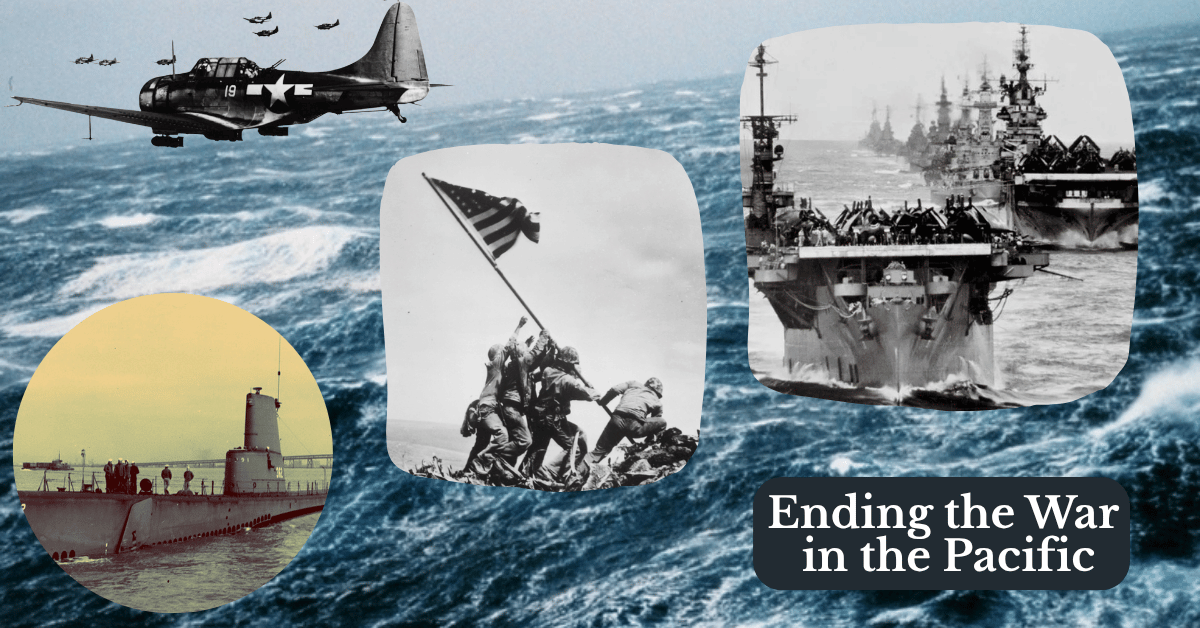
Image credit: various photographs from Naval Aviation Museum, National World War II Museum, and US Navy Archives.