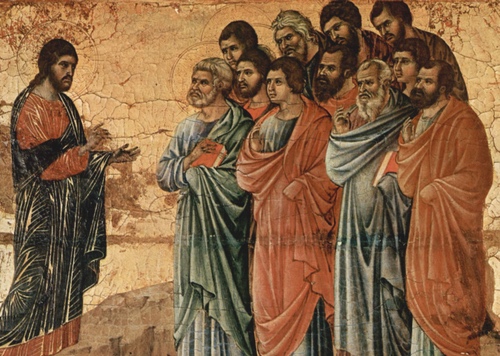
We conclude our look into Sunday’s Gospel with some final thoughts about Jesus’ lesson to the disciples. If the first teaching was troublesome, the next would have been downright shocking. In our time we have a different view of children. We hold children to be innocent and precious. This does not seem to have been the view of 1st century. In ancient culture, children had no status. They were subject to the authority of their fathers, viewed as little more than property. In Roman culture adults were adopted, not children. Consider St. Paul’s statement: “I mean that as long as the heir is not of age, he is no different from a slave, although he is the owner of everything, but he is under the supervision of guardians and administrators until the date set by his father.” (Gal 4:1-2) If this is said of the heir, can you imagine the attitude for children in general?
Perkins [p. 637] writes: “… the child in antiquity was a non-person…Children should have been with the women, not hanging around the teacher and his students (cf. 10:13-16). To say that those who receive Jesus receive God does not constitute a problem. A person’s emissary was commonly understood to be like the one who sent him. But to insist that receiving a child might have some value for male disciples is almost inconceivable.”
Perkins echos the text in Matthew 10, “Whoever welcomes you welcomes me, and whoever welcomes me welcomes the one who sent me….” but is pointing out that Jesus is telling the disciples that while there are times you will indeed be my emissary, this is not the problem at hand. The problem is that the Twelve cannot conceive of welcoming the least important people in society, those ranked lowest in human convention. Yet Jesus is saying, “you’ll need to work your way down to the most marginal and lowest (by human convention) in order to find me. I am last of all.”
Remember the recent episode when the disciples were unable to cast out the demon from the child in 9:14-29? The disciples ask Jesus “…in private, “Why could we not drive it out?” He said to them, “This kind can only come out through prayer.” One wonders if the disciples did not think the child was worthy of their time, effort, or prayer? They were willing to command the demon to come one, but not to pray for the child.
The Kingdom of God involves giving status to those who have none. The disciples are not to be like children, but to be like Jesus who embraces the child, the one held to be least of all in human convention.
A young rabbinical student asked the rabbi, “Rabbi, why don’t people see God today as they did in the olden days?” The wise old man put his hands on the student’s shoulders and said, “The answer, my son, is because no one is willing to stoop so low.”
Source
- Pheme Perkins, The Gospel of Mark, vol. 8 of The New Interpreter’s Bible (Nashville, TN: Abington Press, 1994) 635-38



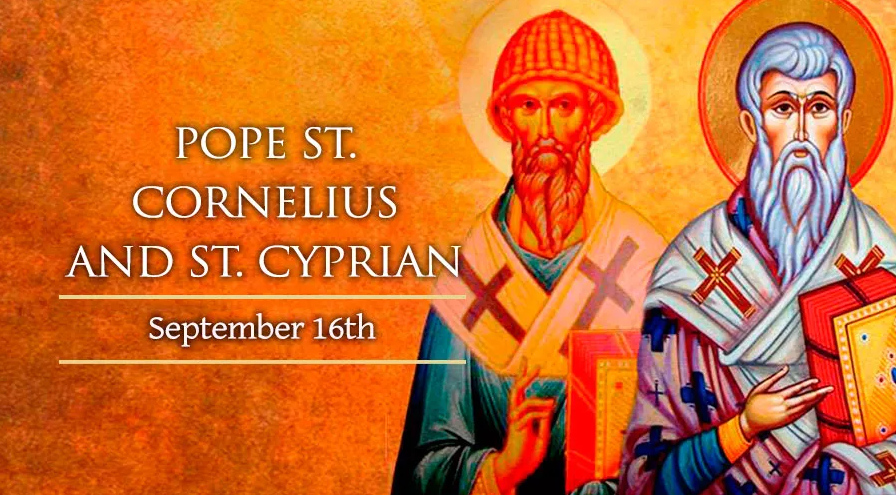 Saint Cornelius was elected Pope in 251 during the persecutions of the Emperor Decius. His first challenge, besides the ever present threat of the Roman authorities, was to bring an end to the schism brought on by the first anti-pope Novatian of Carthage. The great controversy that arose was as a result of the Decian persecution. In the wake of the persecution the question faced by the Church was whether or not the Church could pardon and receive back into the Church those who had apostatized in the face of martyrdom.
 In next Sunday’s