

 In today’s gospel we hear Matthew’s account of the Sermon on the Mount:
When Jesus saw the crowds, he went up the mountain, and after he had sat down, his disciples came to him. He began to teach them, saying:
“Blessed are the poor in spirit, for theirs is the Kingdom of heaven.
Blessed are they who mourn, for they will be comforted… (Mt 5:1-12) They are words familiar to all Christians. They are words that have been parsed and prodded for meaning since the time of Christ. Continue reading
Sermon on the Mount
Reply
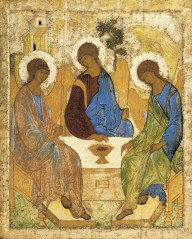 Holy Trinity Sunday. On Trinity Sunday, we are called to reflect with joy and thanksgiving what the Father, Son and Holy Spirit have done to bring about redemption and the possibility of salvation for all. We celebrate to respond to the love God has shown for us, praising Him, and giving Him glory. We that we were created in the image of God, saved by God despite our sins, and our journey in this life is accompanied by God at each moment. It is a celebration and invitation to share the inner life of the Trinity.
 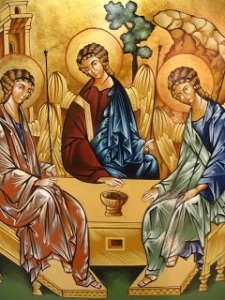 Years ago, while a Franciscan novice, my fellow friars and I attended a gathering of all the Franciscan novices, men and women, who lived in the Eastern United States. During our week-long gathering, each group was responsible for leading morning or evening prayer or animating the Eucharistic celebration. One morning, a group of Franciscan sisters was responsible for morning prayer. Just before we were to begin, the leader of prayer explained that we would not be using the traditional words associated with the sign of the Cross. Rather, we would say “In the Name of the Creator, the Redeemer, and the Sanctifier.” She explained this was a way to remove the gender bias from the opening of prayer and to make all feel welcomed.
  This day’s
  There are people, average like us and quietly going about life, that have moved to the national spotlight. We now know their names: George Floyd, Ahmaud Arbery, Breonna Taylor, Eric Garner, Philando Castile and Trayvon Martin – and these are just the recent ones that made national news. The nation is moved in outrage. Yes, all lives matter, but Black Lives Matter. As someone pointed out: all houses on the block matter, but when one of them is on fire, it matters more.
 President Trump recently announced “The governors need to do the right thing and allow these very important essential places of faith to open right now, this weekend. If they don’t do it, I will override the governors.” While his powers to do so were questionable to say the least, I am glad that he considers houses of worship and their religious services essential. I would not disagree on that particular point, but would note that a large percentage of citizens do not attend weekend worship services at all plus another group of of households that participate irregularly. My Church has its own C&E Catholic faithful (that’s Christmas and Easter only – although to be fair, Ash Wednesday and Palm Sunday are also part of that particular mix). So, while I would agree on the essential nature of Mass and worship services, obviously they are not essential in the minds of all.
 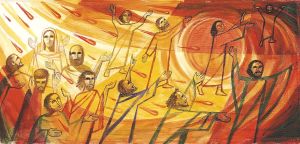 Next Sunday is the celebration of the
 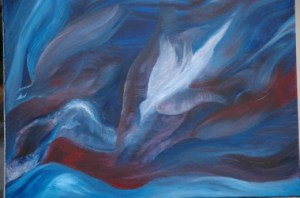 Ever since the shift to daylight savings began my “inner alarm clock” wakes me up somewhere between 3:00 and 3:30 am. I am used to early rising, but really. And yes, naps are required at point(s) during the day. I was chatting about this yesterday with a friend who remarked, “You know, my 90 year-old aunt has the same problem…” Yikes! My new measure is one of even-more-senior citizens? Oh well, I am still young at heart.
 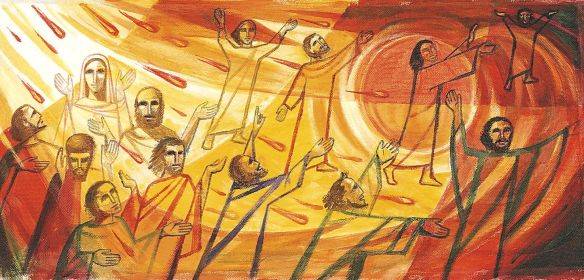 When I was a child growing up in the 1950s Catholic milieu, we prayed “In the Name of the Father, and the Son, and the Holy Ghost.” We didn’t give it a lot of thought. We were kids. We also did not particularly make the connection between the third person of the Trinity and Casper the Friendly Ghost or any of his not-so-friendly counterparts. But at some point, the phrase “Holy Ghost” gave way to “Holy Spirit.”
  friarmusings