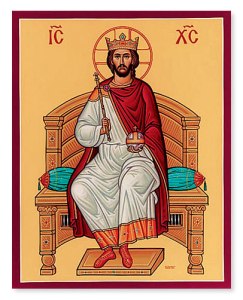
 This coming Sunday marks our journey in Ordinary Time, the 34th Sunday in Year C – the Solemnity of Christ the King. You can read a complete commentary on the Sunday Gospel here.
33 When they came to the place called the Skull, they crucified him and the criminals there, one on his right, the other on his left. 34 (Then Jesus said, “Father, forgive them, they know not what they do.”) They divided his garments by casting lots. [The above is not part of the Sunday reading, but is generally considered within the narrative. ] 35 The people stood by and watched; the rulers, meanwhile, sneered at him and said, “He saved others, let him save himself if he is the chosen one, the Messiah of God.” 36 Even the soldiers jeered at him. As they approached to offer him wine 37 they called out, “If you are King of the Jews, save yourself.” 38 Above him there was an inscription that read, “This is the King of the Jews.” 39 Now one of the criminals hanging there reviled Jesus, saying, “Are you not the Messiah? Save yourself and us.” 40 The other, however, rebuking him, said in reply, “Have you no fear of God, for you are subject to the same condemnation? 41 And indeed, we have been condemned justly, for the sentence we received corresponds to our crimes, but this man has done nothing criminal.” 42 Then he said, “Jesus, remember me when you come into your kingdom.” 43 He replied to him, “Amen, I say to you, today you will be with me in Paradise.” (Luke 23:35-43) Continue reading →


 Did you know that gratitude has been scientifically studied? In just the last 10 years, there have been hundreds of studies that have documented the social, physical, and psychological benefits of gratitude. The graphic and the following text all point to some of the benefits of practicing gratitude: Continue reading
  In
In  In Jesus’ day there was one thing that dominated the skyline of Jerusalem – the Temple – easily seen from across the way on the Mount of Olives, hovering over the Old City, and visible from every balcony in the upper city. It wasn’t the original Temple, that had been destroyed some 600 years before by the armies of King Nebuchadnezzar and Babylon. This the second temple. Construction started about 520 years before Jesus’ time but it was King Herod the Great who make the temple a “wonder of the world.” While some people were speaking about how the temple was adorned with costly stones and votive offerings (Luke 21:5).
  I don’t remember – it has been so long now – but somewhere, sometime ago, I began to start emails, letters, cards and the like with the same phrase: “May the grace and peace of Christ be with you.” It is an expression that begins many of St. Paul’s letters, in one form or another, e.g., Galatians 1:3. It is not a scripted beginning; there is a great deal of intention about it. There are times when I am in a hurry, responding to emails, that I am reminded at the end to return to the beginning and insert the greeting. It often leads to editing of the email if there is some part that does not have grace or peace about it.
 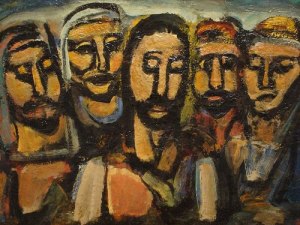 This coming Sunday marks our journey in Ordinary Time, the
 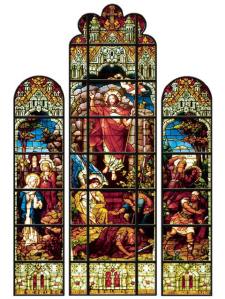 One of the amazing stained-glass windows in our church is the triptych window of the Resurrection on the first Easter Sunday. It is a piece that takes its place in the gallery of Resurrection artwork across Christianity. Depictions and artwork that has graced the walls of catacombs of ancient Rome, as well as more formal works such as frescos, icons, illuminated manuscripts, altar pieces, Romanesque reliefs, sculptures and more. The Resurrection has been depicted by the great artists of the West: Caravaggio, Peter Paul Rubens, Annibale Carracci, Giotto, Titian, Piero della Francesca, Fra Angelico, El Greco, Jan van Eyck, Raphael, and Michelangelo.

 friarmusings