

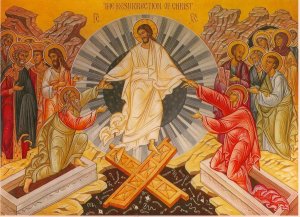
 This coming Sunday marks our journey in Ordinary Time, the 32nd Sunday in Year C. You can read a complete commentary on the Sunday Gospel here.
27 Some Sadducees, those who deny that there is a resurrection, came forward and put this question to him, 28 saying, “Teacher, Moses wrote for us, ‘If someone’s brother dies leaving a wife but no child, his brother must take the wife and raise up descendants for his brother.’ 29 Now there were seven brothers; the first married a woman but died childless. 30 Then the second 31 and the third married her, and likewise all the seven died childless. 32 Finally the woman also died. 33 Now at the resurrection whose wife will that woman be? For all seven had been married to her.” Continue reading


 The Office of Vocations invites you to pray for vocations to the priesthood and religious life during National Vocation Awareness Week, November 3-8, 2019.
  This coming Sunday marks our journey in Ordinary Time, the
  Today marks the
  In our gospel story, the tax collector went home justified. Sure, he has been extorting people, shaking them down for the Roman overlords and some profit for himself. Sure, he is considered a traitor and an outcast from Jewish life – someone whose life is “breaking bad.” But he has reached a moment of conversion, right? He is about to get right with God; get justified. Here is the one moment, a moment when all the trappings of life are torn away, he finally sees himself in humble relationship to God: “O God, be merciful to me a sinner.” And the tax collector went home justified.
  Back in the day when I was a parishioner at a small country parish in Northern Virginia, once a year the chairperson of the parish council would speak during the Masses about parish finances. There were several handouts about assets, cash flow, expenses and revenues. All true and necessary things. Even though a parish is meant to be a center of worship, ministry, faith, and life – there are still budgets to make, bills to pay and plans to make.
  This week the first readings for Mass are taken from St. Paul’s Letter to the Romans. He lays out stark choices for us and does not hesitate to reference our condition to one of slavery. It paints the picture of an individual facing a world a world of pernicious and pervasive temptation. St Paul spent a lot of time in Corinth, which like any “navy town” is not short on all manner of opportunities to make bad choices. I think that he just observed people, the choices they made, the habits that became ingrained in their lives, and simply wrote: “For just as you presented the parts of your bodies as slaves to impurity” (Romans 6:19) from
  friarmusings