Or did we?

“He called ten of his servants and gave them ten gold coins and told them, ‘Engage in trade with these until I return.’.”

Today’s gospel might sound familiar as just this past Sunday we heard St. Matthew’s version of this parable. Or did we? Scholars agree that each sacred writer has taken the parable from a common source, but the use of the parable is quite different, with differing messages and intent.

In Matthew, the parable appears in the midst of Jesus’ great eschatological discourse (Mt 24-25). The sequence is pericopes of faithful and wicked servants, the wise and foolish maides, the talents (Sunday’s gospel) and next the judgment of the nations. Matthew is addressing what the disciples should do while awaiting Jesus’ return – which seems to be delayed. The “talents parable” is meant to encourage the disciples to faithful disciples during the delay. And so across the eschatological discourse there is an emphasis on preparedness, use of skills and abilities, as well as final judgment.

Luke’s purpose is quite different from Matthew’s, and Luke tells us why he includes the parable: “because he was near to Jerusalem, and because they supposed that the kingdom of God was to appear immediately” (Lk 19:11). Jesus is approaching Jerusalem and many seem to expect a dramatic manifestation of God’s kingdom upon arrival, perhaps involving national restoration, judgment of Israel’s enemies, and the public enthronement of the Messiah. Luke’s concern is to correct that expectation. The kingdom is coming, but not in the way or on the timetable the crowd assumes. Another major difference from Matthew is the presence of the citizens who hold that: “We do not want this man to reign over us.”

In the Matthean telling, each servant receives a different amount according to ability. But in Luke each servant gets the same amount because the emphasis is a common commission. The parable focuses on the differing fidelity in carrying out the king’s business during his absence. This fits Luke’s concern with the mission of the Church between Jesus’ departure and return which is Acts of the Apostles.

So in Luke the parable is not merely about using one’s gifts well. It is a narrative about the Messiah’s departure, heavenly enthronement, the rejection of his rule by some, the mission entrusted to his servants, the delay of the kingdom’s consummation, and the certainty of a future reckoning.

And you might be thinking, “this was more of a mini-bible study than a homily” and you would be correct. It is a reminder that we are to let the Word of God tell us the message rather than “Oh, yeah, we just heard that Gospel.”

It is the old literature adage: read a great book as a youth, an adult, and in your later years – and you will discover that you have read three different great books because the same story will reveal more and more of itself in the wisdom and experience of your life. Or said another way, the gospel story will reveal more of God’s word as you have grown in your faith.

Be a life-long learner of the Word of God.


Image credit: The Parable of the Talents by Willem de Porter, 17th century, National Gallery of Prague, PD-US

Rebirth and Birth

The gospel for yesterday and today combine to cover John 3:1-15, the encounter of Jesus and Nicodemus. In the passage, Jesus says to Nicodemus, “Amen, amen, I say to you, unless one is born anothen, he cannot see the Kingdom of God.” As is characteristic of John’s gospel, it is in the subtly of words that people are offered a choice. Popularly, Bibles translate the passage as “unless one is born again.” And indeed that is an acceptable translation, but not the primary or best if being true to the text. The best translation is “unless one is born from above.” It not only takes the primary meaning of the word anothen, but also ties into the “direction” of the references in the passage: Continue reading →

Demands of Discipleship

This coming Sunday marks our journey in Ordinary Time, the 31st Sunday in Year C. You can read a complete commentary on the Sunday Gospel here.

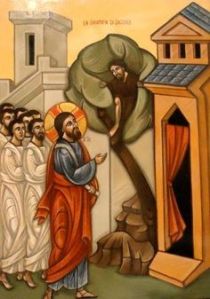
1 He came to Jericho and intended to pass through the town. 2 Now a man there named Zacchaeus, who was a chief tax collector and also a wealthy man, 3 was seeking to see who Jesus was; but he could not see him because of the crowd, for he was short in stature. 4 So he ran ahead and climbed a sycamore tree in order to see Jesus, who was about to pass that way. 5 When he reached the place, Jesus looked up and said to him, “Zacchaeus, come down quickly, for today I must stay at your house.” 6 And he came down quickly and received him with joy. 7 When they all saw this, they began to grumble, saying, “He has gone to stay at the house of a sinner.” 8 But Zacchaeus stood there and said to the Lord, “Behold, half of my possessions, Lord, I shall give to the poor, and if I have extorted anything from anyone I shall repay it four times over.” 9 And Jesus said to him, “Today salvation has come to this house because this man too is a descendant of Abraham. 10 For the Son of Man has come to seek and to save what was lost.” (Luke 19:1-10) Continue reading →

Jesus and Zacchaeus – Saving What Was Lost

Zacchaeus in the Sycamore Awaiting the Passage...Luke 19:1-10. 1 He came to Jericho and intended to pass through the town. 2 Now a man there named Zacchaeus, who was a chief tax collector and also a wealthy man, 3 was seeking to see who Jesus was; but he could not see him because of the crowd, for he was short in stature. 4 So he ran ahead and climbed a sycamore tree in order to see Jesus, who was about to pass that way. 5 When he reached the place, Jesus looked up and said to him, “Zacchaeus, come down quickly, for today I must stay at your house.” 6 And he came down quickly and received him with joy. 7 When they all saw this, they began to grumble, saying, “He has gone to stay at the house of a sinner.” 8 But Zacchaeus stood there and said to the Lord, “Behold, half of my possessions, Lord, I shall give to the poor, and if I have extorted anything from anyone I shall repay it four times over.” 9 And Jesus said to him, “Today salvation has come to this house because this man too is a descendant of Abraham. 10 For the Son of Man has come to seek and to save what was lost.”

Salvation. Jesus’ words in v. 9 are literally: “Today salvation has happened to/in this house(hold), because also this one is a son of Abraham.” Continue reading →

Jesus and Zacchaeus – Conversion

Zacchaeus in the Sycamore Awaiting the Passage...Luke 19:1-10. 1 He came to Jericho and intended to pass through the town. 2 Now a man there named Zacchaeus, who was a chief tax collector and also a wealthy man, 3 was seeking to see who Jesus was; but he could not see him because of the crowd, for he was short in stature. 4 So he ran ahead and climbed a sycamore tree in order to see Jesus, who was about to pass that way. 5 When he reached the place, Jesus looked up and said to him, “Zacchaeus, come down quickly, for today I must stay at your house.” 6 And he came down quickly and received him with joy. 7 When they all saw this, they began to grumble, saying, “He has gone to stay at the house of a sinner.” 8 But Zacchaeus stood there and said to the Lord, “Behold, half of my possessions, Lord, I shall give to the poor, and if I have extorted anything from anyone I shall repay it four times over.” 9 And Jesus said to him, “Today salvation has come to this house because this man too is a descendant of Abraham. 10 For the Son of Man has come to seek and to save what was lost.”

Zacchaeus’ Speech. Zacchaeus, in spite of his reputation, is an attractive person. In our brief meeting, qualities akin to those of Peter emerge. Zacchaeus is spontaneous and impetuous, given to extravagant statements. But there is a deep genuineness. Though he is a person of some importance, his position does not prevent him from climbing the sycamore tree nor from publicly admitting his guilt and professing his repentance. Jesus says this is a son of Abraham, even if he is a tax collector. He should not be ostracized because of his failings but helped to find his way back to the flock. Continue reading →

Jesus and Zacchaeus – Seeing and Salvation Comes

Zacchaeus in the Sycamore Awaiting the Passage...Luke 19:1-10. 1 He came to Jericho and intended to pass through the town. 2 Now a man there named Zacchaeus, who was a chief tax collector and also a wealthy man, 3 was seeking to see who Jesus was; but he could not see him because of the crowd, for he was short in stature. 4 So he ran ahead and climbed a sycamore tree in order to see Jesus, who was about to pass that way. 5 When he reached the place, Jesus looked up and said to him, “Zacchaeus, come down quickly, for today I must stay at your house.” 6 And he came down quickly and received him with joy. 7 When they all saw this, they began to grumble, saying, “He has gone to stay at the house of a sinner.” 8 But Zacchaeus stood there and said to the Lord, “Behold, half of my possessions, Lord, I shall give to the poor, and if I have extorted anything from anyone I shall repay it four times over.” 9 And Jesus said to him, “Today salvation has come to this house because this man too is a descendant of Abraham. 10 For the Son of Man has come to seek and to save what was lost.”

Commentary. At first glance we might expect this to be another parable challenging the rich. The rich have not fared well in Luke’s gospel. Jesus pronounces woes upon the rich (6:24). God called the rich farmer a fool (12:16, 20) and required his soul of him. The rich man went to Hades while Lazarus went to the bosom of Abraham, and Jesus observed how hard it is for the rich to enter the kingdom of heaven (18:23, 25).  Zacchaeus is a “wealthy man” (19:2) Continue reading →