

 “It ain’t what you don’t know that gets you into trouble. It’s what you know for sure that just ain’t so.” A quote often attributed to Mark Twain (although it seems that “ain’t so”). Nonetheless it is a nice summary of more than one conversation on the front steps of the church. Such as the one yesterday in which someone expressed their disbelief and near shock that our parish had chosen not to celebrate or announce the holy day of obligation. After a moment of internal… “what is he talking about?…” it dawned upon me that me was referring to the Solemnity of the Annunciation, celebrated today March 25th. When I reminded him the Annunciation was not a holy day of obligation, but that we were certainly celebrating the solemnity at our Masses, I was given “the stare” and then he walked away shaking his head. Of course I can’t know his thoughts, but I have seen “the stare” before. It is the one that says, “No wonder the Catholic Church is in trouble with priests like you.” I hope he well celebrates the solemnity; I know that we will.
Just another tale from the front steps of the church.
 We friars assist as Catholic chaplains at Tampa General. It is not my first time as a hospital chaplain. That was at Bethesda Naval Hospital. My time at Bethesda was at the beginning of the war in Iraq when the Marines were engaged in combat around Fallujah. Casualties were high. Every evening there was a chaplain assigned to the flight line to be there when marines, sailors, airmen and soldiers were medevac’d from the war zone. All of these service men and women were in grave medical conditions. I witnessed injuries that still left me amazed that the person was still alive. Alive with lives that would never be the same, never as they had planned. But the combat/trauma ICU and the flight line were not the hardest chaplain duty at Bethesda – at least not for me. For me, the hardest ward was the NICU; the neo-natal intensive care unit.
  I own a bucket. I suspect you do also. So…what is your favorite story about your bucket? Seriously. Ok, not so seriously. We don’t think about buckets a whole lot. It is not like we have a plethora of “bucket stories.” They are just kinda’ there when we need them. You use ‘em, you put them away. Back in the closet, pantry, or garage ready for the next time. And when the “next time” comes” and we go to find them and they are missing from their assigned place, it is not like the world has ended. Perhaps annoyed or inconvenienced, but not ended. A lots of times, the task is generally not too big and we can work around the missing bucket.
  I have a Lenten question for you: Are you holy? On a recent Friday at the noon Mass I asked the 100 or so folks in the pews to consider that question. I actually called on three people for answers. Their replies were (a) “not yet”, (b) “working on it”, and (c) “yes.” The “yes” was given with some enthusiasm and there followed some chuckles throughout the church – and I suspect some wonder who was the bold, brash soul that responded “yes.” Rather cheeky, one would think. What would have been your answer? I suspect the most common thought would be somewhere between “no,” “no, of course not, Saints are holy, not me,” “not holy, but I am a good person,” and “oh my, no, I am just a sinner” (said with a sincere piety).
  This morning’s
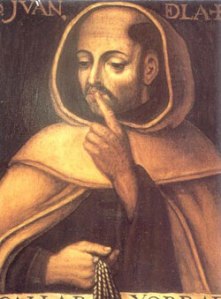 St. John of the Cross (San Juan de la Cruz) was born John de Yepes, the youngest child of a poor family from Toledo, Spain in 1542. He entered the Carmelite monastery in 1563, went on to study theology at the famous University of Salamanca in 1564, and was ordained to the priesthood in 1567. Dissatisfied with the laxity of his order, he considered becoming a hermit but was persuaded by St. Teresa of Avila to remain a Carmelite and work for the reform of the order. Not all Carmelites were pleased with his reforming activities, and he was actually imprisoned on order of a superior and subjected to great hardship for 9 months before escaping. His efforts led to the establishment of the
  In today’s
 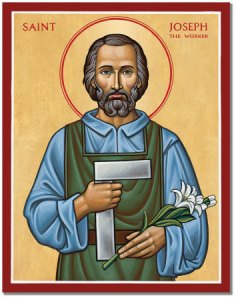 Devotion to St. Joseph, spouse of Mary, can be traced back to the beginning of the Church, with a local feast dedicated to St. Joseph confirmed in Egypt as early as the 4th century. One of the earliest dates for honoring St. Joseph was July 20. On the Byzantine calendar St. Joseph is commemorated on December 26 with many Eastern Churches celebrating Joseph as “Holy Righteous Joseph the Betrothed.”
 This coming Sunday marks the
  friarmusings