
Early technology adopter
Image
Reply


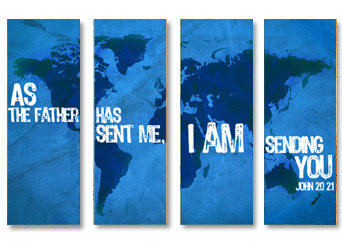 John 20:19-31 19 On the evening of that first day of the week, when the doors were locked, where the disciples were, for fear of the Jews, Jesus came and stood in their midst and said to them, “Peace be with you.” 20 When he had said this, he showed them his hands and his side. The disciples rejoiced when they saw the Lord. 21 (Jesus) said to them again, “Peace be with you. As the Father has sent me, so I send you.” 22 And when he had said this, he breathed on them and said to them, “Receive the holy Spirit. 23 Whose sins you forgive are forgiven them, and whose sins you retain are retained.” 24 Thomas, called Didymus, one of the Twelve, was not with them when Jesus came. 25 So the other disciples said to him, “We have seen the Lord.” But he said to them, “Unless I see the mark of the nails in his hands and put my finger into the nailmarks and put my hand into his side, I will not believe.” Continue reading
 May the grace and peace of the Risen Lord be with you. He is risen, Alleluia! Alleluia! I trust these words find you well, blessed, and part of the Easter people celebrating our awesome and loving God. As an Easter people we will not just celebrate one day — we are about to begin a whole season of Easter from now until Pentecost Sunday on May 20. In that same period, life begins to accelerate with the Annual Pastoral Appeal, Confirmation (April 29), First Holy Communion (May 5 and 6), Mother’s Day, final exams, graduations, summer vacation and camp planning, getting ready for college, and a whole list of things around the home and office. Continue reading
 33 At noon darkness came over the whole land until three in the afternoon. 34 And at three o‘clock Jesus cried out in a loud voice, “Eloi, Eloi, lema sabachthani?” which is translated, “My God, my God, why have you forsaken me?” 35 Some of the bystanders who heard it said, “Look, he is calling Elijah.” 36 One of them ran, soaked a sponge with wine, put it on a reed, and gave it to him to drink, saying, “Wait, let us see if Elijah comes to take him down.” 37 Jesus gave a loud cry and breathed his last. 38 The veil of the sanctuary was torn in two from top to bottom. 39 When the centurion who stood facing him saw how he breathed his last he said, “Truly this man was the Son of God!” 40 There were also women looking on from a distance. Among them were Mary Magdalene, Mary the mother of the younger James and of Joses, and Salome. 41 These women had followed him when he was in Galilee and ministered to him. There were also many other women who had come up with him to Jerusalem. Continue reading
 16 The soldiers led him away inside the palace, that is, the praetorium, and assembled the whole cohort. 17 They clothed him in purple and, weaving a crown of thorns, placed it on him. 18 They began to salute him with, “Hail, King of the Jews!” 19 and kept striking his head with a reed and spitting upon him. They knelt before him in homage. 20 And when they had mocked him, they stripped him of the purple cloak, dressed him in his own clothes, and led him out to crucify him. 21 They pressed into service a passer-by, Simon, a Cyrenian, who was coming in from the country, the father of Alexander and Rufus, to carry his cross. Continue reading
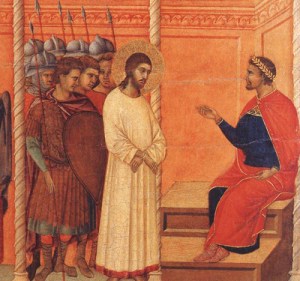 1 As soon as morning came, the chief priests with the elders and the scribes, that is, the whole Sanhedrin, held a council. They bound Jesus, led him away, and handed him over to Pilate. 2 Pilate questioned him, “Are you the king of the Jews?” He said to him in reply, “You say so.” 3 The chief priests accused him of many things. 4 Again Pilate questioned him, “Have you no answer? See how many things they accuse you of.” 5 Jesus gave him no further answer, so that Pilate was amazed. Continue reading
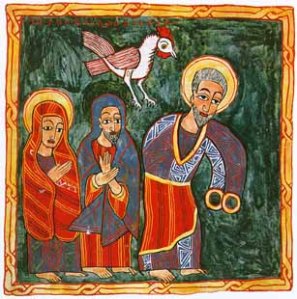 66 While Peter was below in the courtyard, one of the high priest’s maids came along. 67 Seeing Peter warming himself, she looked intently at him and said, “You too were with the Nazarene, Jesus.” 68 But he denied it saying, “I neither know nor understand what you are talking about.” So he went out into the outer court. (Then the cock crowed.) 69 The maid saw him and began again to say to the bystanders, “This man is one of them.” 70 Once again he denied it. A little later the bystanders said to Peter once more, “Surely you are one of them; for you too are a Galilean.” 71 He began to curse and to swear, “I do not know this man about whom you are talking.” 72 And immediately a cock crowed a second time. Then Peter remembered the word that Jesus had said to him, “Before the cock crows twice you will deny me three times.” He broke down and wept. Continue reading
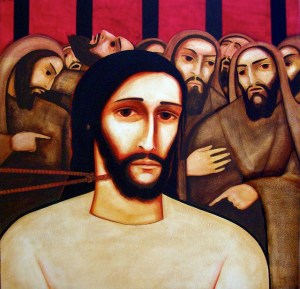 53 They led Jesus away to the high priest, and all the chief priests and the elders and the scribes came together. 54 Peter followed him at a distance into the high priest’s courtyard and was seated with the guards, warming himself at the fire. 55 The chief priests and the entire Sanhedrin kept trying to obtain testimony against Jesus in order to put him to death, but they found none. 56 Many gave false witness against him, but their testimony did not agree. Continue reading
 43 Then, while he was still speaking, Judas, one of the Twelve, arrived, accompanied by a crowd with swords and clubs who had come from the chief priests, the scribes, and the elders. 44 His betrayer had arranged a signal with them, saying, “The man I shall kiss is the one; arrest him and lead him away securely.” 45 He came and immediately went over to him and said, “Rabbi.” And he kissed him. 46 At this they laid hands on him and arrested him. 47 One of the bystanders drew his sword, struck the high priest’s servant, and cut off his ear. 48 Jesus said to them in reply, “Have you come out as against a robber, with swords and clubs, to seize me? 49 Day after day I was with you teaching in the temple area, yet you did not arrest me; but that the scriptures may be fulfilled.” 50 And they all left him and fled. 51 Now a young man followed him wearing nothing but a linen cloth about his body. They seized him, 52 but he left the cloth behind and ran off naked. Continue reading
 32 Then they came to a place named Gethsemane, and he said to his disciples, “Sit here while I pray.” 33 He took with him Peter, James, and John, and began to be troubled and distressed. 34 Then he said to them, “My soul is sorrowful even to death. Remain here and keep watch.” 35 He advanced a little and fell to the ground and prayed that if it were possible the hour might pass by him; 36 he said, “Abba, Father, all things are possible to you. Take this cup away from me, but not what I will but what you will.” 37 When he returned he found them asleep. He said to Peter, “Simon, are you asleep? Could you not keep watch for one hour? 38 Watch and pray that you may not undergo the test. The spirit is willing but the flesh is weak.” 39 Withdrawing again, he prayed, saying the same thing. 40 Then he returned once more and found them asleep, for they could not keep their eyes open and did not know what to answer him. 41 He returned a third time and said to them, “Are you still sleeping and taking your rest? It is enough. The hour has come. Behold, the Son of Man is to be handed over to sinners. 42 Get up, let us go. See, my betrayer is at hand.” Continue reading
 friarmusings