8 As for you, do not be called ‘Rabbi.’ You have but one teacher, and you are all brothers. 9 Call no one on earth your father; you have but one Father in heaven. 10 Do not be called ‘Master’; you have but one master, the Messiah. 11 The greatest among you must be your servant.
12 Whoever exalts himself will be humbled; but whoever humbles himself will be exalted.
By the second century the title “Rabbi” (etymologically “my great one”) was properly used of those who had been trained and formally recognized as scribes (like our “Reverend”), but this technical use probably came in after the time of Jesus: as applied to Jesus (26:25, 49; Mark 9:5; 10:51; 11:21; John 1:49; 3:2 etc.) it was apparently an honorary title, based on his reputation rather than his official status.
In contrast with the scribes’ love of human approbation, Jesus calls on those who follow him to avoid honorific titles. Verses 8–10, while taking up the theme of the scribes’ craving for public respect, are clearly aimed primarily at Jesus’ own disciples (the “scribes” of the kingdom of heaven, 13:52), those for whom he (“the Messiah,” v. 10) is the one true teacher and leader. They highlight a concern for status which, while taken for granted in secular society (20:25) ought not to characterize those who follow Jesus (20:26). Matthew’s inclusion of this warning in his gospel testifies to the fact that the problem had not gone away, as indeed it still has not among Christians today. The three titles singled out were probably all being used in Matthew’s church. It is not difficult for a modern reader to think of similar honorifics in use today, and to discern behind the titles an excessive deference to academic or ecclesiastical qualifications.
In Matthew’s gospel Jesus himself is addressed as “Teacher” only by outsiders, never by his disciples, and the actual Hebrew term “Rabbi” is heard only from the lips of Judas after his apostasy (26:25, 49). But the title is not in itself objectionable, since it is here forbidden not for Jesus himself but for his disciples, and the reason for the ban is to avoid confusion with the only true “teacher” they have, Jesus himself. To recognize him as such is not false adulation but sober fact, but not even the most prominent of his followers is to be placed alongside him in this position of authority. Cf. the comment in 7:28–29 on the unique authority of Jesus the teacher in contrast with “their scribes” who are here under the spotlight. If anyone is entitled to “sit on Moses’ chair,” it is Jesus.
The statement that “you are all brothers” might seem more appropriate after the next verse; here we might have expected “fellow-disciples” as the correlative to “teacher.” But “brothers” is apparently for Jesus a way of expressing equality; it is not for one brother to be set above the others. This usage deserves to be noticed by those who value the biblical view of disciples as brothers and sisters: the term rules out differences of status, for the discourse of Mt 18 (which also made prominent use of the term “brother”) has cast us all together in the role of “little ones.”
The introduction of familial terminology in “you are all brothers” now leads into another family title, which is also open to abuse: “father.” It is found in the OT as a term of respect, usually applied to someone older and/or socially superior to the speaker (e.g. 1 Sam 24:11; 2 Kgs 2:12; 5:13; 6:21). Its use in Judaism for an authoritative teacher is illustrated by the title of the mishnaic tractate ʾAbot, “The Fathers,” a collection of sayings of revered teachers past and present. But Jesus’ special emphasis on the disciple’s relationship with God as the one “heavenly Father” (especially prominent in the Sermon on the Mount) means that it should no longer be thoughtlessly used of other people—except of course in its literal sense. Paul will speak of his evangelistic role as that of a “father” to those whom he has brought to faith (1 Cor 4:15; cf. Phm 10), but there is no NT record of him or any other Christian leader being addressed as “father.”
The third title, “instructor,” occurs only here in the NT, nor is it found in the LXX. Its original sense was “leader” or “guide,” one who shows the way, but it came to be more commonly used for teachers, those who show the way intellectually or spiritually. It may therefore be a virtual synonym of “teacher” in v. 8; perhaps our term “mentor” might convey the same sense. As in v. 8, Jesus is the only person who truly fulfills that role for his followers.
It is surprising that Matthew here portrays Jesus as using “the Messiah” as a third-person title (Mark 9:41 is the only other synoptic example), especially as he has forbidden his disciples to use that term to describe him (16:20) and has previously carefully avoided doing so himself. His disciples were, of course, well aware by now that Jesus did see his mission in messianic terms, and would have understood him here to be speaking of himself, as in v. 8. But the audience is still, according to v. 1, the general public as well as his disciples. We noted above, however, that from v. 8 the primary audience is clearly Jesus’ disciples, and in such a context Matthew has not found the title inappropriate, perhaps because the wording does not actually say that “the Messiah” is Jesus, however obvious this must have been to his disciples at the time, as it would be also to Matthew’s Christian readers.
Further sayings about status, already familiar from Jesus’ teaching in 18:1–5 and 20:26–27, complete the paragraph. Prov 29:23 for an aphorism similar to v. 12. Such sayings occur at several places in the synoptic tradition, v. 12 being closely paralleled twice in Luke in different contexts (Luke 14:11; 18:14). Like “The first will be last and the last first” (19:30; 20:16) these sayings encapsulate Jesus’ repeated assault on pomp and self-importance, and reinforce the portrait of Jesus’ disciples as a community of “little ones” which is important to Matthew.
Notes
Matthew 23:2 the chair of Moses: The earliest known use of “chair of Moses” apparently to describe a literal seat is in the later rabbinic work Pesiq. Rab Kah. 7b, but the context does not make it clear that a synagogue seat is being referred to. For the archeological evidence see L. Y. Rahmani, IEJ 40 (1990) 192–214; Other scholars and archeologist argue that in some synagogues a “chair of Moses” was used to support the Torah scroll, but finds no evidence that the term was used for a teacher’s chair.
Matthew 23:3 they tell you: Mark Allen Powell argues that what the scribes “tell” (Matthew does not say “teach”) is not their teaching but simply the law of Moses which they are authorized to read to what is a largely illiterate populace. In that case, there is no endorsement of scribal teaching here at all. As tempting as that position is, one must note that a dichotomy between words and deeds is foreign to ancient Jewish culture. It is more plausible that scribal teaching is displayed within their ἔργα, “deeds” (better than “example”)
Sources
- Eugene Boring, The Gospel of Matthew in The New Interpreter’s Bible, Vol. VIII (Nashville, TN: Abingdon Press, 1994) 430-33
- Warren Carter, Matthew and the Margins: A Sociopolitical and Religious Reading (Maryknoll, NY: Orbis Book, 2000) 449-56
- T. France, The Gospel of Matthew, The New International Commentary on the New Testament (Grand Rapids, MI: Wm. B. Eerdmans Publication Co., 2007). 859-64.
- Daniel J. Harrington, The Gospel of Matthew, vol. 1 of Sacra Pagina, ed. Daniel J. Harrington (Collegeville, MN: Liturgical Press, 1991) 319-24
- Daniel J. Harrington, “Matthew” in The Collegeville Bible Commentary, eds. Diane Bergant and Robert J. Karris (Collegeville, Minn.: Liturgical Press, 1989) 894
- Craig S. Keener, The Gospel of Matthew: A Socio-Rhetorical Commentary (Grand Rapids, MI: William B. Eerdman’s Publishing, 2009) 535-46
- David Turner and Darrell L. Bock, Cornerstone Biblical Commentary, Vol 11: Matthew and Mark (Carol Stream, IL: Tyndale House Publishers, 2005). 290-91.
Dictionaries
- Gerhard Kittel, Gerhard Friedrich and Geoffrey William Bromiley, Theological Dictionary of the New Testament (Grand Rapids, MI: W.B. Eerdmans, 1995)
- Horst Robert Balz and Gerhard Schneider, Exegetical Dictionary of the New Testament (Grand Rapids, Mich.: Eerdmans, 1990)
Scripture – The New American Bible available on-line at http://www.usccb.org/bible/index.cfm


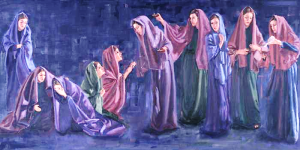 1 “Then the kingdom of heaven will be like ten virgins who took their lamps and went out to meet the bridegroom.” Be it parable or allegory, we are limited in dissecting this passage from the gospel. Many commentaries offer insight from wedding customs, but of another culture or age. One commentary I reviewed was assuming 10th century Jewish wedding customs from Spain reflected an unaltered liturgical custom. Possibly.
 Depend, rely, trust, hope – all synonyms, but each one brings its own nuance. But all generally carry the same questions. Do we depend on a what or who? Upon what or whom do we rely? Where do we place our trust? Upon whom do we trust? And the same questions surround “hope.” What do we hope for? Who do we hope in?
  In my youth, I had an uncle. He would visit once or twice a year, and every three years or so one of his visits would be at Christmas. He was an interesting and worldly person who was ever the font of fascinating information, experiences, and knowledge of the world beyond the confines of my neighborhood. He only had one habit that I found annoying.
  A reposting from All Souls 2016 – Part of the blessing being a parish priest is that you are invited into some of the most intimate moments of a family’s life. There is perhaps none more intimate and intense than the moments when illness passes through uncertain diagnosis, to one which blurs into the final days of a life. It is part of a life of ministry to be into a family whose loved one’s days are numbered. It is a privilege to journey with the family are they prepare for the loss that surely and steadily this way comes. In those times, Hope can seem more tentative, more distant; perhaps hovering on the edge of disappointment.
  4 They tie up heavy burdens (hard to carry) and lay them on people’s shoulders, but they will not lift a finger to move them.
  During the first 300 year of the Christian church, the people of God endured periods of peace, but also extended periods of persecution. Especially in the local churches, each generation remembered the martyrs and the leaders who exemplified the faith. By the fourth century these women and men were honored in liturgies that commemorated their passing into God’s bright glory. In time, churches were named to honor their memory, sometimes even built on their tombs. And in time relics were collected and honored.
  friarmusings