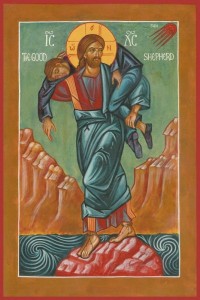
 Amen, amen, I say to you, whoever does not enter a sheepfold through the gate but climbs over elsewhere is a thief and a robber. 2 But whoever enters through the gate is the shepherd of the sheep. 3 The gatekeeper opens it for him, and the sheep hear his voice, as he calls his own sheep by name and leads them out. 4 When he has driven out all his own, he walks ahead of them, and the sheep follow him, because they recognize his voice. 5 But they will not follow a stranger; they will run away from him, because they do not recognize the voice of strangers.” 6 Although Jesus used this figure of speech, they did not realize what he was trying to tell them. 7 So Jesus said again, “Amen, amen, I say to you, I am the gate for the sheep. 8 All who came (before me) are thieves and robbers, but the sheep did not listen to them. 9 I am the gate. Whoever enters through me will be saved, and will come in and go out and find pasture. 10 A thief comes only to steal and slaughter and destroy; I came so that they might have life and have it more abundantly.
Commentary Moloney [301] outlines this narrative by the following schema:
- 9:39-41: Introduction. Jesus is questioned by the Pharisees (among whom there is a division) and he condemns them for their blind ignorance
- 10:1-6: Jesus tells a parable about entering the sheepfold and the Pharisees cannot understand. This section is marked with the unique, “Amen, Amen…”
- 10:7-13: Jesus contrasts himself, the door and the Good Shepherd, with others who are thieves, robbers and hirelings. This section is also introduced with “Amen, Amen…”
- 10:14-18: Jesus the Good Shepherd, out of union with the Father, lays down his life for the sheep
- 10:19-21: Conclusion: A division among “the Jews.”
Continue reading →


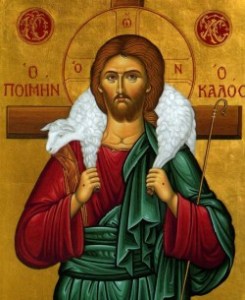 Israel’s leaders were often regarded as shepherds, and even though God was always their principal shepherd, responsible human agents were necessary so that Israel would not be as “sheep without a shepherd” (Num 27:16, 17); and significantly, a charismatic element is said to have rested on such leaders (Num 27:16–21; cf. Isa 11:1–9; 44:28–45:1). God is said to have led the flock Israel through the wilderness by the hand of Moses and Aaron (Ps 77:21; Isa 63:11). Although no Israelite king is ever directly called by the title “shepherd,” it is implied, since David as prince feeds, or shepherds, Israel (2 Sam 5:2), and when Micah predicted the death of Ahab and Israel’s defeat, he said the scattered army would be “as sheep which have no shepherd” (1 Kgs 22:17; 2 Chr 18:16; cf. Num 27:16, 17). Continue reading
 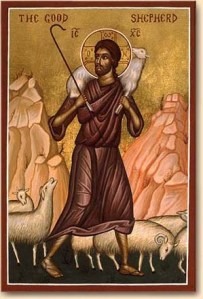 So Jesus said again… It is evident to Jesus that the disciples do not understand, so Jesus offers another explanation. Commentaries have long asked how we are to understand the relationship between vv.1-6 and vv.7-18. Are the latter verses making an allegorical explanation to the already presented parable? The problem with such a view is that characters and imagery has changed. In any case, few people seem to believe that if vv.7-18 are a clarifying or additional explanation, it likely was not any more effective.

 The three saddest words in Scripture, or in our lives, are. “We had hoped….” For these travelers, it is “we had hoped he was the one to redeem Israel.” “We had hoped,” but those hopes were dashed upon the wood of the cross and buried in a tomb. Now they are walking away from the rumors of Resurrection in a slow descent into despair. For years, the power of God had seemed so close. The disciples saw the miracles, heard the preaching, saw Lazarus emerge from the tomb, and so much more. Now it all lays powerless in the tomb. “We had hoped…”
  Our gospel on this 3rd Sunday of Easter is St. Luke’s telling of the two disciples on the road to Emmaus. It is a story about a journey of faith even as it is a journey to faith. The thing about journeys is that you often do not realize that you are on one, or if you do, may not recognize that the nature of the journey has changed. The two disciples had journeyed to Jerusalem with one set of hopes and expectations. They were following Jesus, were in Jerusalem for the events of Holy Week, and saw one journey seemingly end at Golgotha.
  At The Table With Jesus The disciples are struck by what Jesus has said and ask him to stay with them even has he appears to be traveling on. Alan Culpepper (479) offers an interesting insight into the simple passage (v.28):
 Let’s say that San Francisco is the beginning of the voyage. Sydney, Australia is the destination. At the same moment a tramp steamer, a luxury liner, a submarine, a sailboat, a Lamborghini, a single-engine Cessna, and a Boeing 747 airliner begin the journey. All will try to journey to the same destination. Every journey will be encounter different things along the way: storms, rogue waves, turbulence, trade winds, potholes, headwinds, end-of-the-road, and more. For a time, we might be lost, adrift, or stuck in one place. Every tale of the journey will be different. The lessons learned along the way unique. Not all will make it to Sydney. We hope that most will
