

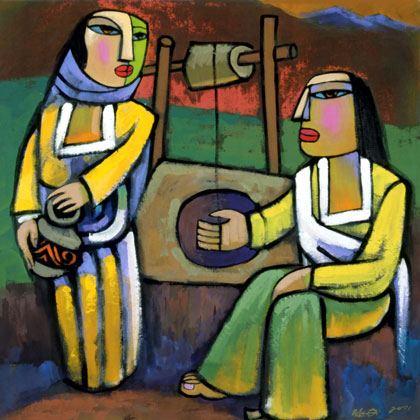
 John 4:5-42 5 So he came to a town of Samaria called Sychar, near the plot of land that Jacob had given to his son Joseph. 6 Jacob’s well was there. Jesus, tired from his journey, sat down there at the well. It was about noon.
7 A woman of Samaria came to draw water. Jesus said to her, “Give me a drink.” 8 His disciples had gone into the town to buy food. 9 The Samaritan woman said to him, “How can you, a Jew, ask me, a Samaritan woman, for a drink?” (For Jews use nothing in common with Samaritans.) 10 Jesus answered and said to her, “If you knew the gift of God and who is saying to you, ‘Give me a drink,’ you would have asked him and he would have given you living water.” 11 (The woman) said to him, “Sir, you do not even have a bucket and the cistern is deep; where then can you get this living water? 12 Are you greater than our father Jacob, who gave us this cistern and drank from it himself with his children and his flocks?” 13 Jesus answered and said to her, “Everyone who drinks this water will be thirsty again; 14 but whoever drinks the water I shall give will never thirst; the water I shall give will become in him a spring of water welling up to eternal life.” 15 The woman said to him, “Sir, give me this water, so that I may not be thirsty or have to keep coming here to draw water.” Continue reading
 “And he was transfigured before them; his face shone like the sun and his clothes became white as light.” (Mt 17:2) Transfigured, metamorphoo – to change the visible appearance; I used to think that maybe Epiphany would have been a better title for what happened on the mountain top. Epiphany meaning the revealing or the unveiling. Then again, I don’t think the full glory of God was revealed; just a single layer was pealed back. Perhaps transfigured is the better word. How much more could the apostles have seen and heard – and, more importantly, to begin to comprehend? The Book of Exodus 33:20 says that if we saw God face-to-face we would not survive the encounter. It would be too much for our mortal being. So, maybe it is better that only a single layer was peeled back.
  Back in the day when I was working in the world and spending way too much time on airplanes accumulating way too many frequent-flyer miles, it seemed to me business travelers did three things on longer flights: sleep, work, or read Stephen’ Covey’s “The 7 Habits of Highly Effective People.” The book argues that one should align universal and timeless principles with one’s values. Covey sees principles as external natural laws, while values remain internal and subjective. Covey asserts that values govern people’s behavior, but principles ultimately determine the consequences. If sales volume is measure of the usefulness of this self-help book, then 25 million copies sold says something. Maybe there are some possibilities for a parallel book about the best practices and habits for Catholics. Might be a Lenten best seller!
 From
From  And sin entered the world. In the second reading, St. Paul is pretty clear that sin entered the world through Adam and Eve. Did you ever stop to think about what exactly was the first sin? Maybe it is as simple as disobedience. “The LORD God gave the man this order: You are free to eat from any of the trees of the garden except the tree of knowledge of good and evil. From that tree you shall not eat; when you eat from it you shall die.” (Gen 2:6-7) That seems awfully clear… lots of trees, lots of fruit, help yourself, but not from that one tree. Awfully clear and awfully tempting. We get to listen to Eve’s thoughts as Satan tempts her: “The woman saw that the tree was good for food, pleasing to the eyes, and desirable for gaining wisdom” (Gen 3:6) I suspect I had many the same thoughts when as a child, I stood before the open refrigerator door staring longingly at the last piece of key lime pie – so good, so pleasing to the eye… and there was mom talking from the next room, “Have a piece of fruit. It’s good for you.” You can guess how that story ends. In my case, it was clearly disobedience, but I am not so sure about Adam and Eve.
  Ash Wednesday, the first day of the penitential season of Lent in the Catholic Church, is always 46 days before Easter Sunday. It is a “movable” feast that is assigned a date in the calendar only after the date of Easter Sunday is calculated. How is it calculated? I’m glad you asked.
