1 He was praying in a certain place, and when he had finished, one of his disciples said to him, “Lord, teach us to pray just as John taught his disciples.” 2 He said to them, “When you pray, say: Father, hallowed be your name, your kingdom come. 3 Give us each day our daily bread 4 and forgive us our sins for we ourselves forgive everyone in debt to us, and do not subject us to the final test.” 5 And he said to them, “Suppose one of you has a friend to whom he goes at midnight and says, ‘Friend, lend me three loaves of bread, 6 for a friend of mine has arrived at my house from a journey and I have nothing to offer him,’ 7 and he says in reply from within, ‘Do not bother me; the door has already been locked and my children and I are already in bed. I cannot get up to give you anything.’ 8 I tell you, if he does not get up to give him the loaves because of their friendship, he will get up to give him whatever he needs because of his persistence. 9 “And I tell you, ask and you will receive; seek and you will find; knock and the door will be opened to you. 10 For everyone who asks, receives; and the one who seeks, finds; and to the one who knocks, the door will be opened. 11 What father among you would hand his son a snake when he asks for a fish? 12 Or hand him a scorpion when he asks for an egg? 13 If you then, who are wicked, know how to give good gifts to your children, how much more will the Father in heaven give the holy Spirit to those who ask him?” Continue reading
Author Archives: Friar Musings
Fully alive
Let me confess to you: I have never much liked the story of Martha and Mary. Maybe it is because there is a part of me that likes “to do,” to see measurable progress, and know we are moving ahead. Don’t get me wrong, I treasure my quite time, but… Most of my life I have heard that the point of this story was that Mary’s attention to Jesus’ teaching is better and more important that what Martha is doing – the work of hospitality. The women in Kenya heard it that way and it rubbed them the wrong way. They quickly pointed out the biblical importance of their work: “Do not neglect hospitality, for through it some have unknowingly entertained angels.” (Hebrews 13:2) They also could have just stayed here in the Gospel of Luke were hospitality is evangelical. In the end, these women felt that they story undervalues or dismissed their efforts to be welcoming, hospitable and to serve. Continue reading
An Open Letter on Violence
The Franciscan friars here at Sacred Heart are Members of the Franciscan Province of the Most Holy Name of Jesus. Our Provincial Minister, Fr. Kevin Mullen, OFM, has sent out a thoughtful letter on a Franciscan response to this recent spate of violence. Sadly, this letter is all to pertinent, especially given the events of July 14th in Nice France. May their souls and all the souls of the Faithful rest in the mercy of God.
Dear Brothers,
Sad to say that each day seems to be filled with more and more stories which indicate the spread of violence increasing on global, national, and local levels. This blanket of violence seems to be like a plague that knows no boundaries. In just the past week or so, we are repulsed to learn about the senseless loss of life in Istanbul, Dhaka, Baghdad, Orlando, Falcon Heights (Minnesota), Baton Rouge, and Dallas. People have been targeted and killed because of their religion, ethnicity, race, sexuality, and profession. The perpetrators of these killings seem to be filled with ignorance, fear, and hatred. They tragically disregard the intrinsic value of life and commit crimes against God and humanity.
We, Franciscan friars, must recognize that the current context of our world has a profound impact upon the way we choose to live the Gospel of Jesus Christ in the 21 st century. Now more than ever, we must choose peace, and we must witness to the value of non-violence. We must see ourselves first and foremost as instruments of peace, healing, and reconciliation. We are called to be bridge-builders. We enter into the midst of the ignorance, fear, and hatred, and we offer a different response — not an “eye-for-an eye” or a “get even” type of response, but rather an alternate approach that walks in the midst of suffering, injustice, pain, and death and calls out in a non-violent voice for understanding, dialogue, healing, justice, mercy, and peaceful resolutions.
As friars, our attitudes, words, and actions express our deeply held convictions. Each friar must resolve to intensify his relationship with God through individual and communal prayer, especially though the celebration of the Eucharist. As members of local fraternities-in-mission we must live at peace with one another in order to give credible witness to the people we serve. In our work and in our ministries, we must always promote peace, harmony, and the cause of justice. Our words should be expressed in ways that help to build-up and bring people together as opposed to the words — expressed all too frequently in these times — that tear down and cause disruption and divisions.
Fifty-three years ago within our country when basic human and civil rights were being denied to African-Americans, Dr. Martin Luther King, Jr. writing from his prison cell in Birmingham, Alabama, reminded people of some fundamental truths. Dr. King wrote:
I am cognizant of the interrelatedness of all communities and states. I cannot sit idly by in Atlanta and not be concerned about what happens in Birmingham. Injustice anywhere is a threat to justice everywhere. We are caught in an inescapable network of mutuality, tied in a single garment of destiny. Whatever affects one directly, affects all indirectly. Never again can we afford to live with the narrow, provincial “outside agitator” idea. Anyone who lives inside the United States can never be considered an outsider anywhere within its bounds.
His words challenged and united people then and they can hopefully do the same for us now. We must remember we are all sisters and brothers.
The better part: final reflection
A Reflection. Part of Culpepper’s (Luke, New Interpreter’s Bible, 232) final “Reflections:”
In its own way, the conjunction of the stories about the good Samaritan and the female disciple voice Jesus’ protest against the rules and boundaries set by the culture in which he lived. As they develop seeing and hearing as metaphors for the activity of the kingdom, the twin stories also expose the injustice of social barriers that categorize, restrict, and oppress various groups in any society (Samaritans, victims, women). To love God with all one’s heart and one’s neighbor as oneself meant then and now that one must often reject society’s rules in favor of the codes of the kingdom — a society without distinctions and boundaries between its members. The rules of that society are just two — to love God and one’s neighbor — but these rules are so radically different form those of the society in which we live that living by them invariably calls us to disregard all else, break the rules, and follow Jesus’ example. Continue reading
St. Bonaventure of Bagnoregio
Today, July 15th is the Feast Day of St. Bonaventure of Bagnoregio. He was a Franciscan theologian and philosopher, held a Master’s Chair at the University of Paris, was elected Minister General of the Franciscan Order in one of its most contentious times, wrote many spiritual texts, compiled a biography (legenda) of St. Francis at the request of the friars, and many more things. His work Itinerarium mentis in Deum (Journey of the Soul to God) is considered a masterpiece of medieval spiritual practice. You can read more about the saint here. Happy Feast Day to all Franciscans.
The better part: out of place
Out of Her Proper Place. There are somethings that are culturally amiss here. First of all, Mary is not in her “proper place” according to the culture. In the gender-based division of space in that culture, it is very likely Mary who is sitting with Jesus in an area reserved for men (whether dining area or “living room” area). Second, it is not clear who is the elder sister here. Since Jesus interacts with Mary here and in John 11, perhaps Martha might have been the younger sister. But since Martha extended the hospitality into “her” (?) home, she is the elder sister. Continue reading
The better part: encounter
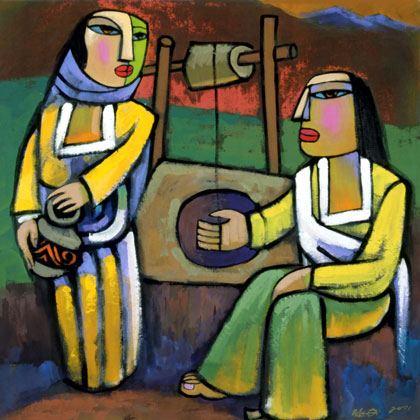
The Encounters with Jesus. “She [Martha] had a sister named Mary (who) sat beside the Lord at his feet listening to him speak. Mary was listening to Jesus’ word or message (logos in the singular) when “Martha, burdened with much serving, came to him and said, “Lord, do you not care that my sister has left me by myself to do the serving? Tell her to help me.”
From the welcome of hospitality, we move to this scene. Culpepper simply states it: “Martha presumes to tell Jesus what he should do; Mary lets Jesus tell her what she should do.” Is that a bad thing? As we shall see next week (Luke 11:1-13), Jesus is clear about the importance of persistence in prayer, e.g., the friend at midnight (11:5-8), the widow before the judge (18:1-8). Telling God repeatedly what we want God to do is not necessarily bad! However, Martha’s words, like the Pharisee’s prayer in Luke 18:9-14, indicate flaws in their motivations. Continue reading
The better part: hospitality
Greek: philoxenia. The practice of receiving a guest or stranger graciously was common to all cultures in the period of both the Old and New Testament. The word most often associated with hospitality in the LXX and the NT is xenos, which literally means foreigner, stranger, or even enemy. In its derived sense, however, the term comes to denote both guest and host alike. Typically, the verb used to describe the extending of hospitality is xenizein (Sir 29:25; 1 Macc 9:6; Acts 10:23; Heb 13:2). In the NT one who receives visitors is said to be philoxenos, i.e., a “lover of strangers,” or to be practicing the virtue of philoxenia (1 Tim 3:2; 1 Pet 4:9; Rom 12:13; Heb 13:2). Continue reading
The better part: context
38 As they continued their journey he entered a village where a woman whose name was Martha welcomed him. 39 She had a sister named Mary (who) sat beside the Lord at his feet listening to him speak. 40 Martha, burdened with much serving, came to him and said, “Lord, do you not care that my sister has left me by myself to do the serving? Tell her to help me.” 41 The Lord said to her in reply, “Martha, Martha, you are anxious and worried about many things. 42 There is need of only one thing. Mary has chosen the better part and it will not be taken from her.” Continue reading
Drawing near
“Go and do likewise.” This seems like a pretty clear command from Jesus. You just heard the parable of the Good Samaritan, so what is it that you are to go and do likewise? Clearly the context for the parable is Jesus’ effort to tease out the scholar of the law what it means to love God and to love one’s neighbor – that’s the theory of it, but what are practical elements of the divine command? The scholar of the law never gets to that “because he wished to justify himself.” He asks Jesus, “And who is my neighbor?” And that is where the proverbial rubber hits the road. Even if the scholar figures out who his neighbor is, there are the practical matters of “doing.” Jesus words punctuate the ending: “Go and do likewise.” Continue reading