

 Context. One thing that is evident when you look at this Gospel reading (Luke 4:21-30) is that the narrative really begins at v.14. As mentioned last week, it is as though the story was cut in half (last week vv.14-21) and we never got to know the reaction of the people in the synagogue. Fortunately, the story continues as Luke 4:21-30 is the Gospel reading for this Sunday (4th Ordinary, C). Many Lucan scholars hold that the two halves together are key and make clear the four major points in Luke’s account:
- the announcement of Jesus ministry as the fulfillment of God’s salvation-time,
- a statement about the content of Jesus’ ministry based on the quotation from Isaiah,
- the foreshadowing of Jesus’ final suffering and rejection,
- the foreshadowing of the movement of the gospel from Jew to Gentile. (found in Stoffregen)
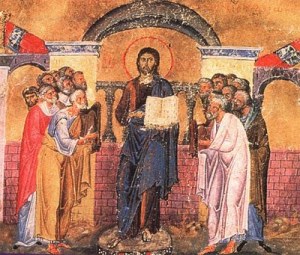
 “Are you Jesus?” It is a question I get asked on occasion, most often because of the Franciscan habit that I wear. Lots of times the question comes from small children. Their picture books show Jesus in his robes and then they see me. I suspect the question is more about my Franciscan robes. Maybe on my good days it is about me. Maybe, just maybe there was a moment when I was Jesus for them.
 Catholics, in general, are reluctant to talk about their faith in the presence of others. Why? It is easy to talk about church issues and controversies or moral values but not about our relationship with Christ or about how we recognize God’s action in our lives. It seems socially ungracious to “talk religion” around the water cooler or on the golf course or at the swimming pool. Maybe some Catholics have grown up without clear knowledge of their beliefs, and therefore, feel inadequate to explain or defend the faith. Others may feel that religion is a private matter.
 The “Wedding at Cana” story comes from the second chapter of John, but allow me to draw your attention to the first chapter. In the beautiful prologue of John’s Gospel, we hear in John 1:14 – “And the Word became flesh and made his dwelling among us, and we saw his glory, the glory as of the Father’s only Son, full of grace and truth.” Full of grace and truth. Now, here at Cana Jesus is drawn into the public light for all to begin to see, witness, and understand – that the fullness of grace and truth stands among us, dwelling with us in all the wonders of this life. This is what grace looks like.
