 “As we express our gratitude, we must never forget that the highest appreciation is not to utter words, but to live by them.” – John F. Kennedy
Yesterday I received an email from one of my brother friars. I thought would post its content. The email raised the question – in the light of all the commercial sales and advertisements: Is Veterans Day really a holiday or is it a holy day?
It’s a holy day when we reflect on the many women and men who serve in the military and put their own lives in danger for the freedom we enjoy.
It’s a holy day when we stop our daily life routines to celebrate at a parade, pause our businesses and close our schools to show joy and respect for what our veterans have done for us and our nation, for the rights and freedoms that they have won and protected through all these years.
It’s a holy day when we remember and give thanks to God for our veterans who have returned safely from areas of conflict and war.
It’s a holy day when we stop everything we are doing and consider what government and military benefits, or lack thereof, our veterans who are returning from service find here at home.
It’s a holy day when we feel the pain of guilt and experience the sadness for those veterans who are homeless, disabled from combat wounds, affected by mental, emotional and spiritual agonies and are left alone in their suffering.
It’s a holy day when we mourn our own selfishness for forgetting to thank and be ever grateful to those veterans who have served our country yet feel unappreciated, lonely and forgotten.
To all veterans, today and every day, we say thank you for protecting us and keeping us safe. We bless you, pray for you and pledge to never forget the sacrifices you have made for our country and for us.
Fr. David Convertino, OFM
Executive Director
Holy Name Province – Franciscan Friars
Office of Development


 see invited him to dine with him, and he entered the Pharisee’s house and reclined at table. 37 Now there was a sinful woman in the city who learned that he was at table in the house of the Pharisee. Bringing an alabaster flask of ointment, 38 she stood behind him at his feet weeping and began to bathe his feet with her tears. Then she wiped them with her hair, kissed them, and anointed them with the ointment. 39 When the Pharisee who had invited him saw this he said to himself, “If this man were a prophet, he would know who and what sort of woman this is who is touching him, that she is a sinner.” 40 Jesus said to him in reply, “Simon, I have something to say to you.” “Tell me, teacher,” he said. Continue reading
  The days of tribulation are upon us! Soon we will see those signs in the heavens. The sun will be darkened the moon will not give its light, stars will fall from the sky, and the powers of heaven will be shaken!! So, get your life in order! Say your prayers! Get right with God! And get on your knees because Jesus is coming!!
  Did you know that gratitude has been scientifically studied? In just the last 10 years, there have been hundreds of studies that have documented the social, physical, and psychological benefits of gratitude. The graphic and the following text all point to some of the benefits of practicing gratitude:
  It is that time of year again when the Baseball Writers will vote to induct someone into the Hall of Fame in Copperstown, NY. Joe Posnanski at NBC Sports has a great
  Promise Amidst Tribulation. 24 “But in those days after that tribulation the sun will be darkened, and the moon will not give its light, 25 and the stars will be falling from the sky, and the powers in the heavens will be shaken. 26 And then they will see ‘the Son of Man coming in the clouds’ with great power and glory, 27 and then he will send out the angels and gather (his) elect from the four winds, from the end of the earth to the end of the sky.
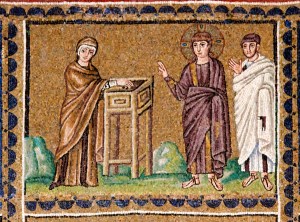 Our gospel is known as the story of the Widow’s Mite. As you just heard, a widow donates two small coins, while wealthy people donate much more. A common explanation of the story is that Jesus praises the poor widow and holds her up as an example to us all because she gave “her whole livelihood.” So even though the rich people gave more, it was just for show and only from their chump change. Not the widow, she is “all in” in what she gives to God. The moral of the story is that small sacrifices of the poor mean more to God than the extravagant donations of the rich. And so I could have a seat at this point, leave you to think about your weekly offering, your APA pledge… are you giving chump change, or are your contributing your whole livelihood? I could (hey I just did!) but there is more here than meets the eye.
