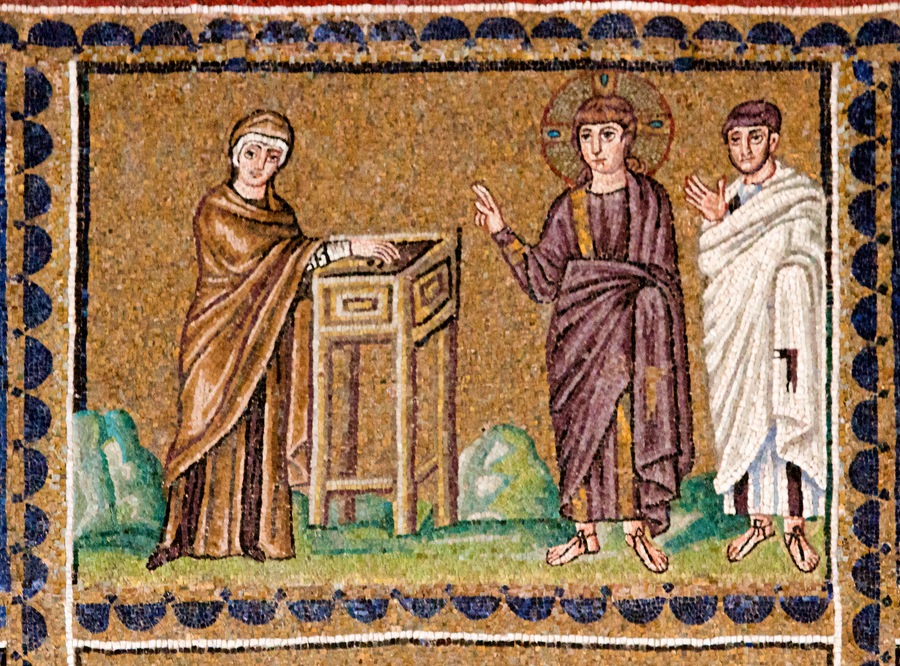
I want to renew and continue the conversation we began about belonging in this column space from the beginning of this year. There has been lots of feedback about it — it seems to have struck a deep cord with people. In a previous column I wrote, “The creation of that good soil church begins when each one here begins a conversation with, ‘Hello, my name is….’ and continues each week as the conversation grows, bearing fruit, when someone suggests, ‘You know what we should do?’ Then in the doing, faith grows, purpose becomes clearer, prayer comes more naturally, forgiveness more easily.” Since then, it seems to me, that people are a bit more engaging with people around them, there are some new “pew communities” forming, and people are beginning to ask about the welfare of folks when they are missing from Mass. All signs of the beginning of a deeper belonging. Continue reading
Author Archives: Friar Musings
Cleansing the house: clarity
Clarity. 21 But he was speaking about the temple of his body. 22 Therefore, when he was raised from the dead, his disciples remembered that he had said this, and they came to believe the scripture and the word Jesus had spoken.
Verse 21 makes the second level of meaning of Jesus’ words is now made explicit. The Evangelist tells the reader that Jesus speaks of “the temple of his body.” Since for Judaism the Temple is the locus of God’s presence on earth, v. 21 suggests that Jesus’ body is now the locus of God. Verse 21 recalls 1:51 where the Son of Man replaces Jacob’s ladder as the locus of God’s interaction with the world. Continue reading
Cleansing the house: misunderstanding
Which Temple? 17 His disciples recalled the words of scripture, “Zeal for your house will consume me.” In v. 17, the focus shifts to the disciples and their recollection of these events. They are interpretive witnesses (see v. 22). John, like many other NT writes sees Psalm 69:10 as pointing to Jesus’ death (e.g., Matt 27:34, 48; Mark 15:23, 36; John 19:28; Rom 15:3). Verse 17 alters Ps 69:10 slightly, however, and that alteration is theologically significant. In the Hebrew and Greek versions of Ps 69:10, the verb “consume” refers to past events, but in the disciples’ recollection of the verse, the verb is translated as a future tense (“will consume me”). Psalm 69:10 thus functions as a prophecy of the time when Jesus will be consumed—that is, his crucifixion. This use of Ps 69:10 gives the temple cleansing a christological emphasis. In the synoptic Gospels, the OT quotations draw attention to the Temple, but Ps 69:9 fixes the reader’s attention on Jesus. John’s temple story is ultimately about Jesus’ fate, not the Temple’s. Continue reading
Willing to hear
One of the things that challenge scripture scholars is where to put the punctuation. The Greek and Hebrew manuscripts don’t include such things. Consider a part of the first reading for Tuesday, March 3rd.
Though your sins be like scarlet,
they may become white as snow;
Though they be crimson red,
they may become white as wool.
If you are willing, and obey,
you shall eat the good things of the land (Is 1:18-19) Continue reading
Cleansing the house: what clutters
13 Since the Passover of the Jews was near, Jesus went up to Jerusalem. 14 He found in the temple area those who sold oxen, sheep, and doves, as well as the money-changers seated there.
The Temple and Money Changers. The “temple” signifies the whole of the Temple precincts, including the various courts as well as the holy place. It is most certain that the area of action occurred in one of the courtyards. It is certain that the selling mentioned took place in the outer courtyard, the court of the Gentiles. The reason for the practice was, of course, the convenience of having at hand a supply of animals required for the prescribed sacrifices. Continue reading
Cleansing the house: context
13 Since the Passover of the Jews was near, Jesus went up to Jerusalem. 14 He found in the temple area those who sold oxen, sheep, and doves, as well as the money-changers seated there. 15 He made a whip out of cords and drove them all out of the temple area, with the sheep and oxen, and spilled the coins of the money-changers and overturned their tables, 16 and to those who sold doves he said, “Take these out of here, and stop making my Father’s house a marketplace.” 17 His disciples recalled the words of scripture, “Zeal for your house will consume me.” 18 At this the Jews answered and said to him, “What sign can you show us for doing this?” 19 Jesus answered and said to them, “Destroy this temple and in three days I will raise it up.” 20 The Jews said, “This temple has been under construction for forty-six years, and you will raise it up in three days?” 21 But he was speaking about the temple of his body. 22 Therefore, when he was raised from the dead, his disciples remembered that he had said this, and they came to believe the scripture and the word Jesus had spoken. 23 While he was in Jerusalem for the feast of Passover, many began to believe in his name when they saw the signs he was doing. 24 But Jesus would not trust himself to them because he knew them all, 25 and did not need anyone to testify about human nature. He himself understood it well. Continue reading
Are you listening?
I don’t think it is possible to hear the story of God asking Abraham to sacrifice his son Isaac — and not feel disturbed, at least a bit uneasy. Even if we do not ask it out loud this time, this day, there probably has been a day when we have wondered, “What kind of God is this that would ask the slaughter of an innocent young boy?” As soon as we think it we catch ourselves and think, “That’s not right. God was only testing Abraham. God never intended to have Abraham go through with it.” But then again, there is the lingering question. And we wonder. Continue reading
Transfiguration and Glory
Every year the Gospel for the Second Sunday in Lent is always one of the accounts of the Transfiguration of the Lord. Be it written by Matthew, Mark, or Luke, each account speaks of Jesus transfigured so that the Glory of God, the Shekhinah, is revealed to the disciples in the person of Jesus. Today, you will hear Mark’s version (9:2-10). The meaning of the Transfiguration is complex and varied, but among its meanings, is that it points to the glory that awaits us as co-heirs of eternal life, and that Christ “has bestowed on us the precious and very great promises, so that through them you may come to share in the divine nature.” (2 Peter 1:4) It’s a lot to ponder, pray, and reflect upon: are we somehow to share in the Glory revealed on that mountain top? It is mystery, indeed. Continue reading
Transfiguration: hearing rightly
What are they to hear? What are they to listen to? While “all the words from Jesus” is a general answer, a more specific answer from our context is Jesus’ teaching just before our text (8:31-38). In these verses, Jesus speaks words that the disciples (especially Peter) were unable to hear – the prediction of his Passion and death. Peter rebukes Jesus for talking about his Passion. Peter doesn’t want to listen to such words. Peter’s problem, as Jesus indicates it, “You are thinking not as God does, but as human beings do” (8:33). The same problem might be evident in his desire to build three booths. Continue reading
Transfiguration: reasons why
What are they to understand? What purposes did this theophany serve? There are a number of possibilities. Brian Stoffregen has compiled a good list of things to consider. Continue reading