The Samaritan Women: give me a drink

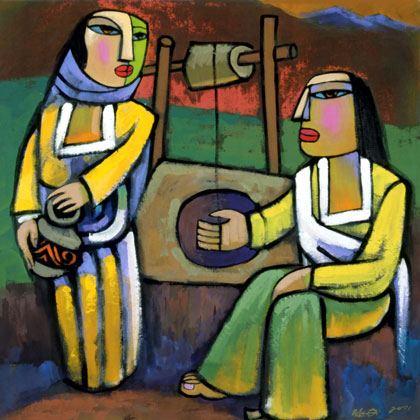
SamaritanWomanAtTheWellConversations between Jesus and the Sa­maritan woman (Jn 4:7-26). The dialogue between Jesus and the Samaritan woman consists of thirteen exchanges, one of the longest dialogues in the Gospel. It divides into two sections, each section introduced by a request/command by Jesus: (I ) vv.7-15 (“Give me a drink”); (2) vv.16-26 (“Go, call your husband”).

7 A woman of Samaria came to draw water. Jesus said to her, “Give me a drink.” 8 His disciples had gone into the town to buy food. 9 The Samaritan woman said to him, “How can you, a Jew, ask me, a Samaritan woman, for a drink?” (For Jews use nothing in common with Samaritans.) 10 Jesus answered and said to her, “If you knew the gift of God and who is saying to you, ‘Give me a drink,’ you would have asked him and he would have given you living water.” 11 (The woman) said to him, “Sir, you do not even have a bucket and the cistern is deep; where then can you get this living water? 12 Are you greater than our father Jacob, who gave us this cistern and drank from it himself with his children and his flocks?” 13 Jesus answered and said to her, “Everyone who drinks this water will be thirsty again; 14 but whoever drinks the water I shall give will never thirst; the water I shall give will become in him a spring of water welling up to eternal life.” 15 The woman said to him, “Sir, give me this water, so that I may not be thirsty or have to keep coming here to draw water.” Continue reading
The Samaritan Women: some background

SamaritanWomanAtTheWellWho are the Samaritans? In John 4:4-42, Jesus’ ministry enters a new stage. He leaves the confines of traditional Ju­daism and turns to those whom his Jewish contemporaries reckoned as outsiders and ene­mies: the Samaritans. The breach between Jews and Samaritans can be traced to the Assyrian occupation of northern Palestine (721 BCE; see 2 Kings 17), but the most intense rivalry began about 200 BCE. The source of the enmity between Jews and Samaritans was a dispute about the correct location of the cultic center (cf. John 4:20). The Samaritans built a shrine on Mt. Gerizim during the Persian period and claimed that this shrine, not the Jerusalem Temple, was the proper place of worship. The shrine at Mt. Gerizim was destroyed by Jewish troops in 128 BCE, but the schism between Jews and Samaritans continued (cf. John 4:9).

When Jesus meets the Samaritan woman at the well, he meets someone who stands in marked contrast to all that has come before in this gospel. When Jesus spoke with Nicodemus (3:1-21), he spoke with a named male of the Jewish religious establishment, a “teacher of Israel.” When Jesus speaks to the Samaritan woman, he speaks with an unnamed female of an enemy people. Continue reading

The Samaritan Women: a context

SamaritanWomanAtTheWellJohn 4:5-42 5 So he came to a town of Samaria called Sychar, near the plot of land that Jacob had given to his son Joseph. 6 Jacob’s well was there. Jesus, tired from his journey, sat down there at the well. It was about noon.

7 A woman of Samaria came to draw water. Jesus said to her, “Give me a drink.” 8 His disciples had gone into the town to buy food. 9 The Samaritan woman said to him, “How can you, a Jew, ask me, a Samaritan woman, for a drink?” (For Jews use nothing in common with Samaritans.) 10 Jesus answered and said to her, “If you knew the gift of God and who is saying to you, ‘Give me a drink,’ you would have asked him and he would have given you living water.” 11 (The woman) said to him, “Sir, you do not even have a bucket and the cistern is deep; where then can you get this living water? 12 Are you greater than our father Jacob, who gave us this cistern and drank from it himself with his children and his flocks?” 13 Jesus answered and said to her, “Everyone who drinks this water will be thirsty again; 14 but whoever drinks the water I shall give will never thirst; the water I shall give will become in him a spring of water welling up to eternal life.” 15 The woman said to him, “Sir, give me this water, so that I may not be thirsty or have to keep coming here to draw water.” Continue reading

More than Just Three Kings Day

Epiphany1January 6th is the day we typically call “Three Kings Day,” more formally known as The Epiphany.  Epiphany is derived from a Greek word ἐπιφάνεια, epiphaneia, meaning “manifestation,” and refers, generally, to Jesus being manifested to the gentile visitors from the East.  But in truth it is more complicated than that.  What is striking is that there are a variety of liturgical celebrations and dates that are all part of our rich Catholic tradition surrounding “Epiphany.”

Continue reading

Guadalupe

Our Lady of Guadalupe.

Today it is common to find villages, towns, cities, and even districts in Mexico, Central and South America named “Guadalupe.”  But in the year 1531 there was no such place in Mexico. So, I have always wondered why the appearance of the Blessed Virgin Mary is referred to as “Our Lady of Guadalupe.”

Guadalupe is the name of an area, a city, a river, and a Marian shrine in Spain. The word itself comes from a mixture of  Arabic and Latin roots. Remember that Spain was occupied in part and whole by an Islamic regime from 720 CE until 1492 CE, hence many words have Arabic origin. The Arabic wadi (seasonal river bed) became the Spanish “quadi” having the same meaning. “Quadi” seems to have been combined with the Latin lupus (wolf) to come up with Guadalupe. Continue reading

The Immaculate Conception

The Immaculate Conception of the Venerable One...It’s important to understand what the doctrine of the Immaculate Conception is and what it is not. Some people think the term refers to Christ’s conception in Mary’s womb without the intervention of a human father; but that is the Virgin Birth. Others think the Immaculate Conception means Mary was conceived “by the power of the Holy Spirit,” in the way Jesus was, but that, too, is incorrect. The Immaculate Conception means that Mary, whose conception was brought about the normal way, was conceived without original sin or its stain—that’s what “immaculate” means: without stain. The essence of original sin consists in the deprivation of sanctifying grace, and its stain is a corrupt nature. Mary was preserved from these defects by God’s grace; from the first instant of her existence she was in the state of sanctifying grace and was free from the corrupt nature original sin brings. Continue reading

Bl. John Duns Scotus

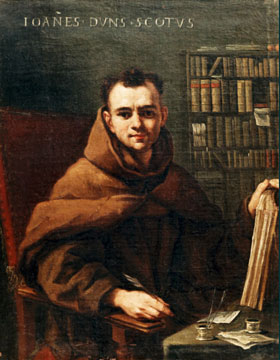
Duns Scotus1November 8th is the feast day of Blessed John Duns Scotus, a Franciscan friar from Scotland noted for his theological and philosophical work in the high-middle ages (late 13th and early 14th centuries). Scotus’ work was in the generation that followed Thomas of Aquinas and Bonaventure. His work was complex and nuanced, and he is generally considered to be one of the three most important philosopher-theologians of his time. He was given the medieval accolade Doctor Subtilis (Subtle Doctor) for his penetrating and subtle manner of thought. Continue reading

Our Lady of Sorrows

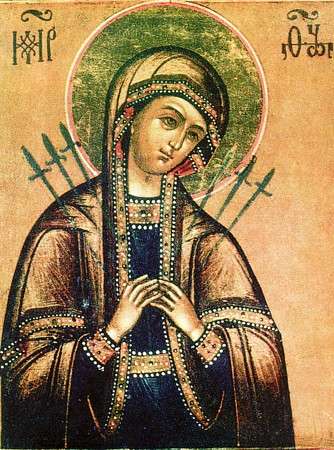
Mother-of-SorrowsOur Lady of Sorrows is celebrated on September 15th in the western Catholic Church. It is a devotion on Mary’s experience of the way in which the prophecy of Simeon came to be:

When the days were completed for their purification according to the law of Moses, Mary and Joseph took Jesus up to Jerusalem to present him to the Lord… Now there was a man in Jerusalem whose name was Simeon. This man was righteous and devout, awaiting the consolation of Israel, and the Holy Spirit was upon him. It had been revealed to him by the Holy Spirit that he should not see death before he had seen the Messiah of the Lord. He came in the Spirit into the temple; and when the parents brought in the child Jesus to perform the custom of the law in regard to him, he took him into his arms and blessed God, saying:  “Now, Master, you may let your servant go in peace, according to your word, for my eyes have seen your salvation, which you prepared in sight of all the peoples, a light for revelation to the Gentiles, and glory for your people Israel. The child’s father and mother were amazed at what was said about him; and Simeon blessed them and said to Mary his mother, “Behold, this child is destined for the fall and rise of many in Israel, and to be a sign that will be contradicted and you yourself a sword will pierce so that the thoughts of many hearts may be revealed.” (Luke 2:25-35)

In Catholic religious imagery, the Blessed Virgin Mary is portrayed in a sorrowful affect, with seven daggers piercing her heart. These represent the seven traditional sorrows:

  1. The prophecy of Simeon (Luke 2:25-35)
  2. The Flight into Egypt (Matthew 2:13)
  3. The loss of the child Jesus in the Temple (Luke 2:34-45)
  4. Mary meeting Jesus on the way to Calvary (John 19:26-27)
  5. Jesus dying on the cross (John 19:30)
  6. The piercing of the side of Jesus and Mary’s receiving the body of Jesus in her arms (Matthew 27:57-59)
  7. The body of Jesus placed in the tomb (John 19:40-42)

The Ringing of Bells

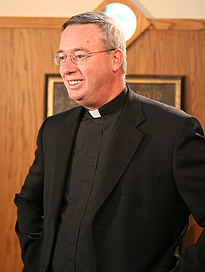
BishopCoyneThe Most Reverend Christopher Coyne was installed as the 10th Bishop of Burlington, Vermont on Thursday.  Here is his homily:
There is an inscription that was found on a bell that hung in the tower of a church in Northern Wisconsin that read:

“To the bath and the table,
To the prayers and the Word,
I call every seeking soul.” Continue reading