Guadalupe

Our Lady of Guadalupe.

Today it is common to find villages, towns, cities, and even districts in Mexico, Central and South America named “Guadalupe.”  But in the year 1531 there was no such place in Mexico. So, I have always wondered why the appearance of the Blessed Virgin Mary is referred to as “Our Lady of Guadalupe.”

Guadalupe is the name of an area, a city, a river, and a Marian shrine in Spain. The word itself comes from a mixture of  Arabic and Latin roots. Remember that Spain was occupied in part and whole by an Islamic regime from 720 CE until 1492 CE, hence many words have Arabic origin. The Arabic wadi (seasonal river bed) became the Spanish “quadi” having the same meaning. “Quadi” seems to have been combined with the Latin lupus (wolf) to come up with Guadalupe. Continue reading

The Immaculate Conception

The Immaculate Conception of the Venerable One...It’s important to understand what the doctrine of the Immaculate Conception is and what it is not. Some people think the term refers to Christ’s conception in Mary’s womb without the intervention of a human father; but that is the Virgin Birth. Others think the Immaculate Conception means Mary was conceived “by the power of the Holy Spirit,” in the way Jesus was, but that, too, is incorrect. The Immaculate Conception means that Mary, whose conception was brought about the normal way, was conceived without original sin or its stain—that’s what “immaculate” means: without stain. The essence of original sin consists in the deprivation of sanctifying grace, and its stain is a corrupt nature. Mary was preserved from these defects by God’s grace; from the first instant of her existence she was in the state of sanctifying grace and was free from the corrupt nature original sin brings. Continue reading

Bl. John Duns Scotus

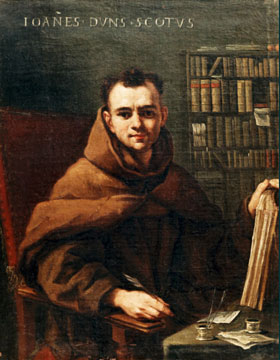
Duns Scotus1November 8th is the feast day of Blessed John Duns Scotus, a Franciscan friar from Scotland noted for his theological and philosophical work in the high-middle ages (late 13th and early 14th centuries). Scotus’ work was in the generation that followed Thomas of Aquinas and Bonaventure. His work was complex and nuanced, and he is generally considered to be one of the three most important philosopher-theologians of his time. He was given the medieval accolade Doctor Subtilis (Subtle Doctor) for his penetrating and subtle manner of thought. Continue reading

Our Lady of Sorrows

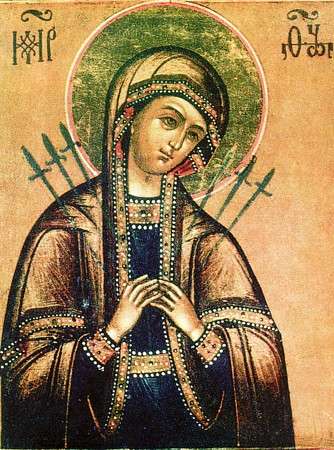
Mother-of-SorrowsOur Lady of Sorrows is celebrated on September 15th in the western Catholic Church. It is a devotion on Mary’s experience of the way in which the prophecy of Simeon came to be:

When the days were completed for their purification according to the law of Moses, Mary and Joseph took Jesus up to Jerusalem to present him to the Lord… Now there was a man in Jerusalem whose name was Simeon. This man was righteous and devout, awaiting the consolation of Israel, and the Holy Spirit was upon him. It had been revealed to him by the Holy Spirit that he should not see death before he had seen the Messiah of the Lord. He came in the Spirit into the temple; and when the parents brought in the child Jesus to perform the custom of the law in regard to him, he took him into his arms and blessed God, saying:  “Now, Master, you may let your servant go in peace, according to your word, for my eyes have seen your salvation, which you prepared in sight of all the peoples, a light for revelation to the Gentiles, and glory for your people Israel. The child’s father and mother were amazed at what was said about him; and Simeon blessed them and said to Mary his mother, “Behold, this child is destined for the fall and rise of many in Israel, and to be a sign that will be contradicted and you yourself a sword will pierce so that the thoughts of many hearts may be revealed.” (Luke 2:25-35)

In Catholic religious imagery, the Blessed Virgin Mary is portrayed in a sorrowful affect, with seven daggers piercing her heart. These represent the seven traditional sorrows:

  1. The prophecy of Simeon (Luke 2:25-35)
  2. The Flight into Egypt (Matthew 2:13)
  3. The loss of the child Jesus in the Temple (Luke 2:34-45)
  4. Mary meeting Jesus on the way to Calvary (John 19:26-27)
  5. Jesus dying on the cross (John 19:30)
  6. The piercing of the side of Jesus and Mary’s receiving the body of Jesus in her arms (Matthew 27:57-59)
  7. The body of Jesus placed in the tomb (John 19:40-42)

The Ringing of Bells

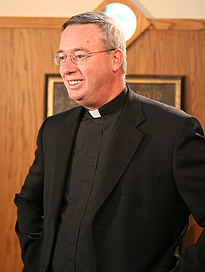
BishopCoyneThe Most Reverend Christopher Coyne was installed as the 10th Bishop of Burlington, Vermont on Thursday.  Here is his homily:
There is an inscription that was found on a bell that hung in the tower of a church in Northern Wisconsin that read:

“To the bath and the table,
To the prayers and the Word,
I call every seeking soul.” Continue reading

Pope Francis and Pets in Heaven?

Pope-FrancisPope Francis is a magnet for myths and urban legends – remember the one about him going out incognito at night to feed the homeless? – and he may have been the object of another one this week, with reports that he told a young boy that animals will go to heaven.

According to David Gibson of the Religion News Service, there’s no evidence Francis ever said that, despite the fact that it managed to wind up on the front page of the New York Times.

Pope-Paul-VIYes, a pope did once say that paradise is open to animals, but it was Pope Paul VI, not Francis. In the 1970s, Pope Paul VI said, “one day we’ll see our animals again in the eternity of Christ.”

According to Gibson’s reconstruction, the confusion began when Corriere della Sera, Italy’s main daily, ran a piece about some remarks by Francis on the renewal of creation, and the correspondent quoted the line from Paul VI. From there, it became conflated with what Francis had said, and it was off to the races.

Given that Francis has shown himself to be remarkably open to taking questions from the media, perhaps one day soon we’ll have the chance to ask what he actually believes about the salvation of pets.

For now, the first lesson is this: Beware of every breathless report you hear about Francis.

by John Allen Jr., Boston Globe – one part of article
December 13, 2014
http://www.cruxnow.com/church/2014/12/13/deal-with-it-francis-is-the-pope/

The only line we have

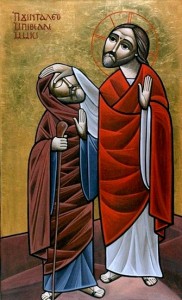
the_born_blind_manQuotidian. Fancy word. It means belonging to the everyday, the ordinary, the normal, the commonplace, the regular, or the familiar. It includes everyday tasks such as laundry. Laundry does not require much thought. I often “sleepwalk” through it. Swimming is like that for me. I have done it for so much of my life, I don’t have to pay too much attention. Sometimes our attention ebbs and flows in other areas to which we should be paying attention. The usual conversation with a friend during which you suddenly realize you’re not listening. The moment you realize that the TV is watching you instead of the other way around. A liturgy in which you are momentarily lost. A homily that sounds like all the rest. Continue reading

Pay attention: a reflection

TransfigAnnemarie Reiner (of Adelaide, Australia) posted this reflection on the Transfiguration on her blog “Who Do You Say That I Am.” (August 2006)  It is a very nice reflection for this Lenten Season.

When we look at our Gospel today we can understand why daily reflection is so important. These three disciples (and the rest of them) didn’t get who Jesus was until well after his death. They didn’t understand what had happened at the transfiguration. They didn’t understand what was happening as they witnessed Jesus’ life. They didn’t understand what was happening at the crucifixion. But they kept pondering their experiences over and over – if they didn’t we simply wouldn’t have the New Testament.

So what do we learn from this? Continue reading

Pay attention: here and not yet

TransfigPeter’s Response. As in 16:13-20, Peter again responds, again without a full understanding.  Consider Peter’s proposal to make three tents (skēnḗ; also “booth” or “tabernacle”). What did he intend? It has been variously understood as traveler’s hut, the “tent of meeting” where God spoke with Moses outside the camp (Exod 33:7), a more formal tent used in the Festival of Booths (cf. Lev 23:42–43; Zech 14:16ff), and even as the Jerusalem Temple tabernacle.  It is this last image that Matthew may have in mind as background – notwithstanding Peter’s intention.  It is the Temple tabernacle where the Shekinah, the fiery cloud that symbolized the continuing presence of God among the people, dwelt over the ark of the covenant.  The response to Peter’s proposal is three-fold (Boring, 364) Continue reading

Paying Attention: a glimpse into destiny

TransfigCommentary. Matthew 17:1-13 is an instructional session for all the disciples – note that in v.10, Peter, James and John have been joined the remainder of the group. Just as the preceding scene (16:13-28) juxtapositions the divine transcendence of Peter’s confession of Jesus as Son of God based on a revelation from heaven (16:17) with Jesus’ own teaching about the suffering Son of Man, so also in this scene the confession of the heavenly voice is juxtaposed with Jesus’ self-confession as suffering Son of Man.

The description of the Transfiguration is brief—just the first three verses of Matthew 17. But the incident becomes the context for two significant incidents for the disciples. Continue reading