Calling Disciples: a context

Calling disciplesThird Sunday in Ordinary Time
Matthew 4:12-23(25) 

12 When he heard that John had been arrested, he withdrew to Galilee. 13 He left Nazareth and went to live in Capernaum by the sea, in the region of Zebulun and Naphtali, 14 that what had been said through Isaiah the prophet might be fulfilled: 15 “Land of Zebulun and land of Naphtali, the way to the sea, beyond the Jordan, Galilee of the Gentiles, 16 the people who sit in darkness have seen a great light, on those dwelling in a land overshadowed by death light has arisen.” 17 From that time on, Jesus began to preach and say, “Repent, for the kingdom of heaven is at hand.” 18 As he was walking by the Sea of Galilee, he saw two brothers, Simon who is called Peter, and his brother Andrew, casting a net into the sea; they were fishermen. 19 He said to them, “Come after me, and I will make you fishers of men.” 20 At once they left their nets and followed him. 21 He walked along from there and saw two other brothers, James, the son of Zebedee, and his brother John. They were in a boat, with their father Zebedee, mending their nets. He called them, 22 and immediately they left their boat and their father and followed him. 23 He went around all of Galilee, teaching in their synagogues, proclaiming the gospel of the kingdom, and curing every disease and illness among the people. Continue reading

A Light to the Nations – giving voice to Faith

light2nationsOver the last several Sundays I have been connecting the readings beginning with Holy Family Sunday.  St. Paul gave us advice on being a holy family: to put on heartfelt compassion, kindness, humility, gentleness, patience, forbearance, forgiveness, and over all these, love. (cf. Col 3:12-13). And so I encourage you to use your family to practice those virtues, to become the embodiment of those virtues. Then on Epiphany Sunday, the message was to reveal those virtues to the world through your life – to become the epiphany of Christ to others. The Feast of the Baptism of the Lord followed in which the prophet Isaiah’s word says that in our baptism we are formed as a covenant the people – a vow, a promise, a bond, a connection that binds us to the promise and the power of Christ on one side and to the world on the other.

And so with good intent and hopeful hearts we work away in our personal lives and in our families – to be the person, the family, the witnesses to heartfelt compassion, kindness, humility, gentleness, patience, forbearance, forgiveness, and over all these, love. We want those virtues in our lives and in our families, but have we been practicing them? Have been talking about them within the family. I suspect most of us pray about it, we work at it, we succeed, we fail, we start over… mostly silently.  And think about it. If we are hesitant to speak about it within the safety of home, how likely are we to testify about it all in the company of others.? Continue reading

“the voice of one crying out in the wilderness”

IsaiahprophetThe OT Context of Isaiah 40:3  After affirming three times who he is not, John the Baptist at long last tells his interrogators who he is. Even though he is none of the scriptural figures expected to make their appearance in Israel in the last days, John does respond in terms of a figure spoken of in Scripture. He is “the voice of one crying out in the wilderness, ‘Make straight the way of the Lord’ ” (John 1:23) featured in Isaiah 40:3

Isaiah 40:3 constitutes the opening of the second of four well-defined speeches in Isa 40:1–9. The entire passage serves as a prologue that sets the tone for Isa 40–48, and indeed for the rest of the book, by announcing the intentions of Yahweh. After all the judgment and condemnation sounded in Isa 1–39, the opening of chapter 40 marks a major shift in orientation, introducing the theme of comfort that represents the leitmotiv for the remainder of the book. Continue reading

Behold the Lamb of God: commentary

I-saw-the-Spirit-come2John 1:29-34 29 The next day he saw Jesus coming toward him and said, “Behold, the Lamb of God, who takes away the sin of the world. 30  He is the one of whom I said, ‘A man is coming after me who ranks ahead of me because he existed before me.’ 31 I did not know him, but the reason why I came baptizing with water was that he might be made known to Israel.” 32 John testified further, saying, “I saw the Spirit come down like a dove from the sky and remain upon him. 33 I did not know him, but the one who sent me to baptize with water told me, ‘On whomever you see the Spirit come down and remain, he is the one who will baptize with the holy Spirit.’ 34  Now I have seen and testified that he is the Son of God.”

Commentary. After John’s interrogation by priests, Levites and Pharisees, the evangelist tells us, The next day John saw Jesus coming towards him and said, ‘Look, the Lamb of God, who takes away the sin of the world!’ This is but the start of a short, compact testimony by the Baptist witnessing to the One he had just baptized. Continue reading

Behold the Lamb of God: context

Baptism-JesusJohn 1:29-34 29 The next day he saw Jesus coming toward him and said, “Behold, the Lamb of God, who takes away the sin of the world. 30  He is the one of whom I said, ‘A man is coming after me who ranks ahead of me because he existed before me.’ 31 I did not know him, but the reason why I came baptizing with water was that he might be made known to Israel.” 32 John testified further, saying, “I saw the Spirit come down like a dove from the sky and remain upon him. 33 I did not know him, but the one who sent me to baptize with water told me, ‘On whomever you see the Spirit come down and remain, he is the one who will baptize with the holy Spirit.’ 34  Now I have seen and testified that he is the Son of God.”

Context. In the prologue the Fourth Evangelist presented John as “a man sent from God” who “came for testimony, to testify to the light, so that all might believe through him. He was not the light, but came to testify to the light.” (John 1:6-8; see also 1:15; and later 5:33) This opening characterization sets the stage for the narration of John’s ministry in 1:19–34. John’s identity is further probed when he is called to account by a delegation sent by the Jewish leaders in Jerusalem. Three times John denies being a particular end-time figure: the Christ (1:20; cf. 1:8, 15); Elijah (1:21a); the Prophet (1:21b; cf. 6:14; 7:40; cf. Deut. 18:15, 18). Continue reading

A Covenant of the People

Baptism-JesusTwo Sundays ago, on the Feast of the Holy Family,  we listened to some of the best advise about how to become a holy family. St. Paul wrote in the Letter to the Colossians: “Put on,… heartfelt compassion, kindness, humility, gentleness, and patience, bearing with one another and forgiving one another…And over all these put on love” (Col 3:12-13).  It raises the question to all of us, in whatever form our families take, are we practicing those virtues in order to become a holy family?  Would someone on the outside peer into our families and see evidence of those virtues? Continue reading

Revealed at home; revealed in the world

all-kinds-doorsNow that New Year’s has arrived our greeting is “Happy New Year.” In the days before December 25th we greeted each other with “Merry Christmas.” Did  you know that the Christmas season begins with the Christmas Eve masses and then moves through Holy Family Sunday, the Solemnity of the Epiphany, and continues to include the Baptism of the Lord – which we will celebrate next weekend.

Christmas through the Baptism of the Lord is all part of one season,  when the church is of one mind – to proclaim that born unto us is a savior – and then to begin to unpack what that will mean for us. The birth is celebrated at the Christmas masses, but the meaning is revealed in the celebrations that follow.  It is all connected. It is all of one voice. Continue reading

What is Revealed? The Epiphany

Epiphany1Matthew 2:1-12   1 When Jesus was born in Bethlehem of Judea, in the days of King Herod, behold, magi from the east arrived in Jerusalem, 2 saying, “Where is the newborn king of the Jews? We saw his star at its rising and have come to do him homage.” 3 When King Herod heard this, he was greatly troubled, and all Jerusalem with him. 4 Assembling all the chief priests and the scribes of the people, he inquired of them where the Messiah was to be born. 5 They said to him, “In Bethlehem of Judea, for thus it has been written through the prophet:

6
‘And you, Bethlehem, land of Judah,
are by no means least among the rulers of Judah;
since from you shall come a ruler,
who is to shepherd my people Israel.’”

7 Then Herod called the magi secretly and ascertained from them the time of the star’s appearance. 8 He sent them to Bethlehem and said, “Go and search diligently for the child. When you have found him, bring me word, that I too may go and do him homage.” 9 After their audience with the king they set out. And behold, the star that they had seen at its rising preceded them, until it came and stopped over the place where the child was. 10 They were overjoyed at seeing the star, 11 and on entering the house they saw the child with Mary his mother. They prostrated themselves and did him homage. Then they opened their treasures and offered him gifts of gold, frankincense, and myrrh. 12 And having been warned in a dream not to return to Herod, they departed for their country by another way. Continue reading

The Baptism of Jesus – Why?

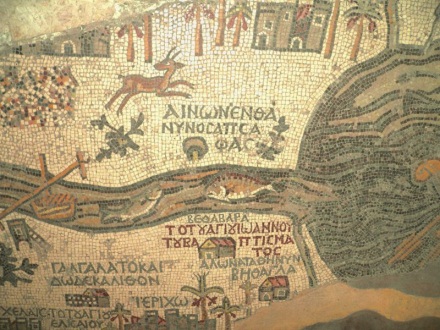
Part of the ancient Madaba Map showing two possible locations of Jesus’ baptism

Part of the ancient Madaba Map showing two possible locations of Jesus’ baptism

Did you ever wonder why Jesus was baptized? This event is recorded in the Canonical Gospels of Matthew, Mark, and Luke. In John 1:29-33, rather than a direct narrative, John the Baptist bears witness to the episode. Here is a part of the Lucan narrative (Luke 3:21–22):21 After all the people had been baptized and Jesus also had been baptized and was praying, heaven was opened 22 and the Holy Spirit descended upon him in bodily form like a dove. And a voice came from heaven, “You are my beloved Son; with you I am well pleased.”

Continue reading

Baptism of the Lord: meaning

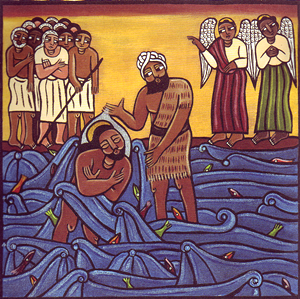
English: Baptism of JesusMatthew 3: 13 Then Jesus came from Galilee to John at the Jordan to be baptized by him. 14 John tried to prevent him, saying, “I need to be baptized by you, and yet you are coming to me?” 15 Jesus said to him in reply, “Allow it now, for thus it is fitting for us to fulfill all righteousness.” Then he allowed him. 16 After Jesus was baptized, he came up from the water and behold, the heavens were opened (for him), and he saw the Spirit of God descending like a dove (and) coming upon him. 17 And a voice came from the heavens, saying, “This is my beloved Son, with whom I am well pleased.”

The First Temptation of Christ. Brian Stoffregen has an interesting insight about righteousness as “do, perform” what God requires of us.

John, by trying to prevent the baptism, tempts Jesus not to do all that God requires of him. He tempts Jesus to assume his proper position now: to be the more powerful one; to baptize with the judgmental Holy Spirit and fire; to meet John’s need. I don’t think that these are too dissimilar to the devil’s temptations that occur immediately after the baptism (4:1-11) — temptations for Jesus to use his power now, for his own glory; and avoid his emptying and eventually the pain and suffering of the cross.

Continue reading