Why we rejoice…

English: Peresopnytsia Gospels. 1556-1561. Min...

 Luke 10:1-20 (10:1-12, 17-20 is the gospel reading)
14th Sunday in Ordinary Time, Year C

Luke 10 contains several sayings that are difficult for the church, e.g., the pronouncement of “woes” upon town and villages – difficult if you understand “woe” as a curse rather than its intended cry of disappointment. I would offer that a deeper difficulty is the sense that some people have that “mission” is part of the realm of the “professionals” in the church. The Franciscans were the first religious order to have a specifically missionary charism in our rule of life. And that is good, but does it allow admirers of St. Francis to stay on the side line and let “the professionals” take care of mission.This passage calls on all disciples to be part of mission. Continue reading


Let me say goodbye…

Jesus from the Deesis Mosaic

The 13th Sunday of Ordinary Time: Luke 9:51-62

51 When the days for his being taken up were fulfilled, he resolutely determined to journey to Jerusalem, 52 and he sent messengers ahead of him. On the way they entered a Samaritan village to prepare for his reception there, 53 but they would not welcome him because the destination of his journey was Jerusalem. 54 When the disciples James and John saw this they asked, “Lord, do you want us to call down fire from heaven to consume them?” 55 Jesus turned and rebuked them, 56 and they journeyed to another village. 57 As they were proceeding on their journey someone said to him, “I will follow you wherever you go.” 58 Jesus answered him, “Foxes have dens and birds of the sky have nests, but the Son of Man has nowhere to rest his head.” 59 And to another he said, “Follow me.” But he replied, ”(Lord,) let me go first and bury my father.” 60 But he answered him, “Let the dead bury their dead. But you, go and proclaim the kingdom of God.” 61 And another said, “I will follow you, Lord, but first let me say farewell to my family at home.” 62 (To him) Jesus said, “No one who sets a hand to the plow and looks to what was left behind is fit for the kingdom of God.” Continue reading

A Prophet, a Pharisee, and a Loving Woman

The 11th Sunday in Ordinary Time: Luke 7:36-8:3

36 A Pharisee invited him to dine with him, and he entered the Pharisee’s house and reclined at table. 37 Now there was a sinful woman in the city who learned that he was at table in the house of the Pharisee. Bringing an alabaster flask of ointment, 38 she stood

Rubens-Feast of Simon the Pharisee

Rubens-Feast of Simon the Pharisee (Photo credit: Wikipedia)

behind him at his feet weeping and began to bathe his feet with her tears. Then she wiped them with her hair, kissed them, and anointed them with the ointment. 39 When the Pharisee who had invited him saw this he said to himself, “If this man were a prophet, he would know who and what sort of woman this is who is touching him, that she is a sinner.” 40 Jesus said to him in reply, “Simon, I have something to say to you.” “Tell me, teacher,” he said. 41 “Two people were in debt to a certain creditor; one owed five hundred days’ wages and the other owed fifty. 42 Since they were unable to repay the debt, he forgave it for both. Which of them will love him more?” 43 Simon said in reply, “The one, I suppose, whose larger debt was forgiven.” He said to him, “You have judged rightly.” 44 Then he turned to the woman and said to Simon, “Do you see this woman? When I entered your house, you did not give me water for my feet, but she has bathed them with her tears and wiped them with her hair. 45 You did not give me a kiss, but she has not ceased kissing my feet since the time I entered. 46 You did not anoint my head with oil, but she anointed my feet with ointment. 47 So I tell you, her many sins have been forgiven; hence, she has shown great love. But the one to whom little is forgiven, loves little.” 48 He said to her, “Your sins are forgiven.” 49 The others at table said to themselves, “Who is this who even forgives sins?” 50 But he said to the woman, “Your faith has saved you; go in peace.” 1 Afterward he journeyed from one town and village to another, preaching and proclaiming the good news of the kingdom of God. Accompanying him were the Twelve 2 and some women who had been cured of evil spirits and infirmities, Mary, called Magdalene, from whom seven demons had gone out, 3 Joanna, the wife of Herod’s steward Chuza, Susanna, and many others who provided for them out of their resources.

Corpus Christi

InRemembranceThis coming Sunday, the second reading – from 1 First Corinthians – calls us all to consider how and why we participate in the Holy Eucharist.

Introduction.  First Corinthians 11-14 deals with problems in the services of worship at the church of Corinth. Verses 2-16 of chapters 11 addressed the question of women covering their heads while praying and prophesying in the service of worship. Problems with the Lord’s Supper are treated in 1 Corinthians 11:17-34. Paul then moves on to the question of spiritual gifts and the exercise of prophecy, tongues, and interpretation. Continue reading

Holy Trinity Sunday – why we celebrate

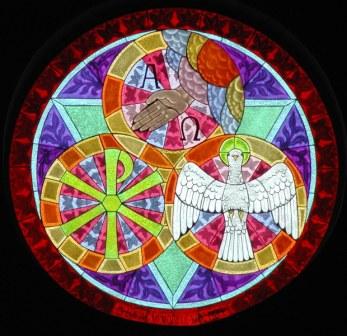
HolyTrinityWindowWe have all kinds of solemnities, feast days, and other special days in the church year. We commemorate happenings in the life of Christ: Mary’s visit from Gabriel announcing the miraculous child she was to bear into the world. We celebrate the arrival of the Three Kings, the Baptism of our Lord, the Transfiguration when the glory of Christ is revealed, and on Palm Sunday, we celebrate Jesus riding triumphant into Jerusalem amidst palms and cheers. We celebrate the empty tomb and Resurrection of Easter, the glorious Ascension, the explosive coming of God’s spirit to the church at Pentecost … and then we have Holy Trinity Sunday.  And suddenly it is like we have moved from these great events in the life of Christ, and now…. tadah!!  We are celebrating a …..a….. a church doctrine. Continue reading

…that through this belief you may have life in his name

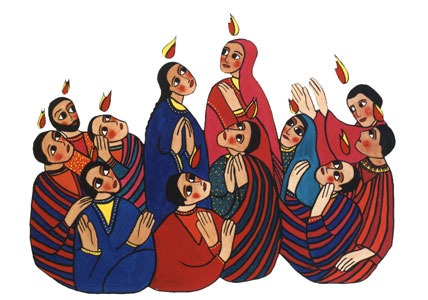
Pentecost3The Catholic lectionary for Pentecost Sunday (Year C) has different gospels:  one for the Vigil Mass and another for the masses on Sunday. This commentary is offered for the Pentecost Sunday gospel

John 20:19-31

19 On the evening of that first day of the week, when the doors were locked, where the disciples were, for fear of the Jews, Jesus came and stood in their midst and said to them, “Peace be with you.” 20 When he had said this, he showed them his hands and his side. The disciples rejoiced when they saw the Lord. 21 (Jesus) said to them again, “Peace be with you. As the Father has sent me, so I send you.” 22 And when he had said this, he breathed on them and said to them, “Receive the holy Spirit. 23 Whose sins you forgive are forgiven them, and whose sins you retain are retained.” 24 Thomas, called Didymus, one of the Twelve, was not with them when Jesus came. 25 So the other disciples said to him, “We have seen the Lord.” But he said to them, “Unless I see the mark of the nails in his hands and put my finger into the nailmarks and put my hand into his side, I will not believe.” 26 Now a week later his disciples were again inside and Thomas was with them. Jesus came, although the doors were locked, and stood in their midst and said, “Peace be with you.” 27 Then he said to Thomas, “Put your finger here and see my hands, and bring your hand and put it into my side, and do not be unbelieving, but believe.” 28 Thomas answered and said to him, “My Lord and my God!” 29 Jesus said to him, “Have you come to believe because you have seen me? Blessed are those who have not seen and have believed.” 30 Now Jesus did many other signs in the presence of (his) disciples that are not written in this book. 31 But these are written that you may (come to) believe that Jesus is the Messiah, the Son of God, and that through this belief you may have life in his name.

Perfect Joy Isn’t Fun

Pope Francis

This is the lesson that Pope Francis drew from the Acts of the Apostles at Friday morning Mass (May 10) as he described the disciples joy in the days between our Lord’s Ascension and Pentecost and what we can learn from them.

“A Christian is a man and a woman of joy. Jesus teaches us this, the Church teaches us this, in a special way in this [liturgical]time. What is this joy? Is it having fun? No: it is not the same. Fun is good, eh? Having fun is good. But joy is more, it is something else. It is something that does not come from short term economic reasons, from momentary reasons : it is something deeper. It is a gift. Fun, if we want to have fun all the time, in the end becomes shallow, superficial, and also leads us to that state where we lack Christian wisdom, it makes us a little bit stupid, naive, no?, Everything is fun … no. Joy is another thing. Joy is a gift from God. It fills us from within. It is like an anointing of the Spirit. And this joy is the certainty that Jesus is with us and with the Father”.

“Can we ‘bottle up’ this joy in order to always have it with us? No, because if we keep this joy to ourselves it will make us sick in the end, our hearts will grow old and wrinkled and our faces will no longer transmit that great joy only nostalgia, melancholy which is not healthy. Sometimes these melancholy Christians faces have more in common with pickled peppers than the joy of having a beautiful life. Joy cannot be held at heel: it must be let go. Joy is a pilgrim virtue. It is a gift that walks, walks on the path of life, that walks with Jesus: preaching, proclaiming Jesus, proclaiming joy, lengthens and widens that path. It is a virtue of the Great, of those Great ones who rise above the little things in life, above human pettiness, of those who will not allow themselves to be dragged into those little things within the community, within the Church: they always look to the horizon”.


The Ascension of the Lord – Part 1

Acts 1:1-11

1 In the first book, Theophilus, I dealt with all that Jesus did and taught 2 until the day he was taken up, after giving instructions through the holy Spirit to the apostles whom he had chosen. 3 He presented himself alive to them by many proofs after he had suffered, appearing to them during forty days and speaking about the kingdom of God. 4 While meeting with them, he enjoined them not to depart from Jerusalem, but to wait for “the promise of the Father about which you have heard me speak; 5 for John baptized with water, but in a few days you will be baptized with the holy Spirit.” 6 When they had gathered together they asked him, “Lord, are you at this time going to restore the kingdom to Israel?” He answered them, “It is not for you to know the times or seasons that the Father has established by his own authority. But you will receive power when the holy Spirit comes upon you, and you will be my witnesses in Jerusalem, throughout Judea and Samaria, and to the ends of the earth.” 9 When he had said this, as they were looking on, he was lifted up, and a cloud took him from their sight. 10 While they were looking intently at the sky as he was going, suddenly two men dressed in white garments stood beside them. 11 They said, “Men of Galilee, why are you standing there looking at the sky? This Jesus who has been taken up from you into heaven will return in the same way as you have seen him going into heaven.”

Continue reading

The dangerous memory

dangerous_memoryI have been musing about memory this week because I had a wonderful two days in Atlanta with my dad’s side of the family – all the cousins and their children.  It was all a walk down memory lane especially with my cousin Frank.  Although at times I wondered if we walked the same lane – but then he has had the advantage of all the things that can trigger memory:  people, places, sights, sounds, smells, and all the rest. It did seem that the longer I was around the family, the more I recalled, and made more memory connections. More and more, a whole range of memories came to ready recall – out of storage somewhere in the misty past of memory. Continue reading