
In the Garden of Eden, humans are presented with a test, a choice between two trees. This familiar story is the beginning of a narrative pattern we see play out again and again throughout the biblical story. But why does God choose to test people? It may seem cruel or like he’s attempting to trap humans into making the wrong choice, but the biblical story is clear. God’s desire is to partner with humans, and these tests are opportunities for humans to return to the ideals of the garden despite our countless failures.
If you would like to read the Bible Project’s blog on this topic/video, you can access it here. The Bible Project is a non-for-profit organization that depends on our support. If you would like to support their efforts with a donation, you can reach them here.
 Every so often someone approaches me after I have celebrated a Mass to inform me what I have done wrong in the ritual. It is in those moments that I have great empathy for the physician who resigns themselves to listen to a patient reveal their self diagnosis based on what they have discovered on WebMD. Given the ubiquity of the internet I suspect every profession has similar moments. On one hand it is good that patients and clients inform and educate themselves; on the other hand there is a reason medical school, internship, residency, and specialty fellowships take a bit more time than an internet search. As a doctor/friend once offered, “There is a reason it is called the ‘Art of Medicine,’ – the human body is beyond complicated in all its possible reactions.”
 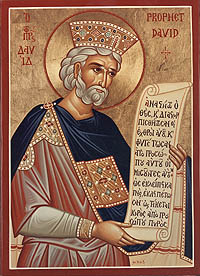 “The kingdom of heaven may be likened to a king…” Kings? Abraham, Isaac, Jacob, Moses, Joshua – some of the great names of Israel’s history. And none of them were king. Yet under the leadership of God, they led Israel from slavery to the freedom of the promised land. Deborah, Gideon, Samson – none of them were kings, yet under the leadership of God, these Judges united Israel to defend itself and its identity against the other nations. To be the qahal Yahweh – the people of God. And the last of the judges was Samuel. It was to Samuel (1 Sam 7) that the people came and said “Now that you are old, and your sons do not follow your example, appoint a king over us, as other nations have, to judge us.” When Samuel prayed about this before the Lord, God said in answer: “Grant the people’s every request. It is not you they reject, they are rejecting me as their king.” And God warned the people of the rights of those other kings:
 In cleaning up files from my computer, I ran across this classic bit of saintly humor. Enjoy!
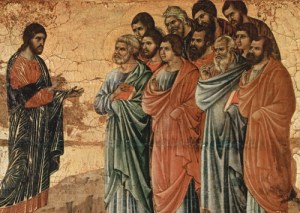 The reading from today’s gospel (with a few extra verses) and St. Francis of Assisi’s answer to the question.
 Today is the Feast of St. Bonaventure the great Franciscan saint, theologian and provincial minister of the Order in the mid-13th century. There are a special set of
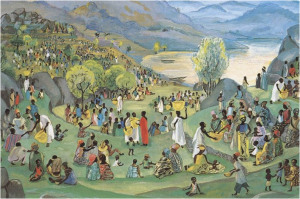 Years from now I will perhaps look back in my notes at this homily and will need to remind myself what was unique and different about this Solemnity of the Body and Blood of Christ, popularly known as Corpus Christi Sunday. Notes to self: 94 days ago, the World Health Organization declared pandemic status for the covid-19 virus. 87 days ago, the churches of the diocese of St. Petersburg were closed to the public. 79 days ago, a safer-at-home order was declared for the City of Tampa.
  During these last days as the topic of racial justice was omnipresent around us, someone emailed to ask if Francis of Assisi had ever written on race relationships. The short answer is “no.” Francis of Assisi lived in the 13th century growing up in the Umbria region of Italy. His world was provincial and focused on the world in which diversity meant which town you were from and the “other” referred to the “Saracens,” against whom the Crusades were aimed in order to free the Holy Land from Islamic control.
  friarmusings