
An Approved Rule of Franciscan Life

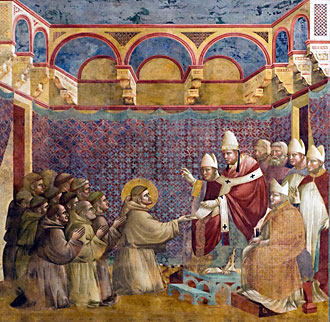
Pope Innocent III Accords Recognition to the F...

The year is 1221 and at the request of the “cardinal protector” of the friars, Cardinal Hugolino, Francis and several of his brothers have taken up the task of writing a formal rule of life.  It was not clear that the Franciscans were actually a “religious order.”  When Francis visited Pope Innocent III in 1209, the pope verbally approved (or did he?) a Rule of Life that was written down in few words.  In 1216, the 4th Lateran Council ruled that no new religious orders could be formed:  all new groups would be absorbed into existing religious orders.  Hugolino recognized the uniqueness of the charism of St. Francis and his brothers and was determined that it not be lost to the church.

Francis and some companions undertook the writing of the “early rule” also known as the Rule of 1221.  It is a potpourri of spiritual reflections, exhortations, and communal and individual norms of behavior – all animated by extensive citations from Scripture.  Even though Francis was attempting to write a juridical rule of life that would “pass muster” from the canon lawyers in the Roman Curia, at the same time he was trying to write a rule borne out of his lived experience of following Christ and the pathway that was revealed to him:  “God has called me to walk in the way of humility and showed me the way of simplicity.  I do not want to hear any talk of the rule of Saint Augustine, of Saint Bernard, or of Saint Benedict.  The Lord has told me that he wanted to make of me a new fool in the world, and God does not want to lead us by any other knowledge than that.” (Assisi Compilation, 18)

The rule was finished, shown to Hugolino (we do not know of his reaction), and submitted to the Roman Curia.  We know the end result.  There is a reason why the “early rule” or “Rule of 1221” is more formally known as the regula non bullata – it was rejected.  But undaunted, Francis and his brothers rolled up their sleeves and went to work on a more streamlined rule, one more suited to the tastes of the canon lawyers.  This “later rule” or “Rule of 1223” is known as the regula bullata because it was formally issued under the Papal Bull (seal) Solet annuere.   It conferred on the Franciscans the official status of “Order” as a juridical foundation.

The document was the most the Curia would accept and was far less than Francis wanted, even if it remained faithful to his fundamental intuitions of the way of life God had showed to him.  For the next three years of his life, Francis worked to continue to give example, a living testimony, of the manner and meaning of the approved rule – and at the end of his life Francis wrote his Testament, a clear indication of what Francis wanted for the order:  live under the Rule of 1223 – but hold the Rule of 1221 close to your heart.  Here is one example of the differences between the two rules:

Regula non bullata (1221)

Chapter 16:  Those who are going among Saracens and other non-believers

Regula bullata (1223)

Chapter 3:  Of the Divine Office and fasting, and how the friars are to travel about the world

The Lord says:  Behold, I am sending you as lambs in the midst of wolves.  Therefore, be prudent as serpents and simple as doves (Mt 10:16).  Therefore, any brother who, by divine inspiration, desires to go among the Saracens and other nonbelievers should go with the permission of his minister and servant.  And the minister should give [these brothers] permission and not oppose them, if he shall see that they are fit to be sent; for he shall be bound to give an account to the Lord (cf. Lk 16:2) if he has proceeded without discretion in this or in other matters.  As for the brothers who go, they can live spiritually among [the Saracens and nonbelievers] in two ways.  One way is not to engage in arguments or disputes, but to be subject to every human creature for God’s sake (1 Pet 2:13) and to acknowledge that they are Christians.  Another way is to proclaim the word of God when they see that it pleases the Lord, so that they believe in the all-powerful God—Father, and Son, and Holy Spirit—the Creator of all, in the Son Who is the Redeemer and Savior, and that they be baptized and become Christians; because whoever has not been born again of water and the Holy Spirit cannot enter into the kingdom of God (cf. Jn 3:5) There are 14 more lines- all scripture about mission. And this is my advice, my counsel, and my earnest plea to my friars in our Lord Jesus Christ that, when they travel about the world, the should not be quarrelsome or take part in disputes with words (cf. 2 Tim. 2:14) or criticize others; but they should be gentle, peaceful, and unassuming, courteous and humble, speaking respectfully to everyone, as is expected of them.  … Whatever house they enter, they should first say, “Peace to this house” (Lk. 10:5), and in the words of the Gospel they may eat what is set before them (Lk. 10:8).

The differences are sometimes quite clear.   In the 1223 Rule, one travels about the world while making sure that the Divine Office is prayed and proscribed fasts are observed – both worthy things.  Only then is one to evangelize and be about mission – which has a certain logic and order to it all.In the 1221, the rules on prayer and fasting have their own section as foundational to being a friar, but the Rule holds up a model of minoritas and mission as intrinsic to the friar way of life.  It is in this Rule that one sees the passion and soul of St. Francis and his attempt to describe the vision God has shown him.  Especially prominent is mutual discernment between one brother and his community about God’s call.

The Rule of 1221 and the Testament, even though not juridically approved, reveal the soul and passion of St. Francis, and as such are the “go to” texts when Franciscans study what it means to be “friar minor.”
Franciscan Rules

francis-innocentThe year is 1220 and Francis has just announced his decision to step down as “leader” of the Franciscan brothers.  In last week’s installment (Hierarchy of Authority – Hierarchy of Example), I described Francis’ reason for stepping down.  Francis had already seen the effects of a vacuum in spiritual authority brought about by his year-long absence while in the Middle East.  It is in leaving to his “vicar” and to the Roman Church the care of making decisions of a normative or disciplinary type that he could hope to preserve a superior authority, of a spiritual type, that would only have been diminished in the heat of daily administration. Continue reading

St. Bonaventure

Saint Bonaventure

Saint Bonaventure (Photo credit: Wikipedia)

This Monday marks the Feast Day of one of the great figures in Franciscan history – St. Bonaventure of Bagnoregio – as well as the eighth anniversary of our Franciscan presence in this historic downtown parish.  St. Bonaventure is a good model of what it means to be a Franciscan, while at the same time being a priest in leadership positions in a parish.  Bonaventure reminded the friars of his day that our first vocation is as “brother.”  At the core of our charism, we are a fraternity in mission to the People of God striving to continue our Order’s 800-year-old mission:  bringing the Gospel into the everyday experience of men and women through our life in fraternity and compassionate service to all. Continue reading

Hierarchy of Authority – Hierarchy of Example

saint-francis-of-assisi-cimabueAfter his 1220 return from his mission/travels to Egypt, Palestine, Syria, and Asia Minor, Francis of Assisi resigned as “minister” of the Franciscan movement. As with most changes in the life of St. Francis, there are a host of modern commentaries that offer reasons why. Some conjecture Francis was upset that clerics, ordained priests, were starting to inject their priestly charism upon the fraternity; hence he resigned in protest. Others offer that he was protesting the increased oversight and intrusion of the Pope into the affairs of the friars and their life. Some have insisted that Francis recognized that this religious movement was becoming a religious order – something he did not intend nor desire. Continue reading

Charism of the Founder – Vocation of the Friars

Francis-brothersIn the early summer of 1219, Francis left Assisi and traveled to Egypt, meeting with the Sultan of Egypt, Al-Malik al-Kamil.  According to the Franciscan chronicler Jordan of Giano, informed by an eyewitness, a prophetess living in the Holy Land who was known as “the Tongue-that-Proclaims-the-Truth” declared to the friars:  “Come back, come back, for the order is troubled by the absence of Brother Francis; it is divided and in the process of destroying itself.”  Thus in May of 1220, the Poor Man of Assisi returned to Italy, where problems had been multiplying in his absence.  In a prior article we mentioned some of the problems that had arisen, which Francis addressed.  He then considered the future of the Franciscan movement.  In September, 1220, he formally resigned his role as minister of the brothers.  Continue reading

While Francis Was Away…

saint-francis-of-assisi-cimabueIn our previous three articles we described Francis’ part of the 5th Crusade and his meeting with the Sultan of Egypt, Al-Malik al-Kamil.  We know that Francis was away at a time when the community began to grow rapidly – and not just around Assisi, but in many other parts of Italy, Spain, France, and the Germanic nations as well.  While Francis was away, what happened to the friars he left behind?

Francis had delegated his powers to two vicars during his absence:  Matthew of Narni, who remained in Assisi, and Gregory of Naples, who visited the communities throughout Italy.  Another friar, Phillip the Tall, was entrusted with the care of St. Clare and her sisters, the Poor Ladies of San Damiano.  They were given very few orders or instructions.  This might seem odd, given that religious life in the 13th century was quite ordered and obedience was a topic often written about – even by Francis himself.  However, the friars were not technically an ordo, a religious order – they were still a “religious movement” – albeit, a quite famous and rapidly growing one that had the attention of the Pope and the Roman Curia – both in praise and concern. Continue reading

St. Anthony of Padua – part 4

anthony-padua2Miracles and Traditions of St. Anthony. St. Anthony Bread is a term used for offerings made in thanksgiving to God for blessings received through the prayers of St. Anthony. Sometimes the alms are given for the education of priests. In some places parents also make a gift for the poor after placing a newborn child under the protection of St. Anthony. It is a practice in some churches to bless small loaves of bread on the feast of St. Anthony and give them to those who want them.

Different legends or stories account for the donation of what is called St. Anthony Bread. By at least one account it goes back to 1263, when it is said a child drowned near the Basilica of St. Anthony, which was still being built. His mother promised that if the child was restored to her she would give for the poor an amount of corn equal to the child’s weight. Her prayer and promise were rewarded with the boy’s return to life. Continue reading

St. Anthony of Padua – part 3

tn_anthony-padua1Public Preacher, Franciscan Teacher. Anthony’s superior, St. Francis, was cautious about education such as his protégé possessed. He had seen too many theologians taking pride in their sophisticated knowledge leading to an abandonment of their commitment to a life of real poverty. In Anthony, however, he found a kindred spirit for his vision, who was also able to provide the teaching needed by young members of the order who might seek ordination. Francis wrote in 1224, “It pleases me that you should teach the friars sacred theology, provided that in such studies they do not destroy the spirit of holy prayer and devotedness, as contained in the Rule.” He thereby entrusted the pursuit of studies for any of his friars to the care of Brother Anthony. From then on his skills were used to the utmost by the Church. Occasionally he took another post, as a teacher, for instance, at the universities of Montpellier and Toulouse in southern France, but it was as a preacher that Anthony revealed his supreme gift. Continue reading

St. Anthony of Padua – part 2

tn_anthony-padua1Before He Was Anthony of Padua.  Anthony of Padua was born Fernando Martins de Bulhões on August 15, 1195 in Lisbon, Portugal. His was in a very rich family of the nobility who wanted him to become educated, and they arranged for him to be instructed at the local cathedral school. Against the wishes of his family, however, at the age of 15 he entered the community of Canons Regular at the Abbey of St. Vincent on the outskirts of Lisbon. Monastery life was hardly peaceful for young Fernando, nor conducive to prayer and study, as his old friends came to visit frequently and engaged in vehement political discussions. Continue reading

St. Anthony of Padua – part 1

tn_anthony-padua1For more than 100 years, Sacred Heart Catholic Church (in downtown Tampa, FL) had been under the pastoral guidance of the Jesuits. When we Franciscans arrived at Sacred Heart in 2005, we were quite surprised to find that one of the clerestory windows (the ones up high in the nave vault) was Saint Anthony of Padua, a Franciscan contemporary of St. Francis of Assisi.  In fact, we Franciscans still have a brief letter, in Francis’ own hand, written to Anthony. Most people know St. Anthony of Padua as the patron saint of lost and stolen articles, but have you ever wondered why he is that particular patron saint?

The Patron Saint of Lost Things. The reason for invoking St. Anthony’s help in finding lost or stolen things is traced back to an incident in his own life. As the story goes, Anthony had a book of psalms that was very important to him. You have to remember this was before the age of the printing press and so all books were of great value, and besides the value of the book, the psalter had the notes and comments he had made to use in teaching students in his Franciscan Order.

A novice who had already grown tired of living religious life decided to depart the community. Besides going AWOL, he also took Anthony’s psalter! Upon realizing his psalter was missing, Anthony prayed it would be found or returned to him, and after his prayer the thieving novice was moved to return the psalter to Anthony and to return to the Order, which accepted him back. Legend has embroidered this story a bit. It has the novice stopped in his flight by a horrible devil, brandishing an ax and threatening to trample him underfoot if he did not immediately return the book. Obviously a devil would hardly command anyone to do something good, but the core of the story would seem to be true. The stolen book is said to be preserved in the Franciscan friary in Bologna.

In any event, shortly after his death people began praying through Anthony to find or recover lost and stolen articles. And the “Responsory of St. Anthony” composed by his contemporary and brother friar, Julian of Spires, proclaims, “The sea obeys and fetters break/And lifeless limbs thou dost restore/While treasures lost are found again/When young or old thine aid implore.”