
 One of the events of Francis’ life that has received scant public attention was his meeting with the sultan of Egypt, Al-Malik al-Kamil in 1219 during the so-called “Fifth Crusade.” This meeting has loomed large in the imagination of the “Franciscan world” because of its effect on the Rule of Life and in the Franciscan charism of missions, but has only recently gained public attention because of the new era of tensions with the Islamic world. People are surprised to learn that Francis was part of a crusade – a claim that scholars argue to no end as they argue so many other aspects of Francis’ life. Each side has generally already taken a view of the little poor man from Assisi: Francis the loyal churchman or Francis the radical reformer. Those views are often revelatory of how the scholar views the Crusades. And as with all things, history has a context.
Francis and the Crusades – Part 1
3
 Over the last few weeks, we described Francis of Assisi in the role in which he is most popularly recognizable: the lover of nature and animals. Interestingly, this role is not original in the Christian tradition. In a valuable book reviewing the nature stories of Franciscan literature, Edward Armstrong shows that many of Francis’ attitudes have precedents in biblical, early Christian, and medieval ideas about nature. One group of scholars place Francis in the tradition of hermits who retired to wilderness and befriended animals. Others associate him with a theological trend, unfortunately not dominant, which affirms creation as containing intrinsic value. Most see the stories about Francis as having precedents in the already-known lives of saints, although they may have been true of Francis as well.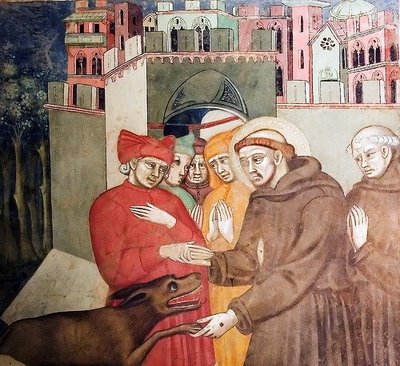
 People are surprised to learn that the Early Rule of the friars instructed the brothers not to own pets – as well they were not to ride horses. These rules are only partly about poverty; they encouraged friars not to treat animals as objects or possessions. And, in the case of horseback riding, his rule distanced the friars from the proud world of chivalry. Later in his life when sickness compelled him to ride, Francis always preferred a donkey.
 St. Francis of Assisi is the patron saint of Italy, merchants, stowaways, ecology, but most famously, of animals. If one searches the internet, you can easily find all kinds of pious, ecologically insightful, and often amazingly-modern sounding quotes from St. Francis. And they are inevitably without a citation from one of Francis’ writings or at least a later Franciscan source writing about Francis. As I noted in the beginning of this series, Francis has always been reinvented and marketed as needed. Perhaps the one book most responsible for casting Francis as the lover of animals and nature is a collection of stories – many miraculous and all very saintly – that first appeared in 1390 in Tuscany: the Fioretti (The Little Flowers). But can we say about St. Francis, the patron saint of animals?
  By the spring of 1213, four years after the founding of the “order,” Francis’ reputation had risen to the attention of the Italian aristocracy – not just in Assisi but throughout central Italy. The order was beginning to attract men from the higher social classes. Sons of merchants like Francis, sons of the landed wealthy, sons of ruling households, men with established careers in law, music and the arts, and also ordained priests. They joined the already formed group of men from middle and lower backgrounds in muddling through what it meant to follow Christ in the manner of Francis. G.K. Chesterton’s later definition of the Catholic Church – “here comes everybody” – was being lived out in Francis’ day.
  Over the last several weeks we have been considering what awaited the men who came to join Francis of Assisi and this growing fraternity of believers seeking to follow Christ more fully in the world. We had mentioned there were no rules, regulations, or even a formation program; there was only Francis and the other brothers. But what drew the men to want to “come and see?” Undoubtedly, as today, a complex of reasons, but key among those reasons was Francis of Assisi’s reputation for holiness and miracles.
 friarmusings