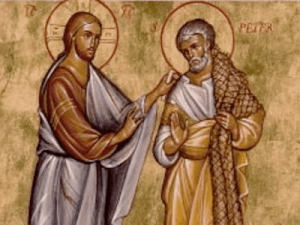
The Chair of St. Peter

Most of the apostles and lots of saints have their own feast day, but there is no “Feast of St. Peter.” Today (February 22) the Church celebrates the “Chair of Peter” the sign that Peter was the first among the apostles and the one designated to lead the early Church after Jesus’ Resurrection and Ascension. For the record, Peter is not alone. St. Paul does not have a “Feast of St. Paul.” We celebrate these great saints together in a single celebration, the Feast of Sts. Peter and Paul.

Continue reading

Naming Lent

In Italian, Lent is quaresima or forty (days). In German, it is Fastenzeit or time for bodily restraint. Our English word comes from an older Anglo-Saxon word for spring—len(c)ten—whence our Lent. Italian tells us how long it will last (with its symbolic overtones). German tells us what to do in that time. But English tells us what is supposed to happen, that is, we are supposed to experience a springtime of faith, a time growth and new life.

On fasting

The following is often attributed to Pope Francis – not likely according to Fr. Horton and his They Didn’t Say It blog. But nonetheless, it is great spiritual guidance by which to renew one’s Lent.

  • Fast from hurting words and say kind words.
  • Fast from sadness and be filled with gratitude.
  • Fast from anger and be filled with patience.
  • Fast from pessimism and be filled with love.
  • Fast from worries and have trust in God.
  • Fast from complaints and contemplate simplicity.
  • Fast from pressure and be prayerful.
  • Fast from bitterness and fill your hearts with joy. F
  • ast from selfishness and be compassionate to others.
  • Fast from grudges and be reconciled.
  • Fast from words and be silent as you listen.

Ash Wednesday and Sundays in Lent

lent-2-heartlargeAsh Wednesday, the first day of the penitential season of Lent in the Catholic Church, is always 46 days before Easter Sunday. It is a “movable” feast that is assigned a date in the calendar only after the date of Easter Sunday is calculated. How is it calculated? I’m glad you asked.
According to the norms established by the Council of Nicaea (325 AD) and later adopted for Western Christianity at the Synod of Whitby, Easter Sunday falls each year on the first Sunday following the first full moon after the vernal equinox. This year the vernal equinox falls on Saturday, March 20, 2021 and the first full moon after that occurs on Sunday, Mach 28th. Therefore, Easter Sunday is celebrated this year on April 4th. If you want to know the date of Ash Wednesday, just count backwards 46 days and you get February 17th. Continue reading

The time given

Today’s first reading continues with the accounts in the Book of Genesis. We move from the story of Cain and Abel at the beginning of Genesis 4 to the story of Noah in Genesis 6. Let me fill in the highlights in between. The descendants of Cain are described in terms of violence (Lamech) and yet at the same time as craftsmen, nomads, and minstrels. We also learn that Adam and Eve have another son, Seth, who is described – not in terms of occupation – but in terms of the practice of worshiping God as Seth’s lineage “began to invoke the LORD by name.” (Gen 4:26). Genesis 5 is a genealogy of the generations from Seth to Noah. – and his sons, Shem, Ham, and Japheth. Taking the text literally, between the sin of Cain and the Flood is a period of 1,600 years. Quite a long time to let things play out, so to speak.

Continue reading

It’s your choice

In today’s first reading, the brothers Cain and Abel have just brought an offering to the Lord. Abel brought his best lamb to offer to God in sacrifice. Cain brought some of the first fruits of the harvest, but pointedly not the best. “The Lord looked with favor on Abel and his offering, but on Cain and his offering he did not.” (Gen 4:5-6a)

Several commentaries offer that what follows in Genesis 4:6-7 is perhaps the most challenging verse facing translators in the Book of Genesis, or perhaps all of the Hebrew Scriptures. “So, the LORD said to Cain: “Why are you so resentful and crestfallen. If you do well, you can hold up your head; but if not, sin is a demon lurking at the door: his urge is toward you, yet you can be his master.”

Continue reading

Everything and nothing

In today’s first reading, despite the sin of Adam and Eve, even in the face of its consequences, life goes on. Life will be hard, but God is ever present. And it all started with the tree of good and evil. But here at the end of Genesis 3 the tree of life (Gen 2:16-17) assumes importance. It has not yet functioned as an integral part of the story, but now, because of sin, humanity is denied access to this tree and is expelled from the garden. Humanity is not able to seize the birthright of immortality offered by God. Adam and Eve are expelled from the Garden, cherubim stationed at the gate as guardians of the tree of life to prevent humanity from re-entering the garden. Continue reading

The Tree of Life

In today’s first reading, we continue the narrative from the Book of Genesis, Chapter 3 – the infamous encounter of Adam and Eve with the serpent in the Garden of Eden. We know the shape of the exchange that concludes: “But the serpent said to the woman: ‘You certainly will not die! No, God knows well that the moment you eat of it your eyes will be opened and you will be like gods who know what is good and what is evil.’” (Gen 3:4-5) And so, Adam and Eve partake of the fruit of the tree of good and evil – and they did not die… not immediately anyway. But evicted from the Garden, in the end they surely died.

Continue reading